Ferrar Dolerite Lewis Ice Tongue Antarctica
Brand : Jensan Scientifics LLC
- SKU:
- JPT-852278
- Availability:
- Usually ships in 24 hours.
- Weight:
- 2.00 LBS
- Minimum Purchase:
- 1 unit
- Maximum Purchase:
- 1 unit
- Shipping:
- Calculated at Checkout

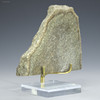
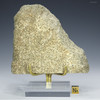
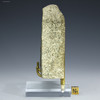
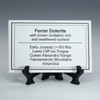
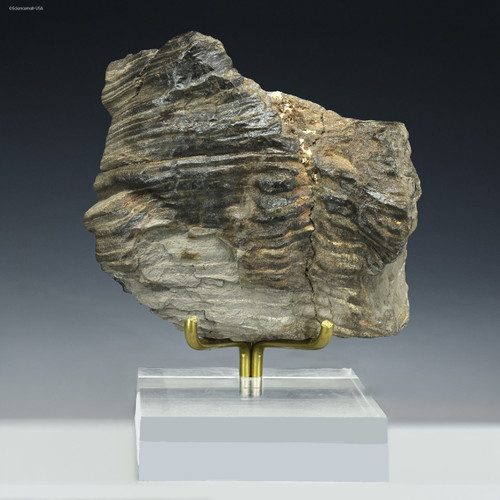
Antarctic Ferrar Dolerite from Lewis Cliff
This Ferrar Dolerite specimen came from the Lewis Cliff Ice Tongue in Antarctica's Transantarctic Mountains, one of the richest meteorite hunting grounds on Earth. It shows a striking brown oxidation rind and a weathered surface shaped by a very long exposure in one of the coldest, driest places on the planet.
About This Ferrar Dolerite
About 183 million years ago, in the Early Jurassic, enormous volumes of magma pushed into the crust across what is now Antarctica as the supercontinent Gondwana began to break apart. That magma cooled underground into dolerite, a dark, crystalline igneous rock. Today the Ferrar Dolerite runs for about 3,500 km through the Transantarctic Mountains.
- Brown oxidation rind. Iron in the rock slowly rusted inward from the surface. In Antarctica's frozen, nearly waterless climate, that takes an extremely long time.
- Two surfaces, two stories. One side is the bleached, long-exposed weathered surface. The other is a fresher break showing the rind as a brown band around the darker interior.
- A famous neighborhood. The glacial rubble where it was collected is scattered with meteorites, including one from Mars.
How We Know It's Dolerite
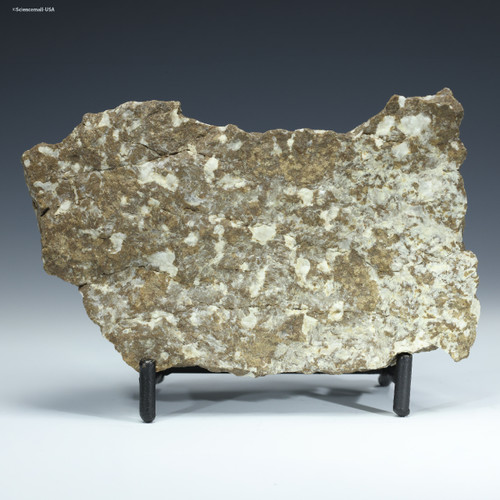
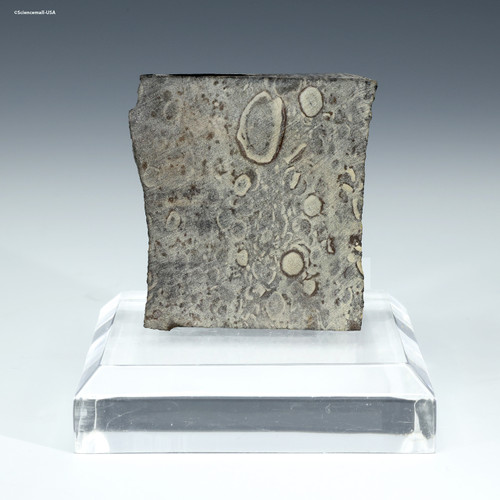
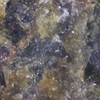
Under 10× magnification, this specimen shows pale, lath-shaped plagioclase feldspar crystals set at random angles, with dark pyroxene filling the spaces between them, the interlocking "subophitic" texture characteristic of dolerite. About half the rock is made of these dark minerals, far too many for a granite, and there are no rounded quartz grains that would mark it as a sandstone. Weathering in the outer rind has turned the feldspar chalky white, making the texture stand out even more clearly against the dark pyroxene. This is Ferrar Dolerite, the 183-million-year-old igneous rock that intruded across Antarctica's Transantarctic Mountains as the supercontinent Gondwana began to break apart.
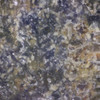
Macro #1: Rind transition under magnification: iron-stained, tan-to-brown plagioclase feldspar mingles with dark bluish pyroxene where the oxidation rind meets the fresher interior.
Macro #2: Dolerite texture under magnification: chalky white plagioclase laths set at random angles with dark pyroxene filling the spaces between them, the interlocking “subophitic” texture that identifies dolerite, with brown iron staining toward the right. There are no rounded quartz grains, which rules out sandstone, and about half the rock is dark minerals, far too many for a granitic rock. This is Ferrar dolerite.
Fun Facts About the Lewis Cliff Ice Tongue
- Why "Ice Tongue"? Ice flowing off the polar plateau is turned aside by Lewis Cliff and runs along its base. It ends in a long, narrow lobe that pokes out into a vast field of glacial rubble, just like a tongue. Scientists split it into an Upper and a Lower Ice Tongue.
- Who was Lewis? The cliff is named for Richard E. Lewis, a U.S. Navy aviation electronics technician who was injured during Operation Deep Freeze II in 1956–57.
- Named for a star. Mount Achernar, where the cliff begins, is named for the star Achernar. New Zealand surveyors used it in 1961–62 to fix their survey baseline.
- A meteorite treasure trove. The ice here traps meteorites and brings them to the surface. Finds include LEW 86010, one of the oldest volcanic rocks in the solar system, and LEW 88516, a meteorite from Mars.
- Small space rocks. Meteorites here average only about 10 grams, and many were probably blown across the ice by wind.
- The classic "meteorwrong." Dark, weathered dolerite like this specimen is the rock meteorite hunters most often have to pass over.
- Salt on ice. In summer, sun-warmed rubble melts small ponds on the glacier. As they dry, they leave behind rare salt minerals.
- Far, far south. At about 84° South, Lewis Cliff sits roughly 640 km (400 miles) from the South Pole.
Product Information
| Specimen ID | 852278 |
| Rock Type | Ferrar Dolerite with brown oxidation rind and weathered surface |
| Geologic Age | Early Jurassic (~183 Ma) |
| Locality | Lewis Cliff Ice Tongue, Queen Alexandra Range, Transantarctic Mountains, Antarctica |
| Dimensions and Weight | 112 mm W x 97 mm H x 30 mm D, 600 grams |
| Science Gift Options | A memorable gift for rock and meteorite collectors, Antarctic enthusiasts, geology students, and educators |
| What's Included | Certificate of Authenticity, specimen tag, tag stand, information about the specimen (specimen display stand and photo cube not included) |
| Legality | Legally collected in the 1980s, before the Antarctic Treaty's Protocol on Environmental Protection |
| Provenance | All of our material is proprietary and sourced from scientists and/or verified scientific estate collections, backed by the included Certificate of Authenticity. |
Images professionally photographed under controlled studio lighting using Zeiss optics and a pro-grade Canon camera, for guaranteed accuracy. The brass scale cube measures 1 cm per side.
Rarity and Significance
| Scientific Significance | ★★★★★ |
| Locality Uniqueness | ★★★★★ |
| Rarity | ★★★★★ |
| Market Availability | ☆☆☆☆☆ |
| Historical Importance | ★★★★☆ |
| Display Appeal | ★★★★☆ |
Questions Commonly Asked About Ferrar Dolerite
What is dolerite?
Dolerite is a dark igneous rock that forms when magma cools underground in sheets called sills and dikes. It has the same ingredients as basalt, but it cooled more slowly, so its crystals are large enough to see with a hand lens. In North America it is often called diabase.
Is it legal to own a rock from Antarctica?
Yes, when it was legally collected. This specimen was collected in the 1980s, before the Antarctic Treaty's Protocol on Environmental Protection, and comes with a Certificate of Authenticity.
What is the brown band around the edge?
That is an oxidation rind. Iron in the rock slowly rusted from the outside in. Because Antarctica has almost no liquid water, a rind like this takes a very long time to form.
You can see it as a band only because the rock later broke open, exposing the fresher interior inside the rind.
Is this a meteorite?
No. It is an Earth rock from a famous meteorite field. In fact, dark, weathered dolerite is the rock meteorite hunters at Lewis Cliff most often mistake for a meteorite, which makes it a great companion piece for a meteorite collection.
Why does the Ferrar Dolerite matter to scientists?
It records the breakup of Gondwana, the supercontinent that once joined Antarctica, Africa, South America, India, and Australia. The same burst of volcanic activity is linked to a major extinction event in the Early Jurassic oceans.
A bold, hand-filling specimen from Antarctica's Jurassic past, with a rich brown rind framing a darker crystalline interior. Collected from the rubble of one of the world's great meteorite fields, it's a rock with a story on every face.