Accretionary Lapilli – Jurassic Volcanic Tuff, Antarctica
Brand : Jensan Scientifics LLC
- SKU:
- JPT-75758
- Availability:
- Usually ships in 24 hours.
- Weight:
- 1.00 LBS
- Minimum Purchase:
- 1 unit
- Maximum Purchase:
- 1 unit
- Shipping:
- Calculated at Checkout


Accretionary Lapilli Transantarctic Mountains, Antarctica
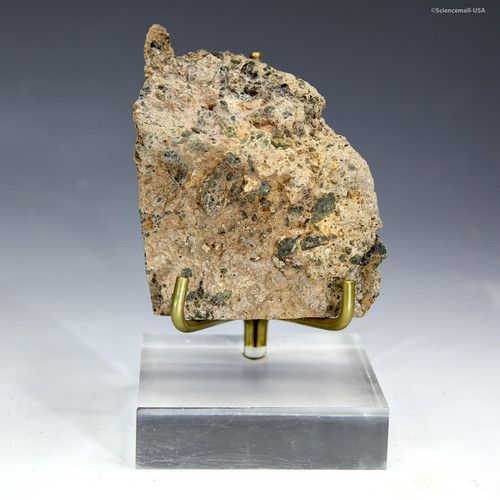
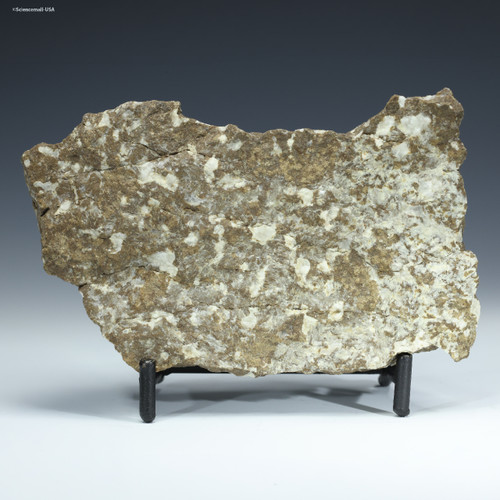
This professionally hand-trimmed piece of accretionary lapilli tuff was collected at Tempest Peak, a 3,410-meter summit in the Marshall Mountains of the Queen Alexandra Range, central Transantarctic Mountains, Ross Dependency, Antarctica. The rock is attributed to the Prebble Formation of the Ferrar Group, the Early Jurassic (~183 million years, Toarcian) pyroclastic unit that lies directly beneath the Kirkpatrick flood basalts and records the wet, explosive opening phase of one of the great volcanic episodes in the breakup of Gondwana.
About This Antarctic Lapilli
Both smooth-cut faces are crowded with pale cream, rounded-to-ovoid lapilli, most between 3 and 10 mm across, set in a fine gray-brown ash matrix. Each lapillus is wrapped in a thin, dark rim, and several show nested concentric rims. Under 5x magnification, the cores resolve into a coarser aggregate of ash-size particles with a faint greenish cast, while the rims are a finer, darker ash coating about a millimeter thick. That coarser-core, finer-rim structure is the defining signature of accretionary lapilli, which nucleate on moist ash particles inside a water-charged eruption plume and grow by accretion as they fall back to the ground. The lens-shaped examples on these faces are what accretionary lapilli look like after burial compaction or where the saw cut passed obliquely through them.
Accretionary lapilli are direct physical evidence that magma met water. The published descriptions of the Prebble Formation document planar-bedded tuff and lapilli tuff of air-fall origin, together with thick tuff breccia and lahar deposits, all produced by phreatomagmatic eruptions in which rising basaltic magma flashed groundwater and surface water to steam. Vents for that activity are preserved a few kilometers from Tempest Peak on the eastern side of Kenyon Peaks, and the neighboring summits of Storm Peak, Elliot Peak and Kip Peak are all named for the Ohio State University geological parties that mapped this massif from 1966 onward. Tempest Peak itself was named by the New Zealand Geological Survey Antarctic Expedition of 1961-62 for the stormy conditions the party endured there.
Within a geologically short interval after these ash beds were laid down, the Kirkpatrick Basalt lavas flooded across them. The Ferrar Large Igneous Province, of which both units are part, extends some 3,500 km along the Transantarctic Mountains and is the Antarctic counterpart of the Karoo flood basalts of southern Africa. This piece therefore preserves the precursor to a continental flood-basalt province: the ash that fell before the lava came.
Product Information
| Specimen | Accretionary Volcanic Lapilli |
| Rock Type | Basaltic phreatomagmatic pyroclastic rock, air-fall origin |
| Formation | Attributed to the Prebble Formation, Ferrar Group |
| Geologic Age | Early Jurassic (Toarcian), approximately 183 million years |
| Locality | Tempest Peak, Marshall Mountains, Queen Alexandra Range, central Transantarctic Mountains, Ross Dependency, Antarctica |
| Preparation | Professionally hand-trimmed, smooth on both sides |
| Dimensions and Weight | 39 mm L × 34 mm W × 10 mm D, 18.9 grams |
| Photographic Notes | Photographed dry, without water spray, so the colors shown are the specimen's natural dry tones. The close-up image is a focus-stacked macro at 5x magnification showing the rimmed internal structure of a single lapillus. The acrylic display base shown is not included. |
| Science Gift Options | A distinctive gift for geologists, volcanologists, polar enthusiasts, educators, and collectors |
| What's Included | Certificate of Authenticity (COA), information about lapilli, specimen tag, tag stand, handout on The Geology of Antarctica |
| Authenticity | Guaranteed authentic; Certificate of Authenticity (COA) included |
| Brand | Jensan Scientifics / Sciencemall-USA |
| SKU | JPT-75758 |
| Availability | Only 1 Available |
Images professionally photographed under controlled studio lighting using Zeiss optics and a pro-grade Canon camera, for guaranteed accuracy.
Rarity and Significance
| Rarity | ★★★★★ |
| Scientific Significance | ★★★★☆ |
| Locality Significance | ★★★★★ |
| Display Presence | ★★★★☆ |
| Educational Value | ★★★★★ |
Questions Commonly Asked
What is an accretionary lapillus?
A small, rounded ball of volcanic ash, typically 2 to 10 mm across, that forms inside a moist eruption cloud. Wet ash particles stick together around a nucleus and build up in layers as the aggregate falls, producing the concentric, rimmed structure visible on the cut faces of this piece. Their presence is accepted evidence that water was involved in the eruption.
How is this related to the Antarctic flood basalts?
The Prebble Formation ash beds were erupted immediately before the Kirkpatrick Basalt lavas of the Ferrar Group spread across this part of Antarctica. The ash records the initial explosive stage, when rising basaltic magma interacted with groundwater, and the lavas that followed record the effusive stage. Together they are part of the Ferrar Large Igneous Province, formed as Gondwana began to break apart.
Why are the lapilli pale when the ash is basaltic?
The original basaltic glass in these ash particles has been altered to clay and chlorite-group minerals over 183 million years, giving the lapilli their cream-to-faint-green tones. The surrounding matrix, being finer-grained, has altered to a darker gray-brown. This color contrast is what makes the lapilli so clearly visible on a cut face.
Where exactly is Tempest Peak?
Tempest Peak stands 3 nautical miles north-northeast of Storm Peak in the Marshall Mountains, at the southwestern end of the Queen Alexandra Range overlooking the Beardmore Glacier. It lies in the Ross Dependency sector of the central Transantarctic Mountains, roughly 600 km from the South Pole.
Antarctic accretionary lapilli, sharply preserved, are rare. This is ash from the explosive volcanic phase that preceded Antarctica's great flood-basalt eruptions during the Jurassic, as Gondwana began to break apart—hand-trimmed to reveal its preserved internal structure.
ONLY 1 AVAILABLE