
Phillipsite Zeolite, Victoria Land, Antarctica
Brand : Jensan Scientifics LLC
- SKU:
- JPT- 85926
- Availability:
- Usually ships in 24 hours.
- Weight:
- 1.00 LBS
- Minimum Purchase:
- 1 unit
- Maximum Purchase:
- 1 unit
- Shipping:
- Calculated at Checkout


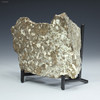
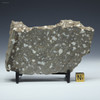


Zeolite-Bearing Volcanic Rock, McMurdo Dry Valleys, Victoria Land, Antarctica
This is a zeolite-bearing volcanic hand specimen from the McMurdo Dry Valleys region of southern Victoria Land, Antarctica. It is the largest ice-free area on the continent and the coldest, driest desert on Earth.
Zeolites in Antarctica
Zeolite occurrences in this part of Antarctica are reported from two principal settings: cavities and veins in the Jurassic Ferrar Dolerite, and low-temperature alteration of volcanic ash and glass associated with the Cenozoic McMurdo Volcanic Group and with saline, alkaline ice-marginal lakes that once stood in the valleys.
Why This Zeolite from Antarctica Matters
A zeolite is not a mineral that forms just anywhere. It requires volcanic glass, liquid water, and, in most cases, alkaline and cation-rich conditions. Because each zeolite species occupies a narrow and distinct stability field, the species that crystallizes records the chemistry of the water that made it. Phillipsite and similar zeolites are generally understood to require a pH above roughly 9, sodium-rich solutions, and a low silica-to-alumina ratio in the weathering glass.
Collector and Classroom Appeal
The Dry Valleys are the standard terrestrial analog for Mars. NASA-affiliated researchers have studied zeolite formation and cold-desert weathering in these valleys explicitly as a Martian analog, and thermal-emission spectra of Martian dust have been interpreted as consistent with a zeolite component. A specimen like this makes a great Mars analog - a rock from the closest Earth analog to the Martian surface.
Product Information
| Object Type | Zeolite-bearing volcanic rock; reportedly Phillipsite |
| Locality | Taylor Valley, McMurdo Dry Valleys region, Southern Victoria Land, Antarctica |
| Age / Formation | Associated with the Ferrar Dolerite (Early Jurassic) and/or the McMurdo Volcanic Group (Cenozoic). Zeolite alteration in the Dry Valleys is reported to be of Neogene age, on the order of several million years. |
| Dimensions / Weight | 110 mm L x 67 mm H x 47 mm D; 240 grams |
| Specimen Description | Light, porous, vesicular volcanic rock with zeolite development in and around cavities. Stable, no repairs. Specimen ID: 85926 |
| Scientific Significance | Zeolites form only where liquid water has reacted with volcanic glass. In a hyper-arid polar desert, they are a mineralogical record of past liquid water and alkaline brine chemistry. The Dry Valleys are the leading terrestrial analog for Mars, and zeolite weathering there is studied directly as a Martian analog. |
| Provenance | Scientist-sourced material, collected in the 1960s and legally collected before the Antarctic Protocol, 1998. |
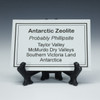
| What Is Included | Certificate of Authenticity, specimen tag, tag stand, and printed information about the specimen. Copy of the scientific article: "Authigenic phillipsite in lacustrine sediments, Taylor Valley, Antarctica" |
| Use and Display | Classroom instruction, museum-style display, private scientific collection, planetary science, and astrobiology teaching. |
| Authentication and Compliance | Ships with a Sciencemall-USA Certificate of Authenticity and specimen information |
| Shipping | Shipping calculated at checkout. |
| U.S. Shipping | Free Priority Shipping within the USA. |
Images professionally photographed under controlled studio lighting using Zeiss optics and a pro-grade Canon camera.
Rarity and Significance
| Scientific Significance | ★★★★★ — Records liquid water and alkaline brine chemistry in the leading terrestrial analog for Mars. |
| Market Availability | ½☆☆☆☆ — Almost never available. Antarctic geological material seldom enters the collector market. |
| Locality Specificity | ★★★★★ — Tied to a specific, named, and exhaustively studied Antarctic locality with a well-characterized geologic setting. |
| Display Appeal | ★★★★☆ — Substantial 110 mm hand specimen with visible vesicular texture and zeolite development. Strong shelf presence and an excellent teaching piece. |
The significance here is not simply that the rock came from Antarctica. It is a mineral that requires liquid water formed inside a rock in a place that has been frozen and hyper-arid for millions of years. That contradiction is exactly what planetary scientists are trying to read on Mars, and this specimen is a great physical example of the problem.
Questions Commonly Asked
What do the McMurdo Dry Valleys teach us about astrobiology and Mars?
The Dry Valleys are the coldest, driest, most Mars-like place on Earth, and they have been a workhorse of astrobiology for decades. Cryptoendolithic microbial communities live inside sandstone grains. Blood Falls vents iron-rich brine from a sealed subglacial reservoir. Don Juan Pond remains liquid at roughly -50 °C because it is highly saturated with calcium chloride. That last one matters: chloride and perchlorate brines are the leading candidates for any transient liquid water on Mars today.
Zeolites belong in this story more directly than you might guess. They are reported from the Dry Valleys themselves, including a deposit near Gneiss Point long mistaken for shale that turned out to be phillipsite, formed millions of years ago from volcanic ash altering in a briny, ice-marginal lake. Thermal emission spectra of Martian dust have been interpreted as consistent with zeolites, and Mars plainly had the ingredients to make them: low-temperature water acting on volcanic glass. So far, analcime is the only zeolite species identified on Mars with confidence, because its relatives are difficult to distinguish from orbit. But on Earth, drying saline-alkaline lakes lay zeolites down in a predictable sequence: fresh glass at the dilute margins, then a phillipsite and clinoptilolite zone, then analcime, then potassium feldspar in the saltiest center of the basin. Read that sequence on the floor of a Martian crater, and you are reading the story of how a lake died.
What do scientists mean by "cold origins," and what experiments relate to it?
Most origin-of-life research points to hot environments: alkaline hydrothermal vents or terrestrial hot springs, where wet-and-dry cycling concentrates and links molecules. The "cold origins" school argues the opposite, and it is a minority position worth understanding rather than a settled one.
The core insight is that freezing does two useful things at once. When a dilute salty solution freezes, it does not freeze uniformly. Pure ice crystallizes out and pushes everything else into shrinking pockets of unfrozen brine between the crystals, a process called eutectic freezing. Dilute molecules that would never meet in open water become highly concentrated in those pockets. At the same time, the cold dramatically slows the hydrolysis reactions that tear fragile molecules apart. Cold concentrates and cold preserves.
The best-known experiments come from Stanley Miller and Jeffrey Bada, who left dilute ammonium cyanide solutions frozen for years and recovered nucleobases including adenine and guanine, along with amino acids. Later work showed that RNA is far more stable at low temperature, and that some RNA-copying ribozymes actually perform better in the eutectic brine pockets of ice than in liquid water. None of this proves life began cold. It does show that ice is a chemically productive place, not an inert one, and it is part of why frozen worlds such as Europa and Enceladus are treated seriously as astrobiological targets.
How do zeolites form?
Zeolites are hydrated aluminosilicates built on an open, cage-like framework of linked silicon-oxygen and aluminum-oxygen tetrahedra. That framework is riddled with channels and cavities that hold water molecules and loosely bound, exchangeable cations such as sodium, potassium, and calcium. This is why zeolites act as molecular sieves and ion exchangers, and why they carry a high cation exchange capacity.
They form at low temperatures when water attacks volcanic glass. The glass dissolves, releasing silica and alumina into solution, and zeolites crystallize out of that solution. Two settings dominate. In volcanic rocks, groundwater percolates through gas cavities and fractures, and zeolites grow inside them as cavity fillings and vein linings. In sedimentary settings, volcanic ash falls into a closed, saline, alkaline lake and alters in place.
Which species you get is the interesting part. Each zeolite has a limited and distinct stability field, so the species records the water chemistry. Phillipsite is generally understood to require a pH above roughly 9, sodium-rich solutions, and a low silica-to-alumina ratio in the weathering glass. In a drying alkaline lake basin, the zeolites zone outward in a predictable order, from unaltered glass at the dilute margin, through phillipsite, clinoptilolite, and erionite, to analcime at higher salinity, and finally to potassium feldspar in the briny center. Read the zone, and you have read the ancient water.
What is the geology of the McMurdo Dry Valleys?
The valleys expose a clean, layered section of Antarctic crust. At the base sits an ancient crystalline basement of metamorphic rock and granite, planed flat by erosion. Above that lies the Beacon Supergroup, a thick sequence of Devonian to Triassic sandstones that contain plant fossils from when Antarctica was part of temperate Gondwana. Slicing through both are the Ferrar Dolerite sills, dark sheets of magma injected around 183 million years ago as Gondwana began to break apart. Zeolites are reported from cavities and veins in these dolerites. Capping the sequence in places are the much younger Cenozoic alkaline volcanics of the McMurdo Volcanic Group, the family of rocks that includes Mount Erebus.
The valleys themselves were carved by glaciers, then abandoned by them. As the Transantarctic Mountains rose, they walled off the East Antarctic Ice Sheet and starved the valleys of ice. What remains is a hyper-arid polar desert: mean temperatures always below freezing, effectively no rainfall, the little snow that falls removed by sublimation, and relentless katabatic winds pouring off the plateau. Because nothing washes away, salts accumulate. Calcium chloride brines occur in shallow groundwater, ponds, and lakes throughout the valleys, which is unusual on Earth and is one reason planetary scientists watch the place so closely.
What makes this specimen a great collectible?
Three things. First, locality. Antarctic geological material is rarely available on the collector market, and material tied to the Dry Valleys is scarcer still. Second, size. At 110 mm across, this is a substantial hand specimen rather than a thumbnail chip, large enough to pass around a classroom and to hold a display shelf on its own. Third, meaning. This is not a pretty rock with a good story attached afterward. The mineral itself is the story: zeolites cannot form without liquid water, so their presence in the driest desert on Earth is a genuine scientific statement, and it is the same statement planetary scientists hope to read on Mars.
What is included with the specimen?
The specimen ships with a Sciencemall-USA Certificate of Authenticity, a specimen tag, tag stand, and written information covering the locality, the geologic setting, and the scientific context described above. Shipping is calculated at checkout, with free Priority Shipping within the USA.
Add this Antarctic zeolite specimen to a serious Earth science collection, a planetary science or astrobiology classroom, or a museum-style geological exhibit. ONLY 1 AVAILABLE.
Zeolites do not form without liquid water. That a zeolite formed inside this rock, in the coldest and driest desert on Earth, is a mineralogical record of alkaline water that stood in these valleys millions of years ago and then vanished. It is the same signature planetary scientists are searching for in the crater floors of Mars, held in the hand.


