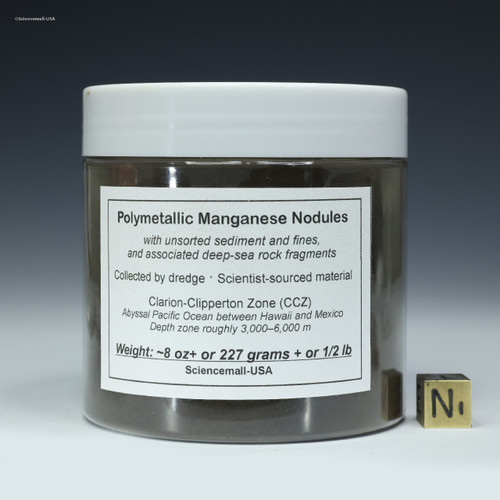
Polymetallic Nodule Rare Interior - CCZ
Brand : Sciencemall-USA
- SKU:
- JPT-854489
- Availability:
- Usually ships in 24 hours.
- Weight:
- 1.00 LBS
- Minimum Purchase:
- 1 unit
- Maximum Purchase:
- 1 unit
- Shipping:
- Calculated at Checkout



Banded Polymetallic Nodule - Naturally Sectioned - 24 g
Sectioned polymetallic nodule from the abyssal Pacific seafloor, recovered from Clarion-Clipperton Zone material. The exposed interior face preserves nested, sweeping growth laminae, a well-developed columnar oxide texture, and high-contrast ochre alteration zones. Growth banding of this width and structural clarity is uncommon in nodule interiors, most of which part or section to a nearly uniform dense black or featureless gray.
What the Interior Face Shows
Curved growth bands sweep across the upper part of the face and can be followed by eye for several centimeters. Some stack neatly on top of one another; others cut straight across their neighbors. Those interruptions matter: they show the nodule stopped growing, sat, and then started again, instead of building outward smoothly the way most nodules do. Across the lower third runs a wide ochre band with a fine, column-like texture standing perpendicular to the layers. That texture is the most important thing on the specimen. Researchers who study these nodules recognize two different ways they grow, one fed by metals settling out of seawater and one fed by fluids in the seafloor mud beneath, and each leaves a different texture behind. This piece shows both, plainly, without a microscope.
Pale, chalky patches sit in the middle of the face and cover most of the back. These have not been analyzed, and we are not going to guess at a name for them. The most likely candidates are zeolite, clay, or the silica remains of microscopic plankton, all of which are common in the deep-sea sediment these nodules grow in. Fine hairline veins cut across the dark outer rim, so they formed after the layering did. Along one edge, the nodule's original outer skin is still intact, dark and gently lumpy, which means the surface it grew on the seafloor and the structure hidden inside can both be seen on the same small piece.
Product Information
| Specimen | Naturally Sectioned polymetallic ferromanganese nodule |
| Classification | Abyssal marine polymetallic manganese nodule |
| Source Material | Clarion-Clipperton Zone, abyssal Pacific Ocean |
| Depositional Setting | Abyssal plain, below the carbonate compensation depth. Nodule fields in this region are generally reported between roughly 3,000 - 5,500 meters. |
| Growth Rate | Hydrogenous nodule growth is generally reported in the range of a few millimeters per million years. On that basis, a section of this thickness represents a very long accretionary interval, though no age is measured or claimed for this specimen. |
| Interior Description | Natural interior face. The nodule opened along its own internal structure, exposing the growth architecture with its natural relief intact. Exterior surfaces are the original seafloor surface. |
| Sectional Rarity | Exceptional. Rare. Across several hundred pounds of Clarion-Clipperton Zone material sorted in-house, the overwhelming majority of nodules present interiors that are dense, tightly micro-laminated, and visually uniform, sectioning to near-solid black or undifferentiated gray. A specimen with growth banding this wide, this distinct, and this structurally pronounced is rare. |
| Pale Zones | Candidate phases are phillipsite, clay, or biosiliceous material. Not analytically determined. |
| Dimensions | 43 mm L x 30 mm W x 26 mm D (1.69 x 1.18 x 1.02 in) |
| Weight | 24 grams (0.85 oz) |
| Display | Small four-prong acrylic display base included |
| What's Included | Certificate of Authenticity (COA) and information about the specimen |
| SKU | 854489 |
Images professionally photographed under controlled studio lighting using Zeiss optics and a pro-grade Canon camera, for guaranteed accuracy. The brass scale cube measures 1 cm per side.
Rarity and Significance
| Rarity of Source Material | ★★★★★ |
| Rarity of This Interior Structure | ★★★★★ |
| Scientific Interest | ★★★★★ |
| Display Presence | ★★★★★ |
| Value as a Teaching Specimen | ★★★★★ |
Questions Commonly Asked
How is this different from an ordinary manganese nodule?
The difference is entirely in the interior, and it is not subtle once the two are placed side by side.
Sorting through several hundred pounds of Clarion-Clipperton Zone material yields nodule after nodule with the same interior character: dense, homogeneous, micro-laminated iron-manganese oxide in which the growth layering is so tight and so uniform that a parted or sectioned face reads as almost solid black, or as an undifferentiated gray with no legible structure. The layers are there. They are simply too fine and too regular to resolve without magnification. Those specimens are geologically ordinary and, as display or teaching pieces, very generalized.
This specimen departs from that pattern on three counts at once, which is what makes it uncommon rather than merely a generic manganese nodule.
The growth geometry is bold and asymmetric rather than tight and concentric. Most nodules nucleate on a very small seed, often a microscopic basalt fragment, a shark tooth fragment, or a microfossil, which is quickly enveloped by even concentric accretion. The sweeping, wide-radius, asymmetric laminae on this face, and their discordant, truncating contacts, are consistent with growth around a substantially larger and irregular nucleation host that governed the depositional geometry for a long interval. No nucleus is exposed on any face.
Two distinct growth textures are preserved and visible. The dense laminated zones and the well-developed columnar band represent the two growth textures that the published literature associates with hydrogenous and diagenetic accretion. Nodules that record a single regime throughout are common. Nodules that display both textures legibly on one face, without a microscope, are not.
High-contrast mineralization outlines the structure instead of blending it. The ochre alteration zones and pale halos bordering the central mass separate the internal architecture into readable tones. In the great majority of nodules, contrast simply is not present, and the structure disappears into a uniform dark matrix.
A specimen has to hit all three of those conditions together to look like this. Each is uncommon on its own; the intersection is what makes this specimen a genuine standout from bulk abyssal material.
What are the pale, light-toned zones?
They are not identified, and we do not claim otherwise. Realistic candidates include zeolite, most commonly phillipsite, which is abundant in the pelagic clays of this region; clay minerals; or biosiliceous material such as radiolarian or diatom debris. Carbonate is less likely to persist as a broad zone at abyssal depths in this part of the Pacific, though it is worth noting that carbonate and phosphatic material does occur inside nodules, since shell fragments, foraminifera tests, and shark teeth are all documented nucleus materials that were sealed within the growing oxide. These phases are not distinguishable by eye, and no X-ray diffraction or electron microprobe work has been performed on this specimen.
Why is there ochre and rust-colored material inside a deep-sea nodule?
Two explanations are consistent with what is visible, and they are not mutually exclusive.
The first is secondary oxidation: goethite and limonite formed by localized fluid movement and fracture filling after the primary concretion had accreted, cementing and outlining the internal structure in high-contrast tones. The sharp-walled hairline veinlets cutting the dark rim support post-accretionary fluid access along fractures.
The second is nucleus-related. Altered basaltic glass, or palagonite, is a common nodule nucleus material in this region and weathers to precisely this yellow-orange-brown range. If that is the origin, the ochre is not a separate phenomenon at all but the visible expression of the same large seed fragment that produced the asymmetric growth geometry.
We cannot resolve which applies without analysis, and we present both rather than picking the more convenient one.
Was this specimen cut, or is the face natural?
The interior face is a natural parting surface, not a sawn plane. It retains genuine relief, with broken ledges and topography that catch raking light, and it follows the specimen's own internal structural weakness. In practice, this is preferable to a saw cut: the piece opened along the boundaries its own growth history created, which is why the laminae, the columnar band, and the alteration zones read as distinctly as they do. The exterior surfaces are natural nodule surfaces, unpolished and untreated.
How old is this specimen?
No age has been measured for this piece, and none is claimed. For general context, hydrogenous ferromanganese accretion is widely reported at rates on the order of a few millimeters per million years, among the slowest known geological processes. Applied to a concretion of this size, that implies an accretionary history of very substantial duration.
Is it safe to handle and display?
Yes, under normal handling. The specimen is a stable concretion. Handle it as you would any mineral specimen: do not abrade, grind, or cut it, and wash hands after handling. See the Cautions and Safety section below for details.
Cautions and Safety
This specimen is an intact solid article and is not a hazardous chemical product under 29 CFR 1910.1200. No safety data sheet is required for an article in this form. Polymetallic ferromanganese concretions contain manganese and iron oxides together with minor nickel, copper, and cobalt. In solid, undisturbed form, these present no meaningful exposure route.
Do not cut, grind, drill, crush, or abrade the specimen. Any such operation generates respirable metal oxide dust and would require appropriate respiratory protection, local exhaust ventilation, and wet methods. Do not ingest. Keep away from small children who may place objects in the mouth. Wash hands after handling. Store dry; the specimen requires no chemical treatment or stabilization.
Provenance and Authenticity
Our specimens were acquired from prominent scientists who obtained them from various scientific estate collections. Because of the highly competitive and sensitive nature of sourcing material from historic, closed research initiatives, the various scientists' identities and the exact estate remain proprietary. We are required to maintain strict confidentiality with the scientists who supply Sciencemall-USA in order to continue bringing these exceptionally rare specimens to private collectors and other research venues. Our sourcing network maintains an uncompromised, unbroken chain of custody extending directly back to the inception of Sciencemall-USA. The accompanying Certificate of Authenticity (COA) serves as our business's legal and professional guarantee of each specimen's absolute authenticity and chain of custody, ensuring you can display it with total confidence.
ONLY 1 AVAILABLE
This is a single specimen. When it sells, it is gone. No comparable piece can be reordered, because no comparable piece exists in our inventory.
Polymetallic nodules accumulate on the abyssal seafloor at a rate measured in millimeters per million years, in permanent darkness, under several kilometers of water. Nearly all of them keep that history to themselves; parted or sectioned, they show a dense uniform black that reveals almost nothing about how it formed. This specimen is one of the few that opened along its own structure and put the entire accretionary record in a single readable place. It is offered as it was found, with its structure intact.