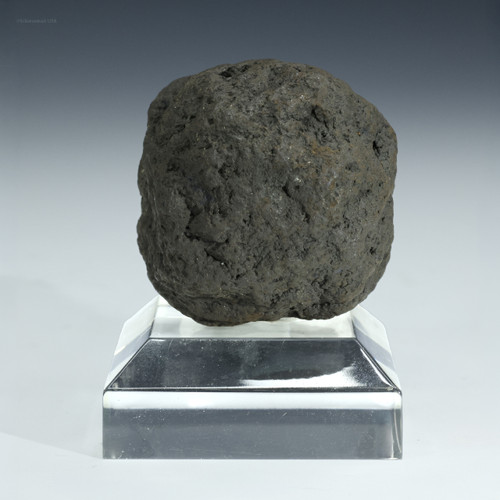
Manganese Nodules - CCZ- Pacific Ocean - 1 lb
Brand : Sciencemall-USA
- SKU:
- JPT-75247
- Availability:
- Usually ships in 24 hours.
- Weight:
- 1.00 LBS
- Minimum Purchase:
- 1 unit
- Maximum Purchase:
- 1 unit
- Shipping:
- Calculated at Checkout


Polymetallic Manganese Nodules [CCZ] - 1 lb Jar
A full pound of the abyssal Pacific seafloor, sealed in a labeled jar. This container holds polymetallic manganese nodule material dredged from the Clarion-Clipperton Zone between Hawaii and Mexico, including nodule pieces, associated deep-sea rock fragments, and the residual dust, dirt, and unsorted fine sediment that accompanies recovered nodule material. It has not been washed, screened, or sorted, so what sits in the jar is what came up off the bottom.
Where This Material Comes From
The Clarion-Clipperton Zone is a stretch of abyssal plain in the equatorial Pacific, bounded by two enormous fracture zones and covering an area larger than the continental United States. Across a depth range of roughly 3,000 to 6,000 meters, the seafloor there is carpeted with dark potato-sized concretions lying loose on pale sediment. It is the most thoroughly mapped nodule field on the planet, and it has been at the center of deep-ocean science and international seabed policy for more than fifty years.
This material was recovered by dredge, the standard sampling method for nodule fields, which is why the jar holds sediment and rock fragments alongside the nodules themselves rather than nodules alone.
How a Nodule Is Built
Every nodule begins with a seed. A rock chip, a fragment of an older nodule, or in many documented cases a shark tooth or a fossil whale ear bone settles onto the abyssal floor, and manganese and iron oxides begin precipitating onto it from seawater and from the pore fluids in the sediment below. The oxides build outward in concentric layers, and reported accretion rates are commonly a few millimeters per million years, among the slowest growth rates recorded for any natural solid.
The arithmetic is worth sitting with. A nodule you can close your hand around may have taken longer to form than the entire history of the genus Homo. Broken fragments in this jar expose that layered interior directly, which is the part a polished display nodule keeps hidden.
What this One-Pound Jar Contains
One pound occupies useful middle ground. It is substantially more material than a single specimen jar, enough to pass around a full class, section and polish a few fragments, sieve the fines for micronodules, or set aside a portion for analysis while keeping the rest intact. It is also a striking object on a shelf: a heavy, tightly packed jar of black deep-ocean material with the locality and depth zone printed on the face.
Product Information
| Object Type | Polymetallic manganese nodule material with unsorted sediment and fines, and associated deep-sea rock fragments |
| Locality | Clarion-Clipperton Zone (CCZ), abyssal Pacific Ocean between Hawaii and Mexico |
| Depth Zone | Roughly 3,000 to 6,000 meters |
| Collection Method | Collected by dredge |
| Approximate Growth History | Millions of years, based on commonly cited nodule accretion rates of a few millimeters per million years |
| Weight | 1 lb plus - 454 grams plus of nodule material |
| Container | Clear jar with tight-fitting white lid and printed specimen label, 3.5 in diameter x 3.75 in H |
| Specimen Description | Matte to sub-metallic black and brown-black nodule material; nodule pieces and associated deep-sea rock fragments with residual dust, dirt, and unsorted fine sediment, as recovered |
| Scientific Significance | Authentic deep-ocean polymetallic nodule material from the most studied nodule province on Earth; quantity sufficient for sectioning, sieving, and hands-on instruction |
| Provenance | Scientist-sourced material, professionally and legally collected; long-held scientific collection stock |
| What Is Included | Labeled jar of nodule material, Sciencemall-USA Certificate of Authenticity, and specimen documentation. Sizing cube shown for scale only; not included. |
| Use and Display | Classroom instruction, private scientific collection, museum-style display, oceanography and Earth science teaching, division into smaller study lots |
| Cautions and Safety | Do not breathe the dust. Wash hands after handling. Wash work surfaces. Store with the jar closed and labeled. Sold as a natural mineral specimen for collector and educational use; a Materials Handling Sheet is included. This is not a Safety Data Sheet and does not constitute a hazard classification under 29 CFR 1910.1200. |
| Authentication and Compliance | Ships with a Sciencemall-USA Certificate of Authenticity and specimen documentation. HS code 970529; U.S. 10-digit code 9705290000. Declared purpose: scientific and mineralogical study. Natural mineralogical specimen for scientific study. |
| Shipping | Calculated at checkout |
| U.S. Shipping | Free Priority Shipping within the USA |
| Item ID | 75247 |
Images professionally photographed under controlled studio lighting using Zeiss optics and a pro-grade Canon camera.
Rarity and Significance
| Scientific Significance | ★★★★★ - Deep-ocean polymetallic nodule material from the most intensively studied nodule province on Earth |
| Market Availability | ★★★☆☆ - Nodule material surfaces on the collector market periodically, though pound-scale jars with recorded locality and depth are far less common |
| Locality Specificity | ★★★★★ - Attributed to the Clarion-Clipperton Zone, a defined and scientifically meaningful abyssal province, with depth zone recorded on the specimen label |
| Display Appeal | ★★★★☆ - Substantial labeled jar, densely packed with black deep-sea material; strong shelf and classroom presence |
What distinguishes this jar is documentation at scale. Loose nodule material circulates without any record of where it came from; this pound is tied to a named province, a stated depth zone, and a recorded collection method, which is what allows it to function as a scientific specimen.
Questions Commonly Asked
What is at the center of a manganese nodule?
A nucleus of some kind, around which the oxide layers accreted. Rock chips and fragments of older nodules are the most common, but shark teeth and fossil whale ear bones are well documented as nuclei, since durable biological hard parts survive on the abyssal floor long enough for mineral growth to begin. Cutting a nodule in half is the standard way to reveal what seeded it.
Why do nodules sit on top of the sediment instead of being buried?
This is a long-standing question and is not fully resolved. Sedimentation on the abyssal plain is extremely slow, which is part of the answer, and researchers have also proposed that bottom currents and the burrowing and nudging activity of seafloor animals help keep nodules at the surface. Whatever the mechanism, the result is a field of concretions lying exposed rather than entombed.
How are nodules different from ferromanganese crusts?
Both are seafloor manganese and iron oxide deposits, but they occupy different settings. Nodules form as free-lying concretions on soft abyssal sediment, while crusts form as pavements on exposed hard rock, typically on seamount flanks swept clear of sediment. Their metal budgets differ as well, with crusts generally reported to be richer in cobalt.
Which metals do these nodules contain?
Manganese and iron oxides form the bulk of the material, with nickel, copper, and cobalt among the trace metals characteristically reported from this province. That combination is precisely why the Clarion-Clipperton Zone has drawn commercial attention and why deep-sea mining there remains contested.
How should the jar be stored and displayed?
Keep the lid closed when the jar is not in use, which keeps the fines contained and the label legible. Ordinary room conditions are fine; the material is stable and needs no special environment. If you decant a portion for study, work over a washable surface, avoid raising dust, and wash your hands afterward.
Add this 1 lb jar of Clarion-Clipperton Zone polymetallic manganese nodule material to a private scientific collection, a university or classroom teaching set, or a museum-style Earth science display. ONLY 1 AVAILABLE.
A pound of material from a plain lying three to six kilometers beneath the Pacific, built up in layers at a rate of millimeters per million years around seeds that fell to the bottom before the first humans walked. Documented to province, depth zone, and collection method, and offered as a single jar.