Assorted Polymetallic Manganese Nodules with Fines - 3 oz - 85 grams plus
Brand : Sciencemall-USA
- SKU:
- JPT-811225
- Availability:
- Usually ships in 24 hours.
- Weight:
- 1.00 LBS
- Minimum Purchase:
- 1 unit
- Maximum Purchase:
- 4 units
- Shipping:
- Calculated at Checkout



Polymetallic Manganese Nodules [CCZ] - 3 oz Jar
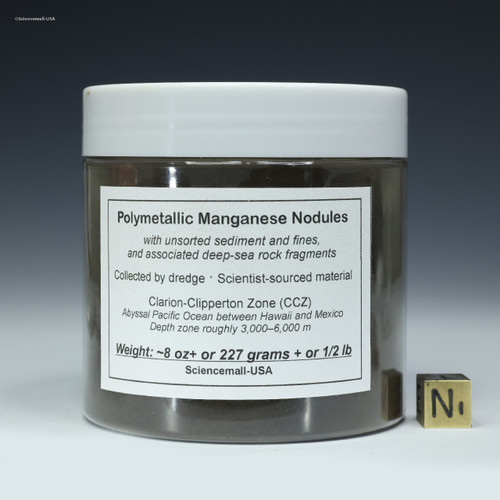
This labeled jar holds approximately three ounces (85 grams plus) of polymetallic manganese nodule material dredged from the Clarion-Clipperton Zone, the abyssal Pacific plain lying between Hawaii and Mexico. The contents are a working mix of nodule pieces, associated deep-sea rock fragments, and the residual dust, dirt, and unsorted fine sediment that accompany recovered nodule material. Nothing has been washed, screened, or picked over, so the jar shows the deposit as the dredge brought it up.
Why This Material Matters
The Clarion-Clipperton Zone is the most intensively studied polymetallic nodule province on Earth, a vast abyssal plain bounded by the Clarion and Clipperton fracture zones that has been the focus of deep-ocean resource science since the 1970s. The nodules rest on soft abyssal sediment across a depth zone of roughly 3,000 to 6,000 meters, in near-total darkness under several kilometers of water. Material from this province sits at the center of current scientific and public debate over deep-sea mining, which makes an authentic sample of it unusually relevant for teaching and discussion.
Nodules are also remarkable for their pace of formation. Polymetallic manganese and iron oxides accrete around a nucleus at rates commonly cited as a few millimeters per million years, among the slowest growth rates known for any natural solid. A nodule of ordinary size, therefore, records millions of years of continuous, uninterrupted deep-ocean chemistry, one concentric layer at a time.
Collector and Classroom Appeal
Three ounces is a practical study quantity: enough material for a classroom demonstration, a shelf display, or hands-on examination without committing to a bulk lot. Because the jar contains fragments and fines rather than a single curated nodule, it shows features that an intact display specimen conceals, including broken interior surfaces, associated abyssal rock, and the fine dark sediment that surrounds nodules on the seafloor. The compact jar displays well beside a mineral collection, a periodic table set, or an oceanography teaching shelf.
Product Information
| Object Type | Polymetallic manganese nodule material with unsorted sediment and fines, and associated deep-sea rock fragments |
| Locality | Clarion-Clipperton Zone (CCZ), abyssal Pacific Ocean between Hawaii and Mexico |
| Depth Zone | Roughly 3,000 to 6,000 meters |
| Collection Method | Collected by dredge |
| Approximate Growth History | Millions of years, based on commonly cited nodule accretion rates of a few millimeters per million years |
| Weight | Approximately 3 oz plus - 85 grams plus of nodule material |
| Container | Clear jar with tight-fitting white lid and printed specimen label, 2.75 in diameter x 2.125 in H |
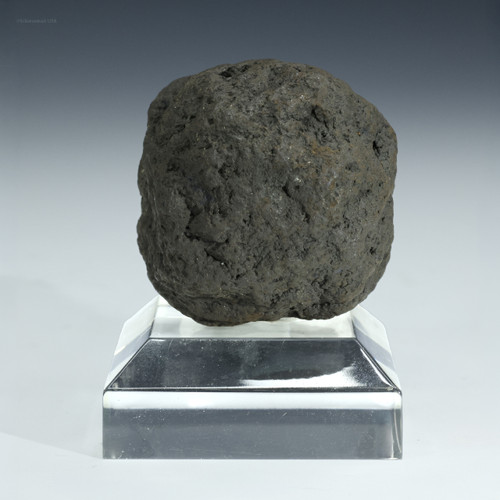
| Specimen Description | Matte to sub-metallic black and brown-black nodule material; nodule pieces and associated deep-sea rock fragments with residual dust, dirt, and unsorted fine sediment |
| Scientific Significance | Authentic deep-ocean polymetallic nodule material from the most studied nodule province on Earth |
| Provenance | Scientist-sourced material, professionally and legally collected; long-held private estate scientific collection stock |
| What Is Included | Labeled jar of nodule material, Sciencemall-USA Certificate of Authenticity, and specimen documentation. Batch XRF included! Sizing cube shown for scale only; not included. |
| Use and Display | Classroom instruction, private scientific collection, museum-style display, oceanography, and Earth science teaching |
| Cautions and Safety | Do not breathe the dust. Wash hands after handling. Wash work surfaces. Store with the jar closed and labeled. Sold as a natural mineral specimen for collector and educational use; a Materials Handling Sheet is included. This is not a Safety Data Sheet and does not constitute a hazard classification under 29 CFR 1910.1200. |
| Authentication and Compliance | Ships with a Sciencemall-USA Certificate of Authenticity and specimen documentation. HS code 970529; U.S. 10-digit code 9705290000. Declared purpose: scientific and mineralogical study. Natural mineralogical specimen for scientific study; not intended for metal extraction or industrial use. |
| Shipping | Calculated at checkout |
| U.S. Shipping | Free Priority Shipping within the USA |
| Item ID | 811225 |
Images professionally photographed under controlled studio lighting using Zeiss optics and a pro-grade Canon camera.
Rarity and Significance
| Scientific Significance | ★★★★★ - Deep-ocean polymetallic nodule material from the most intensively studied nodule province on Earth |
| Market Availability | ★★★☆☆ - Nodule material reaches the collector market periodically, though documented dredge-collected material is less common |
| Locality Specificity | ★★★★★ - Attributed to the Clarion-Clipperton Zone, a defined and scientifically meaningful abyssal province, with depth zone recorded on the specimen label |
| Display Appeal | ★★★★☆ - Compact labeled jar of striking dark deep-sea material; strong shelf and classroom presence |
The value of this jar lies in what it documents. Nodule material is offered often enough, but material tied to a named province, a recorded depth zone, and a stated collection method carries scientific meaning that unattributed material cannot.
Questions Commonly Asked
What exactly is in this jar?
Approximately 85 grams of polymetallic manganese nodule material: nodule pieces, associated deep-sea rock fragments, and the residual dust, dirt, and unsorted fine sediment that accompanies recovered nodule material. It is sold as study material, not as a single curated display nodule.
Why is the Clarion-Clipperton Zone important?
It is the best-characterized polymetallic nodule province on the planet, a broad abyssal plain of the equatorial Pacific between Hawaii and Mexico. It has been the focus of deep-ocean resource science, ecological survey work, and international seabed policy for more than fifty years, which makes material from the province directly relevant to current scientific and public debate.
How do manganese nodules form?
Iron and manganese oxides precipitate from seawater and from pore fluids in the underlying sediment and accrete in concentric layers around a nucleus, which may be a rock fragment, a shark tooth, or an older nodule fragment. Reported accretion rates are commonly a few millimeters per million years, among the slowest growth rates recorded for any natural solid, which is why a nodule of modest size can represent millions of years of continuous deposition.
How was this material collected?
The dredge is the standard method for sampling nodule fields, in which a towed collecting device is drawn across the seafloor, recovering nodules along with the surrounding sediment and associated rock. This is why the jar contains fines and rock fragments alongside the nodule material rather than nodules alone.
Is this suitable for classroom use?
Yes. Three ounces is enough for a class to examine directly, and the mix of fragments and fines supports low-magnification study of nodule structure, micronodules, and abyssal sediment. Follow the handling guidance on the label and supervise students to ensure the dust is not disturbed or inhaled.
Add this 3 oz jar of Clarion-Clipperton Zone polymetallic manganese nodule material to a private scientific collection, a classroom teaching set, or a museum-style Earth science display.
Dredged from an abyssal plain three to six kilometers beneath the Pacific, this material accreted at rates measured in millimeters per million years on a seafloor almost no one has ever seen. Documented to province, depth zone, and collection method, it is among the most genuinely remote materials a collector or classroom can hold.