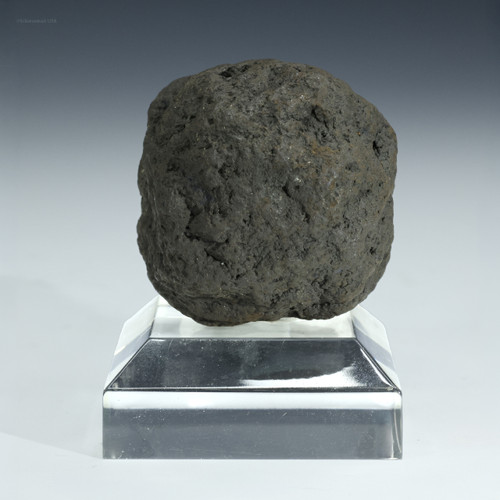
Polymetallic Manganese Nodules-Mixed Fines -0.5 lb -227 grams
Brand : Sciencemall-USA
- SKU:
- JPT-79368
- Availability:
- Usually ships in 24 hours.
- Weight:
- 1.00 LBS
- Minimum Purchase:
- 1 unit
- Maximum Purchase:
- 1 unit
- Shipping:
- Calculated at Checkout


Polymetallic Manganese Nodules [CCZ] - 1/2 lb Jar, 227+ grams
Half a pound of authentic deep-ocean material, dredged from the Clarion-Clipperton Zone of the abyssal Pacific between Hawaii and Mexico. The jar holds polymetallic manganese nodule pieces, associated deep-sea rock fragments, and the residual dust, dirt, and unsorted fine sediment that accompany recovered nodule material. Nothing has been rinsed or picked through, and the locality and depth zone are printed on the label.
The Slowest Growing Rock on Earth
Manganese nodules grow more slowly than almost anything else in nature. Reported accretion rates are commonly a few millimeters per million years, meaning a nodule adds roughly the thickness of a sheet of paper in the time it takes a mountain range to rise and erode away. The oxides build outward in fine concentric layers around a nucleus, each layer a record of the bottom-water chemistry present when it formed.
Because growth is that slow, nodules are effectively archives. Nothing about them is quick, disturbed, or recent, and that is precisely what makes the material scientifically interesting rather than merely unusual.
Dredging the Pacific Ocean Floor
The mix in the jar tells you how it was collected. A dredge is towed across the seafloor and collects whatever lies in its path, so nodules arrive accompanied by the varied abyssal sediments on which they rested and fragments of associated deep-sea rock. Keeping that assemblage together, rather than washing it down to regular nodules, preserves the relationship between the concretions and the seafloor they came from. Broken pieces are an advantage as well, since they expose the layered interior that an intact nodule conceals. This material offers "context" for mining the ocean floor.
A Practical Starting Quantity
Eight ounces is enough material to work with and still small enough to shelve easily. It supports a class demonstration, a comparative mineral display, or a sieved portion examined under low magnification, without committing to a bulk lot. For a collector building a deep-ocean or economic-geology section, it is a substantial and clearly labeled anchor piece.
Product Information
| Object Type | Polymetallic manganese nodule material with unsorted sediment and fines, and associated deep-sea rock fragments |
| Locality | Clarion-Clipperton Zone (CCZ), abyssal Pacific Ocean between Hawaii and Mexico |
| Depth Zone | Roughly 3,000 to 6,000 meters |
| Collection Method | Collected by dredge |
| Approximate Growth History | Millions of years, based on commonly cited nodule accretion rates of a few millimeters per million years |
| Weight | 1/2 lb plus - approximately 8 oz or 227 grams plus of nodule material |
| Container | Clear jar with tight-fitting white lid and printed specimen label, 2.75 in diameter x 2.75 in H |
| Specimen Description | Matte to sub-metallic black and brown-black nodule material; nodule pieces and associated deep-sea rock fragments with residual dust, dirt, and unsorted fine sediment, as recovered |
| Scientific Significance | Authentic deep-ocean polymetallic nodule material from the most studied nodule province on Earth, with the collected assemblage kept intact |
| Provenance | Scientist-sourced material, professionally and legally collected; long-held scientific collection stock |
| What Is Included | Labeled jar of nodule material, Sciencemall-USA Certificate of Authenticity, and specimen documentation. Sizing cube shown for scale only; not included. |
| Use and Display | Classroom instruction, private scientific collection, museum-style display, oceanography, and Earth science teaching |
| Cautions and Safety | Do not breathe the dust. Wash hands after handling. Wash work surfaces. Store with the jar closed and labeled. Sold as a natural mineral specimen for collector and educational use; a Materials Handling Sheet is included. |
| Authentication and Compliance | Ships with a Sciencemall-USA Certificate of Authenticity and specimen documentation. HS code 970529; U.S. 10-digit code 9705290000. Declared purpose: scientific and mineralogical study. Natural mineralogical specimen for scientific study; not intended for metal extraction or industrial use. |
| Shipping | Calculated at checkout |
| U.S. Shipping | Free Priority Shipping within the USA |
| Item ID | 79368 |
Images professionally photographed under controlled studio lighting using Zeiss optics and a pro-grade Canon camera.
Rarity and Significance
| Scientific Significance | ★★★★★ - Deep-ocean polymetallic nodule material from the most intensively studied nodule province on Earth |
| Market Availability | ★★★☆☆ - Nodule material appears on the collector market from time to time, though material offered with the collected assemblage intact is less common |
| Locality Specificity | ★★★★★ - Attributed to the Clarion-Clipperton Zone, a defined and scientifically meaningful abyssal province, with depth zone recorded on the specimen label |
| Display Appeal | ★★★★☆ - Compact labeled jar packed with black deep-sea material; clean shelf presence and immediate classroom interest |
This material is documented to the Clarion-Clipperton Zone, with the depth zone and collection method recorded on the specimen label. That attribution is what allows a jar like this one to be taught from, cited, and compared against the substantial published literature on the province, rather than simply displayed.
Questions Commonly Asked
What are the fines and sediment, and are they worth keeping?
They are abyssal seafloor sediment and the fine material shed from the nodules themselves during recovery and handling. They are worth keeping. Examined under low magnification, fines from nodule fields commonly contain micronodules and small mineral grains, and the sediment is part of the record of where the nodules were lying. Washing it away discards information.
What does "unsorted" mean here, and why does it matter?
It means the material has not been sieved, graded by size, or picked over. This jar gives you the opportunity to see what scientists actually find first when dredging for nodules: concretions, abyssal sediment, fines, and associated deep-sea rock fragments all coming up together. For teaching and study, that is a strength, since the recovered assemblage says more about the seafloor than cleaned nodules alone can.
Are polymetallic nodules found outside the Pacific?
Yes. Nodule fields are reported in the Central Indian Ocean Basin, the Peru Basin, parts of the Atlantic, and some shallow settings. The Clarion-Clipperton Zone remains the largest and, by far, the most intensively surveyed of them, which is why material from this province serves as the reference point for nodule science.
Who is a half-pound jar best suited for?
Instructors who want enough material for a class to handle, collectors adding a documented deep-ocean or economic-geology piece, and anyone who wants a working quantity to examine and display while keeping a portion untouched. It is a step up from a single-specimen jar, without the storage demands of a bulk lot.
Add this 1/2 lb jar of Clarion-Clipperton Zone polymetallic manganese nodule material to a private scientific collection, a classroom teaching set, or a museum-style Earth science display.
This half-pound jar holds polymetallic manganese nodules from the Pacific's abyssal floor, among the rarest materials available to private collectors anywhere on Earth. Slow-grown over millions of years, naturally formed, and recovered by dredge from three to six kilometers beneath the surface, it makes for a fantastic oceanographic collectible.