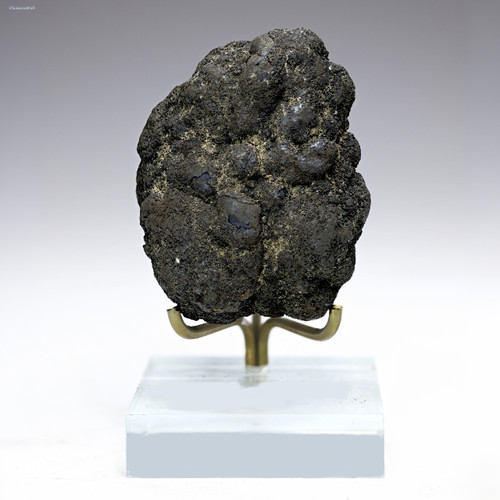
Manganese Nodule CCZ -Large - 85 grams
Brand : Jensan Scientifics LLC
- SKU:
- JPT-893532
- Availability:
- Usually ships in 24 hours.
- Weight:
- 1.00 LBS
- Minimum Purchase:
- 1 unit
- Maximum Purchase:
- 1 unit
- Shipping:
- Calculated at Checkout

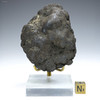
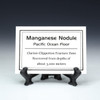
Pacific Manganese Nodule, CCFZ, 85 Grams
This manganese nodule specimen came from the Pacific Ocean floor in the Clarion-Clipperton Fracture Zone (CCFZ), the richest nodule field on Earth. At 70 mm long and 85 grams, it is a great hand specimen.
About This 85-gram Manganese Nodule
Manganese nodules are rounded lumps of metal oxides that form on the deep abyssal seafloor, roughly 4,000 to 6,000 meters below the surface.
- Each one grows around a tiny core, such as a shark tooth, a shell fragment, or a piece of an older nodule
- They take metals from seawater and seafloor mud, growing only millimeters per million years, which makes them some of the slowest-growing natural objects known
- They are rich in manganese and iron, with nickel, copper, cobalt, and rare-earth elements
- The CCFZ, between Hawaii and Mexico, holds the largest known concentration of nodules and is at the center of today's debate over deep-sea mining
- Deep-ocean nodules first gained scientific attention during the HMS Challenger expedition of 1872 to 1876
Product Information
| Specimen | Manganese (ferromanganese) nodule |
| Locality | Clarion-Clipperton Fracture Zone (CCFZ), Pacific Ocean floor |
| Estimated Age | Millions of years of slow growth |
| Composition | Manganese and iron oxides, with silicon, aluminum, nickel, copper, cobalt, and rare-earth elements |
| Dimensions and Weight | 70mm L x 54mm W x 38mm D, 85 grams |
| Science Gift Options | An outstanding gift for oceanographers, geology students, educators, and collectors of deep-sea and economic minerals |
| What's Included | Certificate of Authenticity, specimen information sheet, display tag, tag stand, XRF. Specimen display stand and brass scale cube not included. |
| Cautions and Safety | Natural metal oxide specimen. Wash hands after handling. Do not cut, grind, or ingest. Not intended for young children. Keep dry and handle gently. |
| Legality | Legally collected; legal to own and display |
| Provenance and Authenticity | All of our material is proprietary and sourced from scientists and/or verified scientific estate collections, backed by the included Certificate of Authenticity. |
| SKU | 893532 |
| Availability | ONLY 1 AVAILABLE |
Images professionally photographed under controlled studio lighting using Zeiss optics and a pro-grade Canon camera, for guaranteed accuracy. The brass scale cube measures 1 cm per side.
Rarity and Significance
| Scientific Significance | ★★★★☆ |
| Locality Uniqueness | ★★★★☆ |
| Rarity | ★★★★☆ |
| Market Availability | ★☆☆☆☆ |
| Historical Importance | ★★★★☆ |
| Display Appeal | ★★★★☆ |
Questions Commonly Asked About Deep-Sea Mining
How does deep-sea mining work?
Nodule mining works a lot like a giant underwater vacuum cleaner connected to a ship:
- A ship at the surface lowers a robotic, remote-controlled collector vehicle to the seafloor
- The collector drives across the seabed on tracks, using jets of water and suction to lift nodules off the mud
- The nodules travel up a long pipe, called a riser, to the ship, pushed by pumps or compressed air
- On the ship, the nodules are separated from the water and mud, then shipped to shore for processing
- The leftover water and sediment are released back into the ocean
Is deep-sea mining happening anywhere?
Not at full commercial scale, at least not yet. Here is where things stand:
- Pilot tests have collected nodules in the CCFZ, first in the 1970s and again in 2022
- The Metals Company has applied to the U.S. government for a permit to mine CCFZ nodules commercially
- The International Seabed Authority (ISA), which oversees international waters, has not finalized its rules for commercial mining
- Some nations, including Norway, have paused deep-sea mining, and dozens of countries have called for a moratorium
Seabed mining in shallow coastal waters, such as diamond mining off Namibia, has been running commercially for decades.
Is De Beers ocean mining the same thing?
No. Both use seafloor crawlers connected to a ship, but they are very different operations:
- What they mine: De Beers recovers diamonds from gravel on ancient beaches that are now underwater. Deep-sea mining targets metal-rich nodules like this one.
- How deep: De Beers works about 90 to 150 meters (300 to 500 feet) down. Nodule fields lie 4,000 to 6,000 meters down.
- Where: De Beers mines on the shallow continental shelf off Namibia's southern coast, through Debmarine Namibia, a joint venture with the Namibian government. The CCFZ lies far out in the open Pacific, mostly in international waters.
How many miles deep is deep-sea mining?
In nodule fields like the CCFZ, the seafloor lies about 2.5 to 3.7 miles (4,000 to 6,000 meters) below the surface.
- That is deep enough that no sunlight ever reaches the bottom
- The water pressure is roughly 400 to 600 times greater than at the surface
- By comparison, De Beers diamond mining off Namibia works less than one-tenth of a mile down
This is a large, 85-gram nodule that took millions of years to grow, nearly 3 miles beneath the Pacific. This bold, hand-filling specimen comes from the very seafloor at the heart of today's deep-sea mining debate. Only one available this size.