
Devonian Mass Extinction - Black Shale - Upper Kellwasser, NY
Brand : Sciencemall-USA
- SKU:
- JPT-97883
- Availability:
- Usually ships in 24 hours.
- Weight:
- 1.00 LBS
- Minimum Purchase:
- 1 unit
- Maximum Purchase:
- 1 unit
- Shipping:
- Calculated at Checkout


Devonian Mass Extinction - Black Shale - FF Boundary
This Kellwasser Late Devonian Mass Extinction Horizon specimen is an anoxic black shale from the Point Gratiot Bed of the Hanover Shale, the western New York expression of the Upper Kellwasser Event at the Frasnian–Famennian Boundary, approximately 372 million years ago. This rock specimen helps us understand ocean conditions during the Late Devonian Mass Extinction, one of the five largest biotic crises in the history of life.
About the Late Devonian Extinction Horizon
Near the end of the Frasnian Age, marine life suffered a severe and prolonged collapse. The great Devonian reef systems built by stromatoporoids and corals largely disappeared, and brachiopods, ammonoids, trilobites, conodonts, and many other groups lost a large share of their species. Across much of the world, two distinctive dark, organic-rich layers record this crisis, first described in Germany as the Lower and Upper Kellwasser horizons. The Upper Kellwasser horizon lies at or near the Frasnian–Famennian Boundary and marks the most intense phase of the extinction.
About the Upper Kellwasser Event
In the Appalachian Basin of western New York, the Upper Kellwasser interval event is represented by the Point Gratiot Bed, a thin black shale near the top of the Hanover Shale in the Java Formation. Black shales like this one form when bottom waters lose their oxygen, so organic matter settles and is preserved instead of being consumed. The spread of these low-oxygen conditions is central to most explanations for the Devonian extinction, and researchers still debate the exact drivers, including climate change, nutrient runoff from newly forested land, sea-level shifts, and volcanism.
Black Shale Occurrences
Black shales are some of the most information-rich rocks on Earth. Each millimeter can represent thousands of years of slow settling in still, oxygen-starved water, and the organic carbon locked inside preserves a chemical record of the ancient ocean. Geologists read these layers for clues to past climate, sea level, and the collapse of marine ecosystems, and black shales worldwide also serve as source rocks for much of the planet's oil and natural gas. Dark shale in general is common, but a piece that can be tied to one specific extinction bed is rare. The Point Gratiot Bed is only a thin layer within the Hanover Shale, and it occurs only at a limited number of stream and lakeshore exposures. That makes a specimen documented to this horizon a scarce piece of the Late Devonian extinction record.
Product Information
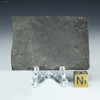
| Object | Kellwasser Late Devonian Mass Extinction Horizon specimen. A thin, flat plate of dark charcoal-gray anoxic black shale with a finely granular, lightly sparkling surface, crossed by pale gray hairline veinlets and faint mineral films, with olive and rust-brown iron staining along one edge of the reverse face. |
| Material | Anoxic black shale |
| Geologic Age | Late Devonian, Frasnian–Famennian Boundary, approximately 372 million years ago |
| Formation | Point Gratiot Bed, Hanover Shale, Java Formation (Upper Kellwasser Event) |
| Source Region | Glade Creek, Wyoming County, New York, USA |
| Preparation | Hand-trimmed, unpolished, untreated |
| Dimensions and Weight | 60 mm L x 42 mm W x 5 mm D, 24.7 grams |
| Photographic Notes | Photographed unsprayed. Shown with a display stand and brass scale cube, which are not included. |
| Science Gift Options | An excellent gift for paleontology and geology students, educators, and collectors of mass extinction and event-stratigraphy horizons |
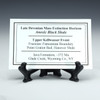
| What's Included | Specimen, Certificate of Authenticity (COA), information sheet, specimen tag, tag stand |
| Provenance and Authenticity | All of our material is proprietary and sourced from scientists and/or verified scientific estate collections, backed by the included Certificate of Authenticity. |
| Brand | Jensan Scientifics / Sciencemall-USA |
Images professionally photographed under controlled studio lighting using Zeiss optics and a pro-grade Canon camera, for guaranteed accuracy. The brass scale cube measures 1 cm per side.
Rarity and Significance
| Geologic Age | ★★★☆☆ |
| Scientific Importance | ★★★★★ |
| Availability to Collectors | ★★☆☆☆ |
| Research and Teaching Value | ★★★★★ |
| Display Presence | ★★☆☆☆ |
Questions Commonly Asked
What is the Upper Kellwasser Event?
It is the second and more severe of two pulses of marine extinction and ocean oxygen loss near the end of the Frasnian Age of the Late Devonian. The name comes from the Kellwasser valley in the Harz Mountains of Germany, where the two dark limestone and shale horizons were first recognized. Equivalent layers have since been traced on several continents, making the event one of the best-known global markers in the Devonian record.
How old is this specimen?
This Kellwasser Late Devonian Mass Extinction Horizon specimen is approximately 372 million years old and comes from the Frasnian–Famennian Boundary interval of the Late Devonian Period. The Boundary itself is defined by changes in the conodont fossil record, and the Upper Kellwasser horizon lies at or just below it.
What is the Point Gratiot Bed?
The Point Gratiot Bed is a thin black shale near the top of the Hanover Shale in the Java Formation of western New York. Stratigraphers regard it as the regional record of the Upper Kellwasser Event in the Appalachian Basin, which makes these New York exposures an important North American reference for the Frasnian–Famennian extinction.
Why is the shale black?
The dark color comes from organic carbon that was preserved because the seafloor had little or no oxygen when the mud was deposited. With few burrowing animals and little decay, organic matter and fine iron sulfide accumulated in the sediment. That is why black shales are used as direct evidence of the anoxic conditions linked to the extinction.
What do scientists think caused the Late Devonian Mass Extinction?
There is no single agreed cause. Leading explanations include widespread ocean anoxia, nutrient runoff from the rapid spread of land plants and early forests, abrupt climate and sea-level changes, and large-scale volcanism, with some researchers also weighing impact hypotheses. Most current work treats the crisis as the result of several linked stresses rather than one event.
What arrives with this specimen?
The specimen ships with a Certificate of Authenticity, specimen tag, tag stand, and information about the specimen. The tag records the Upper Kellwasser Event, the Frasnian–Famennian Boundary, and the bed, formation, age, and locality so you can display the piece with its full documentation.
This individually documented Kellwasser Late Devonian Mass Extinction Horizon specimen exemplifies one of the five great mass extinctions, captured at its most intense phase. It pairs a precise stratigraphic position with a clear account of how the Devonian oceans lost oxygen, collapsing reef ecosystems and causing much of marine life to disappear.


