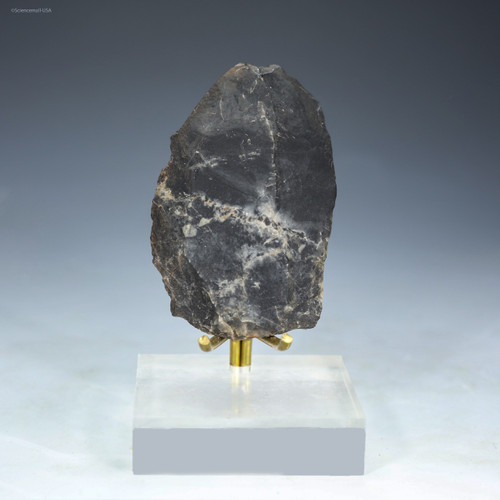
Barberton Kerogen-Bearing Black Chert South Africa
- SKU:
- JPT-898268
- Availability:
- Usually ships in 24 hours.
- Weight:
- 1.00 LBS
- Minimum Purchase:
- 1 unit
- Maximum Purchase:
- 1 unit
- Shipping:
- Calculated at Checkout

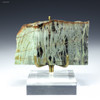


Kerogen-Bearing Barberton Black Chert - 82 g
Archean terranes that preserve evidence of Earth's earliest carbon-rich environments are very rare. This specimen is valuable because it connects collectors, educators, and researchers to one of the classic Archean terranes for studying Earth's earliest preserved carbon-rich environments.
Geologically, Barberton is famous for its geological diversity. Hall's 1918 survey put the belt on the geological map, and it continues to fascinate geologists. The Barberton Greenstone Belt preserves one of the oldest and least metamorphosed volcanic and sedimentary successions on Earth.
Appearance and Details
This Barberton black chert specimen has been professionally diamond-saw-trimmed to a smooth finish on the front side, exposing the internal structure. The principal face shows a pale celadon-to-sage-green silicified matrix cut by steeply inclined black carbonaceous streaks and lenses, some coarse and irregular, others drawn out into fine dark laminae. Green coloration of this kind in silicified Barberton lithologies is generally attributed to fine-grained chromian mica or chlorite rather than to the silica itself. Thin rust-colored hairline fractures cross the face, and a rind of orange to red-brown iron oxide staining follows the original weathered upper margin.
The natural, weathered back carries a heavier oxidation overprint, with tan, ochre, and pale gray zones surrounding angular dark fragments and irregular black patches. Together, the two faces show the same rock at different stages of surface weathering, which is useful for teaching how Archean chert responds to long exposure.
Product Information
| Object | Archean kerogen-bearing black chert, single hand specimen |
| Material | Carbonaceous black chert (microcrystalline silica with kerogen-like carbonaceous matter) |
| Geologic Age | Approximately 3.33 to 3.26 billion years ago, Paleoarchean |
| Formation | Mendon Formation, Onverwacht Group |
| Source Region | Barberton Greenstone Belt, Kaapvaal Craton, South Africa |
| Preparation | Professionally trimmed, smooth front |
| Dimensions and Weight | 70 mm L x 43 mm W x 15 mm D, 82 grams |
| Photographic Notes | Specimen lightly water-sprayed for photographic purposes to show natural color and internal detail. Not included: the acrylic display base and scale cube |
| Science Gift Options | Suitable for geologists, astrobiology and origin-of-life enthusiasts, earth science educators, university collections |
| What's Included | Certificate of Authenticity, specimen information sheet, scientific article on Barberton black chert, free rolled poster titled Earth's Oldest Rocks and Oldest Life, specimen tag, tag stand |
| Authenticity | Certificate of Authenticity issued by Jensan Scientifics / Sciencemall-USA |
| Brand | Sciencemall-USA |
| SKU | 898268 |
| Availability | ONLY 1 AVAILABLE |
Images professionally photographed under controlled studio lighting using Zeiss optics and a pro-grade Canon camera, for guaranteed accuracy. The brass scale cube measures 1 cm per side.
Rarity and Significance
| Geologic Age | ★★★★★ |
| Scientific Importance | ★★★★★ |
| Availability to Collectors | ★☆☆☆☆ |
| Research and Teaching Value | ★★★★★ |
Images professionally photographed under controlled studio lighting using Zeiss optics and a pro-grade Canon camera, for guaranteed accuracy. The brass scale cube measures 1 cm per side.
Questions Commonly Asked
How old is Barberton black chert?
This specimen dates to approximately 3.33 to 3.26 billion years, placing it in the Paleoarchean Era. The Barberton Greenstone Belt preserves one of the oldest and least metamorphosed volcanic and sedimentary successions on Earth, which is why it has been mapped and studied so intensively since the early 20th century.
Does this chert contain evidence of early life?
It contains carbonaceous matter widely described in the literature as kerogen-like, and Barberton black cherts are known for their isotopically light, 13C-depleted carbon. Many researchers interpret that carbon as having a biological contribution, while others suggest abiogenic hydrothermal pathways that can produce similar signatures.
What is the Mendon Formation and where does it sit in the Onverwacht Group?
The Mendon Formation lies near the upper part of the Onverwacht Group, directly below the overlying Fig Tree Group, in the Barberton stratigraphy established by Lowe and Byerly. It includes important black and banded chert intervals that cap komatiitic and basaltic volcanic units, and these chert horizons are the most commonly sampled for early-Earth carbon studies.
Why is Barberton chert important to origin-of-life research?
Silica-rich chert seals and preserves organic carbon far better than most rock types, and the Barberton succession escaped the high-grade metamorphism that destroyed comparable records elsewhere. That combination makes these rocks one of the few places where Archean seawater chemistry, volcanic activity, low-temperature hydrothermal circulation, and possible microbial carbon can be examined together in the same sample set.
Why is it green if it is called black chert?
The name refers to the dark carbonaceous component, not to the color of the whole rock. In this specimen, the carbon is concentrated in the black streaks and lenses that run through the cut face, while the surrounding silicified matrix is pale green. Green tones of this kind in silicified Barberton units are generally attributed to fine-grained chromian mica or chlorite, minerals associated with the alteration of ultramafic and mafic volcanic material that the silica replaced.
What is included with this specimen?
The specimen ships with a Certificate of Authenticity, specimen information, a scientific article on Barberton black chert, a free rolled poster titled Earth's Oldest Rocks and Oldest Life, a specimen tag, and a tag stand. The acrylic display base and photographic scale cube seen in the images are not included.
Rock this old that still contains kerogen-like carbon is very rare. Archean crust makes up only about three percent of Earth's exposed surface, and most of it was metamorphosed past the point where carbonaceous matter endures. Barberton is one of the few places where it was not. This specimen is colorful and visually dynamic on both faces, with sage green silicified matrix, steeply inclined black carbonaceous streaks, and rust-red oxide along the weathered margin. This is a great display specimen for diverse geological collections.