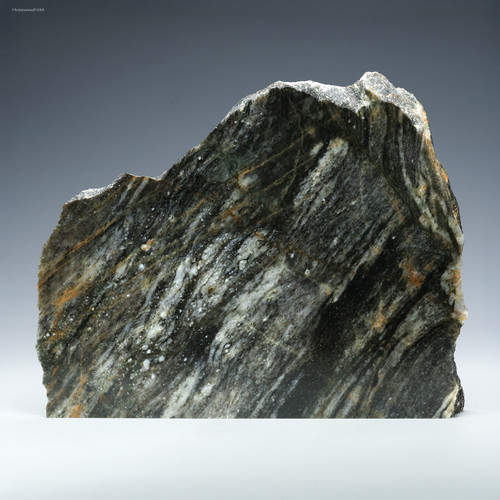
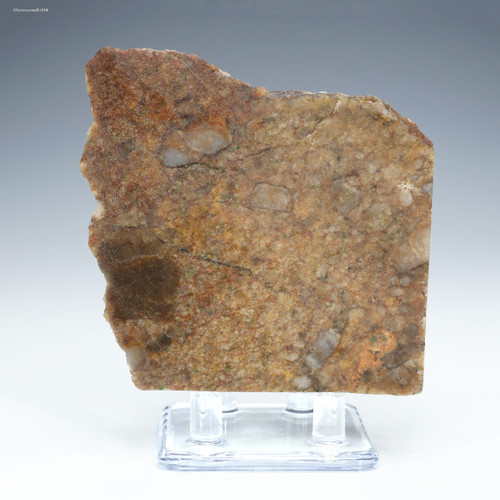
Idiwhaa Acasta Gneiss Oldest Rocks [205 g ~ 4.02 Ga]
Brand : Sciencemall-USA
- SKU:
- JPT-84123
- Condition:
- New
- Availability:
- Usually ships in 24 hours.
- Weight:
- 1.00 LBS
- Minimum Purchase:
- 1 unit
- Maximum Purchase:
- 1 unit
- Shipping:
- Calculated at Checkout


Idiwhaa Acasta Gneiss — 205 g Hand Specimen
This is a nice-sized hand specimen of the Idiwhaa tonalitic gneiss, the oldest mapped rock unit within the Acasta Gneiss Complex of the Slave Craton, Northwest Territories, Canada. Collected in the Acasta River area roughly 300 km north of Yellowknife, the Idiwhaa unit carries a U–Pb zircon igneous crystallization age of approximately 4.02 billion years. It is among the oldest intact, well-characterized rocks on the planet — not a mineral grain recovered from a younger host, but an actual piece of Earth's earliest surviving continental crust.
The scientific weight of this locality is difficult to overstate. In 2023 the International Commission on Stratigraphy ratified the boundary between the Hadean Eon and the Archean Eon at 4031 ± 3 million years, defined by the ten oldest U–Pb zircon ages measured from the Acasta Gneiss Complex along the Acasta River at 65°10′26″N, 115°33′14″W. This outcrop is the global reference point for the base of the Archean. A specimen from this complex is material from the locality that anchors the opening division of the geologic time scale itself.
Product Information
| Specimen | Idiwhaa tonalitic gneiss |
| Geologic Unit | Idiwhaa unit, Acasta Gneiss Complex |
| Age | ca. 4.02 Ga, U–Pb zircon igneous crystallization age |
| Eon and Era | Earliest Eoarchean, Archean Eon |
| Locality | Acasta River area, Slave Craton, Northwest Territories, Canada |
| Mineralogy | Plagioclase, quartz, hornblende, and biotite with minor garnet; thin cross-cutting felsic veins |
| Dimensions | 83 mm L × 64 mm W × 30 mm D |
| Weight | 205 grams |
| Preparation | Front face professionally lapped and diamond-polished, flat and smooth; reverse and sides left natural; all-natural, no repairs |
| Collection | Professionally and legally collected |
| SKU | JPT-17899 |
| Availability | ONLY 1 AVAILABLE this size |
| What's Included | Certificate of Authenticity (COA), specimen tag, tag stand, and reference information on the Idiwhaa Acasta Gneiss |
Images professionally photographed under controlled studio lighting using Zeiss optics and a pro-grade Canon camera for guaranteed accuracy.
The brass scale cube measures 1 cm per side. The polished face was lightly sprayed for photographic clarity. The photo cube and display stand are not included.
A Rock That Predates Almost Everything
Rocks older than 3.6 billion years account for only a few parts per million of Earth's exposed crust. Plate tectonics, erosion, and repeated metamorphism have essentially consumed the entire early record. What survives at Acasta survived by accident of geography — a fragment of ancient crust caught in the northwestern edge of the Slave Craton and carried through more than four billion years of Earth history largely intact.
The Idiwhaa unit was identified and named by Jesse Reimink and colleagues in 2014 following detailed field mapping and U–Pb dating. Its zircons are unusually well preserved, which is precisely why the unit became the benchmark against which the rest of the complex is measured.
What the Chemistry Reveals
The Idiwhaa tonalitic gneiss does not behave like typical Archean continental crust. It is silica-moderate at roughly 58–62 wt% SiO₂, strongly iron-enriched at roughly 12–15 wt% FeO, and carries low magnesium numbers with a flat rare-earth pattern and a pronounced negative europium anomaly. Those signatures point to shallow differentiation of an iron-rich tholeiitic parent magma rather than to a modern-style subduction zone. Reimink and colleagues proposed an Iceland-like setting as the closest present-day analog for how this crust was generated.
The zircons carry a further result that reaches beyond geology. Oxygen isotope ratios recorded across two growth phases indicate that the Idiwhaa magma assimilated older rocks that had already been altered by high-temperature surface water. At 4.02 billion years ago, liquid water was interacting with Earth's crust. This specimen belongs to the small population of rocks that carry direct chemical evidence bearing on the habitability of the earliest Earth.
The banded, foliated texture visible on the polished face postdates the original magma. The complex was reworked repeatedly, with peak metamorphic conditions in the garnet-bearing gneisses modeled at roughly 725–780 °C and 4.5–6.2 kbar. What you are looking at is an igneous rock that was buried, heated, deformed, and recrystallized, then returned to the surface with its zircon clock still readable.
Rarity and Significance
| Rarity | ★★★★★ Restricted, remote Arctic locality with no commercial production |
| Scientific Significance | ★★★★★ Type complex for the ratified base of the Archean Eon |
| Age Rank | ★★★★★ Among the oldest intact rock known on Earth |
| Size for Type | ★★★★½ 205 g is a generous hand specimen; most offered material is far smaller |
| Display Quality | ★★★★☆ Large lapped face showing clear gneissic banding |
| Educational Value | ★★★★★ Anchors any deep-time teaching collection at its oldest end |
Questions Commonly Asked
Is this the oldest rock on Earth?
It is among the oldest, and it is the oldest for which the age is undisputed. The Acasta Gneiss Complex holds the oldest well-dated intact felsic crust known, with U–Pb zircon ages reaching about 4.03 Ga, and the international time scale uses those ages to define the base of the Archean. One other candidate is older: the Ujaraaluk unit of the Nuvvuagittuq Greenstone Belt in northern Québec has been assigned an age near 4.28 Ga on samarium–neodymium systematics, with a 2025 study of a cross-cutting intrusion supporting a minimum age above 4.16 Ga. That interpretation remains actively debated. Acasta remains the reference standard.
How does this differ from a Jack Hills zircon specimen?
The Jack Hills zircons of Western Australia date to about 4.4 Ga and are the oldest known terrestrial material of any kind, but they are individual zircon mineral grains eroded from a lost source rock and later deposited in a much younger sedimentary host. Idiwhaa Acasta Gneiss is the opposite case: the entire rock is roughly 4.02 billion years old. Collectors who want the full picture of earliest Earth generally acquire both, since one represents the oldest mineral and the other the oldest rock.
If it is a gneiss, what does the 4.02 Ga age actually date?
It dates the crystallization of the original tonalite magma, recorded in igneous zircon. The gneissic banding came later, produced by burial, heating, and deformation over subsequent hundreds of millions of years. Zircon is exceptionally durable and retains its uranium–lead clock through metamorphism, which is why the primary igneous age survives.
Why does the name Idiwhaa matter?
Idiwhaa is the unit name introduced in 2014 for the specific mappable body within the Acasta Gneiss Complex that yields the 4.02 Ga ages. Material sold simply as "Acasta Gneiss" may come from anywhere in a complex spanning more than a billion years of magmatism, with units as young as 2.94 Ga. Naming the Idiwhaa unit is what ties a specimen to the oldest end of that range. The word itself means "ancient."
Does this rock say anything about early life?
Not directly — it preserves no biological material. What it preserves is an oxygen-isotope signature indicating that the parent magma incorporated rocks previously altered by hot surface water. That places liquid water at the surface of a 4.02-billion-year-old Earth, the environmental precondition that every model of the origin of life depends on. It is a habitability record rather than a fossil record.
Why is only the front face polished?
Lapping and diamond-polishing one face opens a clean window into the internal banding and mineral relationships while leaving the natural exterior intact on the reverse and sides. Collectors of ancient crustal material generally prefer this treatment: the prepared face reads as a study surface, and the untouched surfaces preserve the specimen as it came out of the ground.
Earth has kept almost nothing from its first half-billion years. This 205-gram specimen of Idiwhaa Acasta gneiss is one of the few rocks surviving the opening chapters in Earth's geological history still available to private collections, from the single locality the world's geologists chose to mark as the beginning of the Archean.
Jensan Scientifics / Sciencemall-USA. Age, unit designation, and geochemical characterization attributed to Reimink et al. (2014, 2016); Hadean–Archean boundary as ratified by the International Commission on Stratigraphy (2023); metamorphic conditions after Kaempf et al. (2024).