
Idiwhaa Acasta Gneiss NWT Canada [1266 g ~ 4.02 Ga]
Brand : Sciencemall-USA
- SKU:
- JPT-90551
- Condition:
- New
- Availability:
- Usually ships in 24 hours.
- Weight:
- 5.00 LBS
- Minimum Purchase:
- 1 unit
- Maximum Purchase:
- 1 unit
- Shipping:
- Calculated at Checkout


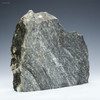

Idiwhaa Tonalitic Acasta Gneiss -1266 g
Buy a large Idiwhaa tonalitic Acasta Gneiss specimen from the Acasta Gneiss Complex in Canada's Northwest Territories, home to the oldest known intact rocks on Earth, ~4.02 billion years old. At 1266 grams, with flowing light and dark bands across its polished face that resemble the Milky Way, it is a museum-grade display piece of Earth's earliest crust.
About This Idiwhaa Acasta Gneiss
Almost nothing survives from Earth's first half-billion years. Erosion, plate tectonics, and repeated heating and melting have recycled nearly all of it. The Acasta Gneiss Complex, along the Acasta River about 300 km north of Yellowknife, is one of the few places where a piece of that early crust survived.
In 2023, the International Commission on Stratigraphy chose an outcrop on the Acasta River as the global reference point for the Hadean–Archean Boundary, the official start of the Archean Eon at 4.031 billion years ago. The Idiwhaa unit is one of the best-studied rocks in the complex.
What makes this specimen stand out:
- Age: ~4.02 billion years, roughly 90% of Earth's age
- Size: a large 1266-gram specimen, far bigger than typical Acasta hand specimens
- Colors: top-tier, all-natural contrasting bands that flow like the Milky Way across the polished face
What is the age of the Idiwhaa Acasta Gneiss?
The Idiwhaa Acasta Gneiss is about 11 million years after the Boundary. Even at the edge of the uncertainty (4.028 Ga), the age stays on the Archean side.
Older sources call it Hadean because, before 2023, the Hadean–Archean Boundary was commonly placed at ~4.0 Ga. Under that convention, 4.02 Ga was Hadean, which is why so much older literature and many dealer listings still describe Acasta that way.
The ratified Boundary is defined by the oldest zircon ages at Acasta itself, so the complex sits right on the line. The very oldest components date to the Boundary age, and a few inherited zircon cores are older still and truly Hadean. The Idiwhaa unit at ~4.02 Ga is earliest Eoarchean.
Product Information
| Object | Idiwhaa tonalitic Acasta Gneiss specimen |
| Material | Tonalitic gneiss, Idiwhaa unit |
| Geologic Age | Eoarchean, ~4.02 Ga |
| Source Region | Acasta Gneiss Complex, Slave Craton, Northwest Territories, Canada |
| Preparation | Natural form with one diamond flat-lapped face polished smooth, lightly sprayed to bring out its natural colors |
| Dimensions and Weight | 177 mm L x 140 mm W x 40 mm D, 1266 grams |
| Science Gift Options | A centerpiece gift for serious collectors of Earth's oldest rocks, museums, and educators, with a free science poster |
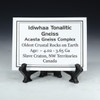
| What's Included | Specimen, Certificate of Authenticity (COA), Acasta Gneiss information sheet, specimen tag, tag stand, free science poster. The brass scale cube is not included. |
| Provenance and Authenticity | All of our material is proprietary and sourced from scientists and/or verified scientific estate collections, backed by the included Certificate of Authenticity. |
| Legality | Professionally and legally collected |
| Brand | Jensan Scientifics / Sciencemall-USA |
| SKU | JPT-90551 |
| Availability | ONLY 1 AVAILABLE this large |
Images professionally photographed under controlled studio lighting using Zeiss optics and a pro-grade Canon camera, for guaranteed accuracy. The brass scale cube measures 1 cm per side.
Rarity and Significance
| Geologic Age | ★★★★★ |
| Scientific Importance | ★★★★★ |
| Availability to Collectors | ★★☆☆☆ |
| Research and Teaching Value | ★★★★★ |
| Display Presence | ★★★★★ |
Questions Commonly Asked About Acasta Gneiss
How old is this specimen?
This Idiwhaa tonalitic Acasta Gneiss specimen is ~4.02 billion years old. Earth itself is about 4.54 billion years old, so this rock formed when the planet was only about 500 million years old.
Scientists date it using tiny zircon crystals inside the rock. Uranium in these crystals slowly decays to lead at a known rate, which works like a natural clock.
Why is the Acasta Gneiss so important to scientists?
It contains the oldest known intact rocks on Earth. In 2023, the International Commission on Stratigraphy used the Acasta River locality to define the Hadean–Archean Boundary, the official start of the Archean Eon at 4.031 billion years ago. That makes Acasta the reference point for one of Earth's most important divisions.
What does "Idiwhaa" mean?
Idiwhaa means "ancient" in the Tłįchǫ language of the region's Indigenous people. Geologists named this unit of the Acasta Gneiss Complex in 2014.
What is a tonalitic gneiss?
Tonalite is a granite-like rock that formed from cooling magma. Over billions of years, deep heat and pressure squeezed and recrystallized it into gneiss, which separated its light and dark minerals into the flowing bands you see on the polished face.
Research suggests the Idiwhaa rocks formed from iron-rich magmas in a setting somewhat like modern Iceland, rather than at a subduction zone like most later continental crust.
Are the Jack Hills zircons older than this rock?
Yes, but they record something different. Jack Hills zircons in Western Australia reach about 4.4 billion years, but they are single sand-sized crystals that eroded from older rocks and ended up in much younger sedimentary rock. The Acasta Gneiss is the oldest known whole rock, not just the oldest crystal.
Are the colors natural?
Yes. The colors and banding are entirely natural. One face was diamond flat-lapped and polished smooth, then lightly sprayed to bring out the colors that are already in the rock.
A museum-grade piece of Earth's oldest rock.
This one-of-a-kind Idiwhaa tonalitic Acasta Gneiss specimen came from the locality that marks the start of the Archean Eon. Weighing 1266 grams and featuring Milky Way–like banding across its polished face, it is a rare chance to own a large, display-quality piece of crust that has survived for ~4.02 billion years.


