
Jack Hills Oldest Zircon Rock Australia [144 g ~ 4.4 Ga]
Brand : Jensan Scientifics LLC
- SKU:
- JPT-57925
- Condition:
- New
- Availability:
- Usually ships in 24 hours.
- Weight:
- 1.00 LBS
- Minimum Purchase:
- 1 unit
- Maximum Purchase:
- 1 unit
- Shipping:
- Calculated at Checkout


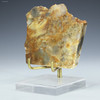


Jack Hills Zircon Metaconglomerate, 144 g
Jack Hills zircons rewrote the opening chapter of Earth's history. Detrital zircon grains recovered from the fuchsitic quartz-pebble metaconglomerate of the Jack Hills belt include the oldest terrestrial minerals ever dated, with ages reaching approximately 4.4 billion years old. This 144-gram specimen, professionally diamond-saw trimmed smooth on both sides, came from Erawondoo Hill, the specific ridge in the Jack Hills where those record-setting grains were found.
What are Jack Hills Metaconglomerates?
The Jack Hills metaconglomerates are metamorphosed sedimentary rock: a quartz-pebble conglomerate deposited from the erosional debris of far older terrain, then buried, deformed, and recrystallized. The green tint that runs through much of it comes from fuchsite, the chromium-bearing variety of muscovite mica, which is why the unit is routinely described in the literature as a fuchsitic quartz-pebble metaconglomerate.
The zircons the site is famous for are detrital. They did not crystallize in this rock. They formed in the earliest phases of Hadean igneous rocks that no longer exist. They have outlasted those parent rocks because zircon is exceptionally durable, traveled as sand grains, and came to rest here among the quartz pebbles. The conglomerate is the vault, not the origin. That distinction is the whole reason this locality is famous. Rock surviving from the Hadean is vanishingly scarce. The Nuvvuagittuq Greenstone Belt is home to the leading candidates. Hadean minerals are a different case: their record is not in dispute, and this is why these rocks and their zircon minerals continue to be famous.
The Discovery Record
Compston and Pidgeon reported detrital zircons older than 4.1 billion years from the Jack Hills in Nature in 1986, establishing the locality as the source of the oldest known terrestrial material. In 2001, Wilde, Valley, Peck, and Graham published an age of approximately 4.4 billion years for a single Jack Hills grain in Nature, along with oxygen isotope evidence they interpreted as indicating interaction with liquid water at low temperature, an argument for a cool early Earth with surface water far sooner than had been assumed.
In 2014, Valley and colleagues applied atom-probe tomography to a Jack Hills grain in Nature Geoscience, mapping the distribution of lead atoms inside the crystal lattice to confirm that its 4.374-billion-year age was not an artifact of radiogenic lead mobility. That paper is generally cited as closing the principal remaining objection to the Hadean ages.
Macro Image Analysis
The following observations describe the macro photograph of this exact 144-gram Jack Hills rock specimen.
Primary Matrix (Quartz Groundmass)
- The dominant background consists of vitreous, semi-translucent to yellowish-green quartz.
- Microscopic fractures and internal reflections throw crisp, tiny specular highlights across the grain boundaries.
Fuchsitic / Mica Patches
- Noticeable greenish cast and subtle micaceous sheen distributed throughout the matrix, characteristic of the fuchsitic quartz-pebble metaconglomerate hosted in the Jack Hills belt.
Inclusions and Accessories
- Opaques and Heavy Minerals: Dark, near-black to iron-stained detrital grains, likely iron oxides, chromite, or dark heavy mineral concentrates, stand out sharply against the lighter quartz matrix.
- Detrital Zircon Context: Small, highly vitreous, translucent micro-grains sit trapped within the matrix crevices, the mineralogical setting in which the ancient detrital zircons (~4.4 Ga) reported from this belt are hosted.
These are optical descriptions made from macro photography.
Product Information
| Object Type | Fuchsitic quartz-pebble metaconglomerate, host lithology of the Jack Hills detrital zircon locality |
| Locality | Erawondoo Hill, Jack Hills, Narryer Gneiss Terrane, Yilgarn Craton, Western Australia |
| Age of Detrital Zircons | Grains from this unit have been dated to approximately 4.4 billion years (Hadean Eon); ages apply to the metaconglomerates from this locality |
| Rock Type | Metasedimentary; metamorphosed quartz-pebble conglomerate with chromian muscovite (fuchsite) and detrital zircons |
| Dimensions | 95 mm L x 78 mm W x 12 mm D |
| Weight | 144 grams |
| Preparation | Professionally diamond-saw trimmed, smooth on both sides. No repairs. Stable specimen. |
| Specimen Description | Vitreous to semi-translucent quartz matrix with a yellowish-green cast, disseminated fuchsitic mica sheen, dark opaque detrital grains |
| Scientific Significance | Host rock of the oldest dated terrestrial minerals known; the primary physical archive of the Hadean Eon |
| Collection | Professionally and legally collected |
| Provenance | From a proprietary scientific estate collection; see the full provenance statement below. Certificate of Authenticity included. |
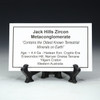
| What Is Included | The specimen, a Certificate of Authenticity, a printed identification tag with tag stand, and an information sheet on Jack Hills zircons. Photo cube and riser are not included. Free "Earth's Oldest Rocks and Oldest Life" poster included. |
| Photography Note | This specimen was lightly sprayed for photographic purposes to reveal matrix detail |
| Use and Display | Collection display, university and museum teaching, geochronology and early-Earth instruction |
| Shipping | Free Priority shipping within the United States; international shipping calculated at checkout |
| Item ID | JPT-875238 - 144 grams |
Images professionally photographed under controlled studio lighting using Zeiss optics and a pro-grade Canon camera.
Rarity and Significance
| Scientific Significance | ★★★★★Host lithology of the oldest dated minerals on Earth |
| Locality Specificity | ★★★★★Secure to Erawondoo Hill, the ridge that produced the record-age grains |
| Market Availability | ★☆☆☆☆Seldom offered; a remote locality, and pieces of this size rarely reach the private market |
| Historical Importance | ★★★★★Forty years of Hadean geochronology trace back to this unit |
| Display Appeal | ★★★★☆Diamond saw trimmed faces finished smooth, strong green fuchsitic color, and visible matrix detail |
Very few localities on Earth carry this weight. The Isua supracrustals in Greenland, the Nuvvuagittuq belt in Quebec, and the Acasta Gneiss in the Northwest Territories all preserve crust far older than most of the planet's surface, and Nuvvuagittuq in particular has been argued to be Hadean in its own right. What sets Jack Hills apart is narrower and firmer: it has yielded directly dated minerals older than any grain reported from other localities.
Questions Commonly Asked
How can a mineral be older than the rock it sits in?
Zircon is extraordinarily tough, both chemically and mechanically, and it locks uranium into its structure while excluding lead. When its original igneous parent rock was weathered away, the zircon grains survived as sand, were transported, and were redeposited in a younger sediment. That sediment later became this metaconglomerate. The grains therefore carry a crystallization age far older than the deposition age of the rock enclosing them, and the uranium-lead clock inside each grain still reads from the moment it crystallized.
Why is some of the rock green?
The color comes from fuchsite, the chromium-bearing variety of muscovite mica. Chromium substituting into the mica structure produces the green tint, and the unit is described in the geological literature as a fuchsitic quartz-pebble metaconglomerate for exactly this reason. The chromium points to an ultramafic component somewhere in the sediment's source terrain.
What did these zircons tell scientists about the early Earth?
Perhaps the Earth had cooled enough to support surface water within roughly 150 million years of its formation, which is far earlier than the older picture of a prolonged global magma ocean. The interpretation continues to be debated in the literature, but it reshaped how the Hadean is taught.
Is the Jack Hills conglomerate the oldest rock on Earth?
No. The metaconglomerate is far younger than the grains it carries. Older intact rocks exist elsewhere: the Acasta Gneiss in Canada at roughly 4.03 billion years, the Isua supracrustals in Greenland at roughly 3.8 billion years, and the Nuvvuagittuq Greenstone Belt in northern Quebec, older than the Acasta Gneiss. Jack Hills holds a unique record: the oldest directly dated terrestrial mineral.
Almost nothing survives from the first five hundred million years of Earth's existence. The crust of the Hadean Eon was recycled into the mantle so completely that what remains of it is exceedingly scarce. Jack Hills zircons are our best evidence for material from the early Earth.


