
Sudbury Impact Triple Shatter Cones - 8.9 lb Large
Brand : Sciencemall-USA
- SKU:
- JPT-80993
- Condition:
- New
- Availability:
- Usually ships in 24 hours.
- Weight:
- 11.00 LBS
- Minimum Purchase:
- 1 unit
- Maximum Purchase:
- 1 unit
- Shipping:
- Calculated at Checkout

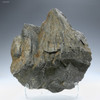


Sudbury Impact Compound Triple Shatter Cones
This is an 8.9 lb museum-grade shatter cone(s) from the Sudbury Impact Structure, Ontario, Canada — a Paleoproterozoic impact basin dated to approximately 1.85 billion years ago. It is among the largest and oldest confirmed impact structures on Earth. Three prominent shatter cones are clearly visible.
The shatter cone faces carry crisp, well-developed horsetail striations radiating from the apex. The horsetail patterns on this shatter cone are clearly exceptional.
Shatter cones form when an impact shock wave—on the order of a few to roughly 30 gigapascals—fractures rock into nested, conical surfaces. At Sudbury, they are developed across the footwall rocks surrounding the basin. Specimens of this size, with striations this legible, are uncommon on the collector market.
Characteristics of this Triple Sudbury Shatter Cone
Why calling this a compound shatter cone with three prominent cone forms is justified.
Three separate cone-like fracture domains are plainly seen:
- Right / Highest cone — the most obvious one, rising to the highest apex with strong longitudinal/horsetail striations.
- Central / Middle cone — a smaller but distinct triangular cone surface with its own apex and radiating grooves.
- Left-hand cone — broader and less sharply bounded, but the fracture lines appear to converge toward a separate apex rather than simply continuing the central cone.
What makes this three cones is that the striation systems do not all appear to radiate from one common point. They converge in 3-different directions, as you would expect in a compound or nested shatter-cone specimen.
Product Information
| Specimen | Museum-grade compound shatter cone |
| Structure | Sudbury Impact Structure |
| Locality | Sudbury, Ontario, Canada |
| Age | Approximately 1.85 billion years (Paleoproterozoic) |
| Size | 230 mm H × 220 mm W × 83 mm D |
| Weight | 8.9 lb (4,059 grams) |
| SKU | JPT-80993 |
| What's Included | Certificate of Authenticity (COA), specimen information on the Sudbury Impact Structure, specimen tag, and tag stand. Display stand and scale cube not included. |
Images professionally photographed under controlled studio lighting using Zeiss optics and a pro-grade Canon camera, for guaranteed accuracy. The brass scale cube measures 1 cm per side.
Rarity and Significance
| Rarity | ★★★★½ |
| Scientific Significance | ★★★★★ |
| Display Quality | ★★★★★ |
| Size Class | ★★★★★ |
Questions Commonly Asked
What exactly is a shatter cone?
A conical fracture surface produced when an impact shock wave passes through rock. The striations diverge from the apex in a branching "horsetail" pattern. Shatter cones are the only shock feature diagnostic of impact that is visible to the naked eye in the field.
How large was the Sudbury impact?
Estimates for the original transient crater generally fall in the 200–260 km range, placing Sudbury alongside Vredefort and Chicxulub as one of the three largest confirmed impact structures on Earth. Later tectonic deformation compressed the basin into its present elliptical shape.
Can shatter cones form any other way?
Only by shock loading. Aside from natural impacts, they have been produced beneath underground nuclear test explosions. No ordinary geological process — faulting, weathering, volcanism — creates them.
How is the specimen prepared?
The cone surfaces are natural and unaltered. Nothing has been polished, coated, or reconstructed — what you see is the fractured rock as the shock wave left it.
ONLY 1 AVAILABLE — this is a single specimen, the only compound triple shatter cone we have ever seen.


![Sudbury shatter cone [15879] shown front on a plexiglass display stand with gold prongs, and photographed on a graduated white to black background.](https://cdn11.bigcommerce.com/s-ijipkdz2cc/images/stencil/500x659/products/293/3332/Sudbury-shatter-cone-15879-for-sale-main__71143.1738627950.jpg?c=1 "Sudbury shatter cone [15879] shown front on a plexiglass display stand with gold prongs, and photographed on a graduated white to black background.")
