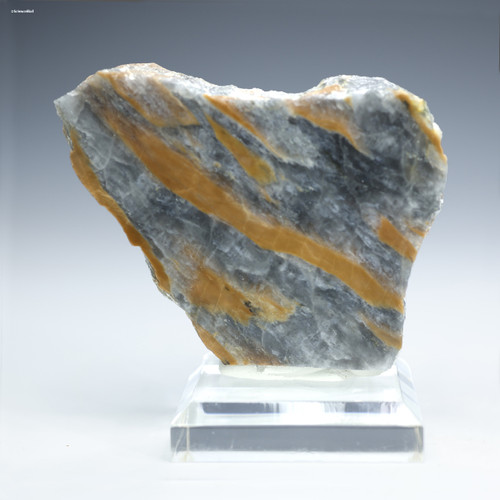
Jack Hills Oldest Zircon Rock Australia [110 g ~ 4.4 Ga]
Brand : Jensan Scientifics LLC
- SKU:
- JPT-892745
- Availability:
- Usually ships in 24 hours.
- Weight:
- 1.00 LBS
- Minimum Purchase:
- 1 unit
- Maximum Purchase:
- 1 unit
- Shipping:
- Calculated at Checkout


Jack Hills Zircon Rock, Erawondoo Hill, 110 g
This zircon-bearing metaconglomerate specimen comes from Erawondoo Hill in the Jack Hills of Western Australia, the ridge that produced the oldest dated minerals on Earth, at about 4.4 billion years old. It is professionally diamond-saw trimmed smooth on both sides, revealing the dynamic features of this ancient metaconglomerate rock.
About This Jack Hills Zircon Rock
The Jack Hills rock is a metaconglomerate: ancient sand and pebbles that were buried, squeezed, and recrystallized. Locked inside it are tiny grains of zircon that are far older than the rock itself. They formed in Hadean crust that has since vanished.
Why this rock matters:
- It hosts the oldest dated pieces of Earth, zircons up to about 4.4 billion years old.
- Those zircons suggest that continental-type crust and liquid water may have existed within about 150 million years of Earth's formation.
Product Information
| Object | Jack Hills zircon-bearing metaconglomerate specimen |
| Locality | Erawondoo Hill, Jack Hills, Narryer Gneiss Terrane, Yilgarn Craton, Western Australia |
| Age | Detrital zircons up to about 4.4 billion years old (ages apply to the zircon suite of the belt, not a measurement of this specimen); host rock deposited roughly 3 billion years ago |
| Dimensions and Weight | 89 mm L x 80 mm H x 8 mm D, 110 grams |
| Science Gift Options | A memorable gift for geologists, earth science teachers, students, and anyone fascinated by the origins of our planet |
| What's Included | Certificate of Authenticity (COA), information about the specimen, specimen tag, tag stand, free poster "Earth's Oldest Rock and Oldest Life" (the brass and acrylic display stand shown is not included) |
| Provenance and Authenticity | All of our material is proprietary and sourced from scientists and/or verified scientific estate collections, backed by the included Certificate of Authenticity. Legally collected |
| Specimen ID | 892745 |
Images professionally photographed under controlled studio lighting using Zeiss optics and a pro-grade Canon camera, for guaranteed accuracy.
Rarity and Significance
| Scientific Significance | ★★★★★ |
| Locality Uniqueness | ★★★★★ |
| Rarity | ★★★★★ |
| Market Availability | ☆☆☆☆☆ |
| Historical Importance | ★★★★★ |
| Display Appeal | ★★★★☆ |
Questions Commonly Asked About Jack Hills Zircon Rock
How can a mineral be older than the rock it sits in?
The zircons formed first, in Hadean rocks that later eroded away. Zircon is so tough that the grains survived as sand. Ancient rivers carried that sand into a fan delta, where it became part of this rock more than a billion years later. Think of the rock as the vault and the zircons as the treasure inside.
How old are the Jack Hills zircons?
The oldest grain found at Erawondoo Hill was dated to about 4.4 billion years, only about 150 million years after Earth formed. Its age was later confirmed by atom-scale analysis. These ages come from grains studied by scientists across the belt.
Can I see the zircons in this specimen?
Not with the naked eye. The zircons are usually smaller than a grain of fine sand and are scattered throughout the rock. What you can see is the setting they came from: quartz pebbles, sand-sized grains, and mica-rich streaks of the original sediment that contains tiny zircons.
Is this the oldest rock on Earth?
No. The rock itself is about 3 billion years old. Jack Hills holds a different record: the oldest dated mineral from Earth. The oldest widely accepted rock is the Acasta Gneiss in Canada, about 4.0 billion years old. Parts of the Nuvvuagittuq belt in Quebec may be older, at about 4.3 billion years, but that age is still debated.
What did these zircons tell scientists about the early Earth?
The Hadean Eon was long pictured as a world of molten rock. The chemistry of the Jack Hills zircons suggests otherwise. Their oxygen isotopes point to rocks that had interacted with liquid water. This suggests that the young Earth cooled quickly and may have had oceans and early crust far sooner than scientists once thought.
Hold a piece of the rock that contains Earth's oldest dated minerals. This Erawondoo Hill metaconglomerate specimen shows its quartz pebbles, mica-rich streaks, and iron-stained grains across smooth diamond saw-trimmed faces. With a generous 89 mm face and a natural rough top edge, it is a striking centerpiece for any collection.