
Beaverhead Shatter Cone - Montana 10.1 lb (4,588 g)
Brand : Sciencemall-USA
- SKU:
- JPT-82847
- Condition:
- New
- Availability:
- Usually ships in 24 hours.
- Weight:
- 13.00 LBS
- Minimum Purchase:
- 1 unit
- Maximum Purchase:
- 1 unit
- Shipping:
- Calculated at Checkout

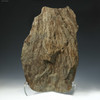

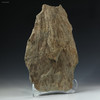

Shatter cone from the second-largest impact structure in the United States
This large Beaverhead shatter cone weighs 10.1 lb (4,588 g) and was legally collected in southwestern Montana in 2001. The specimen has well-defined striated horsetails. Shatter cones were the evidence that established Beaverhead as an impact site.
Discovering Beaverhead
Hargraves, Cullicott, Deffeyes, Hougen, Christiansen, and Fiske reported them in Geology in 1990, describing steeply upward-pointing cones across more than 100 square kilometers of Proterozoic sandstone outcrop. Beaverhead has no bowl, no rim, and no crater lake. Only these cones remain, in a block of shocked rock that plate tectonics carried tens of kilometers from where the impact occurred.
Product Information
| Specimen | Beaverhead impact shatter cone |
| Locality | Beaverhead Mountains, Beaverhead County, Montana, USA |
| Impact Structure | Beaverhead impact structure, Montana-Idaho border |
| Host Rock | Feldspathic quartzite (feldspathic arenite) |
| Age of Impact | Precambrian; not tightly constrained. |
| Structure Diameter | Approximately 60 km (37 mi) per the Earth Impact Database; reconstructions to 75-100 km have been published |
| Shock Evidence | Shatter cones, pseudotachylite, and planar deformation features in quartz are the shock evidence for the Beaverhead impact site |
| Dimensions | 270 mm H x 177 mm W x 92 mm D |
| Weight | 10.1 lb (4,588 g) |
| Collected | 2001, legally collected on our own expedition |
| Specimen ID | 87883 |
| SKU | JPT-82847 |
| What's Included | The specimen, a Certificate of Authenticity, an information sheet on Beaverhead, our new Impact Poster (see Free Gifts), a tag, and a tag stand. The specimen stand and photo cube are not included. |
Images were professionally photographed under controlled studio lighting using Zeiss optics and a pro-grade Canon camera to ensure accuracy.
Rarity and Significance
| Rarity | ★★★☆☆ |
| Scientific Significance | ★★★★★ |
| Size for Type | ★★★★★(exceptional) |
| Display Presence | ★★★★★(excellent) |
| Educational Value | ★★★★★ |
Further Detail
How does Beaverhead rank in size and age for world impacts?
The Earth Impact Database lists Beaverhead at approximately 60 km (37 mi) in diameter, making it the second-largest confirmed impact structure in the United States after the 85 km Chesapeake Bay structure in Virginia, and placing it among the ten largest confirmed impact structures on Earth. Larger reconstructions exist: Hargraves, Kellogg, Fiske, and Hougen (1992) argued that the surviving shocked rock represents a piece of the central uplift of a complex crater at least 75 km across, and Fiske and Hargraves (1994) and Carr and Link (1999) both favored a figure near 100 km. All of these estimates are inferred from the distribution of shock features rather than measured from a crater rim, because no rim survives.
Beaverhead has no satisfactorily measured impact age, and the two published constraints pull in opposite directions. Kellogg, Snee and Unruh (2003, Journal of Geology) reported ⁴⁰Ar/³⁹Ar dates clustering between 899 and 908 Ma on micas from a breccia zone, interpreted as recrystallized impact glass and therefore treated as a minimum age — implying the impact is at least that old. Carr and Link (1999), working on Neoproterozoic conglomerate and breccia at Leaton Gulch in the northern Lost River Range, Idaho, cautiously argued instead for about 600 Ma or younger on trace-fossil evidence. Most reference compilations, including the Earth Impact Database, have since adopted the 600 Ma figure as the default, despite it being the less directly constrained of the two positions. The ~680 Ma shown on our Impacts Map is a central estimate between those competing constraints, not a measurement, and should be read as Neoproterozoic, poorly constrained.
What type of rock is this shatter cone?
It is a quartz-rich clastic sedimentary rock: a fine-grained, massive feldspathic quartzite, described in the impact literature as feldspathic arenite or arkosic sandstone.
The lithology is not incidental. Shatter cones develop best in fine-grained, structurally isotropic rock, which is why quartzites and carbonates produce the finest examples worldwide. Hargraves and White (1996) examined Beaverhead cones petrographically and by transmission electron microscopy and found planar fractures, pseudotachylite veinlets, and planar deformation features in quartz and K-feldspar confined to within about 2 mm of the cone surface, which is direct microstructural confirmation that the cone surfaces themselves are shock features.
What is the difference between an impact structure and an impact crater?
An impact crater is a landform: the excavated depression itself, with a raised rim, a floor, and an ejecta blanket, as at Meteor Crater in Arizona. An impact structure is the entire volume of rock deformed and shocked by the event, at the surface and at depth, whether or not the landform still exists. Geologists use the second term when erosion, burial, or deformation has removed the crater shape and only the shocked rock remains. Every crater is a structure; most structures are no longer craters.
Beaverhead is the textbook illustration of why the distinction matters. There is no Beaverhead crater. The shocked rock sits within the Cabin thrust plate of the Late Cretaceous Cordilleran thrust belt, indicating it is allochthonous: it was carried tens of kilometers northeastward from the impact site. Hargraves et al. (1992) identified it as the first tectonic fragment of a large impact structure recognized in the geologic record. The buried root of the original structure corresponds to a circular gravity, magnetic, and topographic anomaly near Challis, Idaho (McCafferty et al., 1993), roughly 50 km to the west.
Acquire This Specimen
At 10.1 lb and 270 mm tall, this display-scale piece, rather than a small hand sample, shows cone development across multiple faces. Shatter cones of this size rarely come to market. ONLY 1 AVAILABLE.
Somewhere in eastern Idaho, under several kilometers of younger rock, lies the scar of one of the largest impacts ever to strike North America. Nothing of it can be seen. What we can see is this: a block of Mesoproterozoic quartzite whose surfaces were carved into cones by a shock wave that passed through it in a fraction of a second, more than half a billion years before anything walked on land. The crater is gone. The evidence is tangible.

![Large Steinheim shatter cone [80338] from the Steinheim meteorite impact crater, Germany, on a display stand with sizing photo cube. This specimen has prominent horsetail features.](https://cdn11.bigcommerce.com/s-ijipkdz2cc/images/stencil/500x659/products/296/3278/Reis-Steinheim-shatter-cone-80338-front-main-one__60592.1738627591.jpg?c=1 "Large Steinheim shatter cone [80338] from the Steinheim meteorite impact crater, Germany, on a display stand with sizing photo cube. This specimen has prominent horsetail features.")

