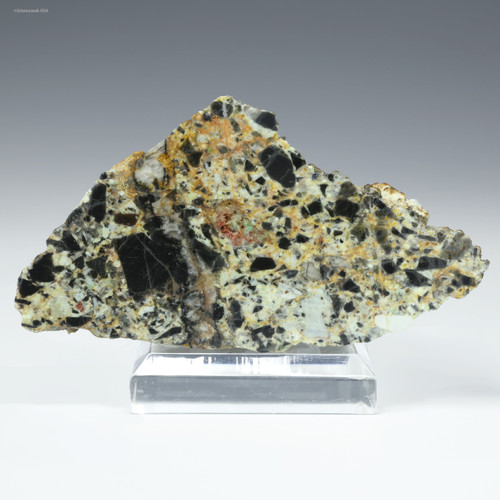
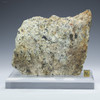
Barberton Spherule Bed Large South Africa [3.23 Ga - 760 g]
Brand : Jensan Scientifics LLC
- SKU:
- JPT-888985
- Availability:
- Usually ships in 24 hours.
- Weight:
- 2.00 LBS
- Minimum Purchase:
- 1 unit
- Maximum Purchase:
- 1 unit
- Shipping:
- Calculated at Checkout

Barberton Impact Spherule Bed, South Africa
This spherule bed specimen S2 came from the Barberton Greenstone Belt in South Africa, home to one of the oldest known records of giant asteroid impacts on Earth. These spherule beds formed ~ 3.23 Ga, when ejected debris from colossal Archean impacts rained down on ancient ocean floors.
About This Impact Spherule Bed
- What is a spherule bed? A spherule bed is a rock layer made by an asteroid impact. The blast turned rock into vapor, which cooled into sand-sized droplets called spherules. These droplets then rained down over huge areas.
- Where did this Barberton Spherule bed come from? The Barberton Greenstone Belt holds some of the oldest well-preserved rocks on Earth, occurring during the Archean, about 3.5 to 3.23 billion years old.
- What Spherule beds teach us: Barberton has at least eight impact layers, formed between ~3.5 to 3.23 Ga. Together, they are among the oldest known direct evidence of impacts on Earth.
- The asteroids were giants: Scientists estimate these impactors were 20 to 70 km across. One of them, known as S2, may have been up to 200 times larger than the asteroid that killed the dinosaurs!
- Proof from space: Chromium isotopes in several beds match carbonaceous chondrite meteorites. That chemical signature confirms that the material came from space.
- Museum grade: Most spherule bed material is small. At 760 grams, this is an opportunity for you to own a large specimen that is museum-grade specimen suitable for museum institutional displays or a serious private collection.
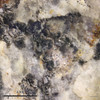
What the 5× Macro image of this Barberton Spherule Bed S2 reveals:
-
What you’re seeing:
- Dark gray fragments: broken spherules. Their original glass was replaced by minerals long ago, and their curved edges are pieces of once-round shells.
- A near-whole spherule: the rounded dark grain at left center, with a tiny pore at its middle.
- Sparkling white background: fine-grained quartz (chert) that cemented the layer and preserved it for billions of years.
- Rusty orange stains: iron-bearing minerals that oxidized over time.
- Tiny black specks: grains of dark minerals scattered through the quartz.
Why “shattered”? Most spherules here are broken rather than whole. That points to violent conditions after they landed. They were likely churned by powerful waves, possibly impact-generated tsunamis, or crushed as the sediment compacted, before silica locked them in place.
Why it matters: Erosion and plate tectonics have erased nearly all of Earth’s early impact history. Beds like this are among the few surviving physical witnesses to the bombardment of the young planet. Every fragment in this tiny frame is debris from a cosmic collision from the Archean!
Product Information
| Specimen | Barberton Impact Spherule Bed, S2 |
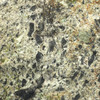
| Material | Impact spherule bed with dark chert fragments in a fine-grained matrix |
| Locality | Barberton Greenstone Belt, Kaapvaal Craton, Mpumalanga, South Africa |
| Age of S2 Impact | ~3.23 Ga, Archean |
| Dimensions and Weight | 132 mm W x 114 mm H x 38 mm D, 760 grams |
| Photographic Notes | The close-up image shows the surface at 1x, revealing the dark chert fragments in the pale matrix, 5× with details |
| Science Gift Options | A museum-grade centerpiece for institutional display or private collections, and a remarkable gift for meteorite and impact collectors, geology enthusiasts, science educators, and anyone fascinated by early Earth |
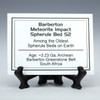
| What's Included | Certificate of Authenticity (COA), information sheet, specimen tag, tag stand. The acrylic display base and brass scale cube are shown for presentation and size reference only and are not included. |
| Provenance | All of our material is proprietary and sourced from scientists and/or verified scientific estate collections, backed by the included Certificate of Authenticity. |
| Product ID | 888985 |
| Availability | LARGEST ONE AVAILABLE |
Images professionally photographed under controlled studio lighting using Zeiss optics and a pro-grade Canon camera, for guaranteed accuracy. The brass scale cube measures 1 cm per side.
Rarity and Significance
| Scientific Significance | ★★★★★ |
| Locality Uniqueness | ★★★★★ |
| Rarity | ★★★★★ |
| Market Availability | ½☆☆☆☆ |
| Historical Importance | ★★★★★ |
| Display Appeal | ★★★★★ |
Questions Commonly Asked About Barberton Spherule Beds
What is an impact spherule bed?
It is a rock layer made of tiny droplets from a giant impact. The impact vaporized rock and threw it high above the atmosphere. The vapor cooled into sand-sized spheres that fell back to Earth and settled on the seafloor.
How old is this specimen?
The Barberton spherule bed S2 formed ~3.23 Ga. At that time, Earth had almost no free oxygen and only very simple microbial life.
How do scientists know an asteroid made these layers?
Several beds contain high levels of iridium, an element rare in Earth's crust but common in meteorites. Their chromium isotopes also match carbonaceous chondrite meteorites, a chemical fingerprint that Earth rocks do not carry.
How big were these impacts?
Far bigger than any impact in recent geologic time. The asteroids are estimated at 20 to 70 km across. The impacts set off tsunamis that swept the ancient seafloor.
Did these impacts affect early life?
A 2024 study of the S2 impact suggests they may have helped it. The tsunami churned iron up from the deep ocean, and the asteroid delivered phosphorus. After the impact, iron-loving microbes appear to have flourished.
How should I care for this specimen?
Keep it dry and display it on a stable surface. A soft brush or a puff of air removes dust safely. Avoid cleaners and soaking.
Buy this large, dynamic, museum-grade specimen from one of the oldest known impact spherule beds on Earth. At 760 grams, this Barberton spherule bed S2 is the largest one we have available, with bold black chert fragments set in a pale, green-flecked matrix left by an Archean asteroid impact ~3.5 Ga. It is a commanding centerpiece for museum display or a private collection.