
Meteorite Impact Spherule Bed Barberton [181 g ~ 3.5 Ga]
Brand : Jensan Scientifics LLC
- SKU:
- JPT-94312
- Condition:
- New
- Availability:
- Usually ships in 24 hours.
- Weight:
- 1.00 LBS
- Minimum Purchase:
- 1 unit
- Maximum Purchase:
- 1 unit
- Shipping:
- Calculated at Checkout


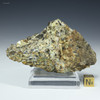

Rare Barberton meteorite impact spherule bed - 181 g
This 181-gram Barberton meteorite impact spherule bed preserves ancient impact-related material from the Barberton Greenstone Belt of South Africa, one of Earth's classic Archean terrains. The specimen came from Spherule Bed #2 and represents an uncommon opportunity to study physical evidence of large extraterrestrial impacts recorded in some of Earth's oldest preserved supracrustal rocks.
Barberton Spherule Bed Geological Significance
The Barberton Greenstone Belt is internationally important because it preserves Archean volcanic, sedimentary, and impact-related deposits from a time when Earth's crust, oceans, atmosphere, and early surface environments were still developing. Impact spherule beds in this region are especially valuable because they record ancient high-energy events that occurred long before the familiar Phanerozoic fossil record.
Spherule beds are interpreted as distal impact deposits. In a major impact, rock can be vaporized, melted, ejected, and dispersed through the atmosphere before settling back into marine or sedimentary environments as tiny, rounded particles, now preserved in ancient rock. In Barberton, these layers have helped researchers investigate early Earth bombardment, impact plume processes, Archean sedimentary environments, and the survival of impact evidence in deeply ancient terrains.
This specimen is best understood as a scientific display specimen. Its value lies in its age, locality, geological context, and relationship to one of the most important known records of Archean impact activity on Earth.
Product Information
| Object Type | Meteorite impact spherule bed rock |
| Locality | Barberton Greenstone Belt, South Africa |
| Specific Layer | Spherule Bed #2, Fig Tree Group, Mapepe Formation |
| Geological Age | Paleoarchean, approximately 3.5 billion years ago; 3.5 Ga |
| Dimensions | 100 mm L X 54 mm W X 43 mm D |
| Weight | 181 grams |
| Specimen Description | Archean spherule-bearing rock from Barberton Spherule Bed #2, preserving impact-related material in ancient matrix. |
| Scientific Significance | Represents rare physical evidence of large extraterrestrial impact activity preserved in one of Earth's oldest geological terrains. |
| What Is Included | Certificate of Authenticity, specimen tag, tag stand, educational information, in situ photo, and free Earth's Oldest Rocks and Oldest Life geology poster. Display base and photo cube not included. |
| Use & Display | Recommended for serious private collections, geological teaching displays, early Earth study collections, impact geology displays, and advanced science gifts. |
| Authentication & Compliance | Professionally and legally collected. Ships with documentation from Sciencemall-USA. |
| Shipping | Shipping calculated at checkout |
| U.S. Shipping | Free Priority Shipping within the USA |
Images professionally photographed under controlled studio lighting using Zeiss optics and a pro-grade Canon camera.
Rarity & Significance
Scientific Significance: ★★★★★
Market Availability: ★
Locality Specificity: ★★★★★
Display Appeal: ★★★★
Questions Commonly Asked
How old is this Barberton spherule bed, and is it verified?
This Barberton spherule bed is Paleoarchean, approximately 3.5 billion years old (3.5 Ga). The specimen is identified as material from Spherule Bed #2 in the Barberton Greenstone Belt of South Africa and ships with a Certificate of Authenticity, specimen tag, educational information, and an in situ photo for documentation.
What exactly am I looking at in the images? What are the spherules?
The images show a spherule-bearing Archean rock, not a meteorite itself. The spherules are small, rounded particles preserved in an ancient matrix. They are interpreted as impact-related droplets or condensed particles produced when a large extraterrestrial impact generated a hot vapor and melt plume. After transport and deposition, these particles became preserved in ancient sedimentary rock.
Which spherule bed layer is it from?
This specimen is from Barberton Spherule Bed #2, within the Fig Tree Group, Mapepe Formation, Barberton Greenstone Belt, South Africa.
Is the impact origin scientifically accepted, or is it disputed?
The impact origin of Barberton spherule beds is widely accepted in the scientific literature, particularly for the major Archean spherule layers that exhibit impact-style textures, broad distribution, and geochemical evidence, including enrichments in siderophile elements and extraterrestrial components. Some researchers argue that the mineralogy provides evidence for extensive hydrothermal and metasomatic alteration of the spherule beds, while the mainstream interpretation, supported by researchers at Stanford and others, holds that these are genuine impact ejecta layers.
This is an exceptionally rare specimen suited for serious private collections. Its Archean age, Barberton locality, and connection to early Earth impact history make it ideal for studying one of the most dramatic processes recorded in the ancient rock record.


