
Authentic Pompeii Decorated Wall Plaster, Painted Interior Wall Fragment
Brand : Sciencemall-USA
- SKU:
- JPT-878593
- Availability:
- Usually ships in 24 hours.
- Weight:
- 1.00 LBS
- Minimum Purchase:
- 1 unit
- Maximum Purchase:
- 1 unit
- Shipping:
- Calculated at Checkout


Authentic Pompeii Decorated Wall Plaster, Painted Interior Wall Fragment
This is a fragment of Roman painted wall plaster, or intonaco, broken from the interior face of a building at Pompeii and sealed beneath volcanic ash during the eruption of Mount Vesuvius in 79 AD.
What is this Pompeii Wall Plaster About?
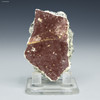
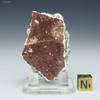
The painted surface carries a deep, slightly brownish red ground crossed by a narrow ochre-yellow line. Bands of this kind served as dividing fillets, the ruled borders that framed and separated the painted panels of a Roman room, so the fragment preserves a junction within a larger decorative scheme rather than an open field of color.
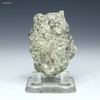
The painted face is smooth and softly reflective. That finish is not varnish or glaze; it is the result of Roman technique, in which pigment was worked into damp lime plaster and the finished coat was then compacted and burnished. Small pale inclusions are scattered through the paint layer. Seen edge-on, the piece shows the layered construction described by Vitruvius: a thin pigmented skin over a pale, fine-grained finishing coat, over a coarse backing mortar. That backing, fully exposed on the reverse, is a pale lime matrix crowded with dark, angular lithic grains, consistent with the volcanic sand that Roman builders in Campania used as aggregate.
Legal Material Collection
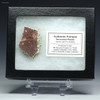
The specimen was legally collected in the 1890s, during the period of systematic excavation carried on at Pompeii under Fiorelli, Ruggiero, and De Petra, and came from a scientific estate collection. It is presented in a glass-topped Riker display case with a printed identification card and a Sciencemall-USA Certificate of Authenticity.
Mt Vesuvius and the Eruption of 79 AD
Mount Vesuvius rises on the Bay of Naples above a subduction zone where the African plate descends beneath Eurasia. It is a somma-stratovolcano, a modern cone nested inside the breached rim of the older Monte Somma, and its magmas are unusually alkaline, phonolitic to tephritic and often leucite-bearing. That gas-charged chemistry favors violently explosive eruption.
Pliny the Younger, watching from Misenum, likened the eruption column to an umbrella pine, and his account to the historian Tacitus gave the name Plinian to eruptions of this type. Reconstructions by Sigurdsson and colleagues place the column near 30 kilometers. Pumice and ash fell on Pompeii for roughly eighteen hours, loading and collapsing roofs and burying the streets. The following morning, pyroclastic density currents, which are hot and fast-moving avalanches of gas and ash, swept down the flanks and reached the town. Pompeii came to rest beneath some four to six meters of tephra. Pliny the Elder died at Stabiae during a rescue attempt.
How a Roman Wall Was Built and Painted
Roman interior walls were finished in successive coats of lime plaster, progressively finer toward the surface, with the uppermost layers often tempered with marble dust. Pigment was applied while the plaster was still damp, then the surface was compacted and burnished. As the lime cured, calcium carbonate formed within and across the painted skin, binding the pigment into the wall rather than leaving it as a separate film on top. The result is a hard, dense, faintly polished surface, and it is the main reason painted Roman walls survive as well as they do.
The Roman palette drew on iron-oxide earth pigments, cinnabar, and Egyptian blue, the earliest known synthetic pigment. Burial sealed these surfaces away from weather and light, which is why entire painted rooms came through the centuries at Pompeii and Herculaneum in a condition unmatched almost anywhere else in the Roman world.
Product Information
| Object Type | Roman painted wall plaster (intonaco), interior wall fragment |
| Locality | Pompeii, Campania, Italy; Bay of Naples. Site-level attribution only; no building or room attribution accompanies the specimen. |
| Age and Event | Roman, first century AD. Buried by the eruption of Mount Vesuvius in 79 AD. |
| Dimensions | Specimen size: 50mm H x 35 mm W x 15 mm D; Riker size: 5.5 inches W by 4 1/2 inches H by 3/4 inches D. |
| Weight | 25.9 grams |
| Specimen Description | Deep brownish-red painted field crossed by a narrow ochre-yellow dividing band. Smooth, lightly burnished painted face with scattered pale inclusions. Layered profile visible along the broken edges. Reverse exposes a pale lime backing mortar packed with dark angular volcanic grains. |
| Scientific Significance | Preserves Roman wall-painting technique and lime-plaster stratigraphy in a single hand specimen, from the best-documented buried urban site in the ancient world. |
| Provenance | Legally collected in the 1890s. From a scientific estate collection. See the full provenance statement below. |
| What Is Included | Specimen in a glass-topped black Riker display case, cotton-lined, 5 1/2 in W x 4 1/2 in H x 3/4 in D. Printed identification card mounted in the case, with additional information on the reverse (see back). Sciencemall-USA Certificate of Authenticity. Display stand not included; the acrylic stand shown in the photographs is used for photography only. |
| Use and Display | Private scientific and antiquities collections, museum-style display, classroom and lecture use in archaeology, art history, Roman studies, and volcanology. |
| Authentication and Compliance | Ships with a Sciencemall-USA Certificate of Authenticity and specimen documentation. |
| Shipping | Shipping calculated at checkout. |
| U.S. Shipping | Free Priority Shipping within the USA. |
Images professionally photographed under controlled studio lighting using Zeiss optics and a pro-grade Canon camera.
Rarity and Significance
| Scientific Significance | ★★★★☆ 4 / 5 |
| Market Availability | ★☆☆☆☆ 1/ 5 (rarely available in the collector market) |
| Locality Specificity | ★★★☆☆ 3 / 5 (site-level; no building attribution) |
| Display Appeal | ★★★★☆ 4 / 5 |
Painted wall plaster from Pompeii is rarely available to private collectors, and material with a documented nineteenth-century collection history is scarcer still.
Questions Commonly Asked
How many people are likely to have died at Pompeii?
Many reference works place the toll within Pompeii itself at roughly 2,000. Broader figures of about 16,000 for the whole affected region are commonly cited, but they are estimates rather than counts. Against a town population usually put at 11,000 to 15,000, even the higher numbers leave a large majority unaccounted for; the long pumice fall that preceded the deadly surges gave people time to recognize the danger and leave.
Did anyone survive?
There were more than two hundred survivors across twelve communities, most of them in coastal Campania, including Neapolis, Cumae, Puteoli, and Ostia. They rebuilt businesses, stood for public office, intermarried with other refugee families, and in some cases carried their hometown religious dedications with them.
Why is the painted surface still smooth and slightly glossy?
Roman painters worked pigment into damp lime plaster and then compacted and burnished the finished coat. As the plaster cured, calcium carbonate formed within and across the surface, locking the pigment into the wall rather than leaving it as a separate film on top. The result is a hard, dense, faintly polished skin. It is the same chemistry that makes lime plaster durable, applied deliberately as a finish.
What is the gray, gritty material on the back?
The backing mortar, which is the coarse structural layer that bonded the finished plaster to the masonry behind it. It is a pale lime matrix packed with dark, angular volcanic grains. Builders in Campania had abundant volcanic sand at hand and used it as aggregate, and it is one reason Roman mortars performed so well. Naming the specific material would require analysis that has not been carried out on this piece, so it is described here as volcanic sand consistent with local Campanian aggregate.
How deeply was Pompeii buried?
Roughly four to six meters, about thirteen to twenty feet, of pumice, ash, and pyroclastic material. Herculaneum lay closer to the mountain and was struck by hotter, denser flows; it is buried far more deeply, which is why it proved so much harder to excavate and why organic material such as wood and papyrus survived there in a way it did not at Pompeii.
Is Vesuvius still active?
Yes. Vesuvius has erupted many times since 79 AD, most destructively in 1631 and most recently in March 1944, during the Allied campaign in Italy. It has been quiet since then, but it remains one of the most closely monitored volcanoes on Earth, watched continuously by the Osservatorio Vesuviano, founded in 1841 and the oldest volcano observatory in the world.
Add this Pompeii decorated wall plaster fragment to a serious antiquities or Earth science collection, classroom display, or museum-style exhibit. ONLY 1 AVAILABLE.
Few objects hold two histories at once as plainly as this one. In the painted face is a Roman room, ruled and colored by a working craftsman in the first century AD. In the coarse gray mortar behind it is the volcano that supplied the sand for the wall and then buried it. Recovered during the great nineteenth-century excavations and preserved in a private scientific collection ever since, it is a hand specimen of Roman technique and of the eruption that sealed it away.


