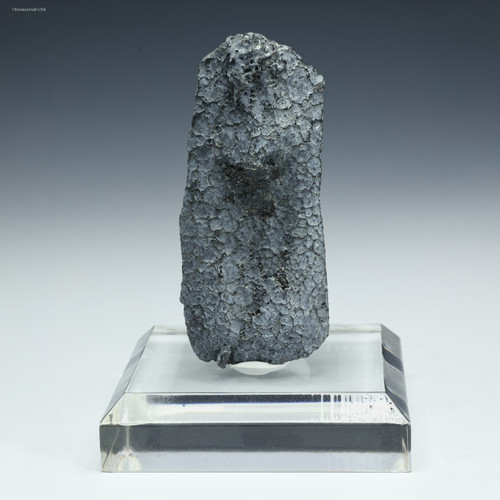
Large Snæfellsjökull Volcanic Bomb Iceland
Brand : Jensan Scientifics LLC
- SKU:
- JPT-252806
- Availability:
- Usually ships in 24 hours.
- Weight:
- 2.00 LBS
- Minimum Purchase:
- 1 unit
- Maximum Purchase:
- 1 unit
- Shipping:
- Calculated at Checkout




Snæfellsjökull Volcanic Bomb - Journey to the Center of the Earth
This volcanic bomb specimen came from the Snæfellsjökull stratovolcano on the Snæfellsnes Peninsula of western Iceland, the glacier-capped peak Jules Verne chose as the historic entry point in his 1864 classic, Journey to the Center of the Earth. Collected in the 1970s, it is a rare, historic piece of one of the most famous volcanoes in literature.
About This Snæfellsjökull Volcanic Bomb
- What it is: A volcanic bomb is a mass of molten lava hurled into the air during an eruption. It cools and hardens in flight before it lands. Geologists call a fragment a bomb only when it is larger than 64 mm, and this specimen measures 107 mm.
- Where it came from: Snæfellsjökull is a glacier-capped stratovolcano about 1,446 meters high at the western tip of the Snæfellsnes Peninsula. On clear days it can be seen across Faxaflói Bay from Reykjavík. It last erupted roughly 1,800 years ago.
- The Jules Verne connection: In Verne's novel, Professor Lidenbrock, his nephew Axel, and their Icelandic guide Hans climb Snæfellsjökull and descend into its crater, guided by the shadow of the Scartaris peak at the end of June. Their underground journey ends when they are blasted out of Stromboli in Italy.
- Historic collection: This specimen was collected in the 1970s, generations before Snæfellsjökull National Park was established in 2001.
What You See in the Photographs
- Front view: A heavily vesicular surface covered in small holes left by gas bubbles trapped as the lava cooled. A purplish-red oxidized zone shows near the top.
- Back view: Long ridges and grooves run the length of the specimen, a texture consistent with molten lava stretching and twisting as it flew through the air.
- Side views: Dense, smooth gray-green patches stand out against the lighter, bubble-filled rock, giving the bomb a striking mottled look from every angle.
- Color: Tan, ochre, and rust-orange tones come from the natural oxidation of iron-bearing minerals in the volcanic rock.
Product Information
| Specimen | Snæfellsjökull Volcanic Bomb |
| Locality | Snæfellsjökull Stratovolcano, Snæfellsnes Peninsula, Western Iceland |
| Collected | Legally collected in the 1970s |
| Preparation | All-natural specimen, uncut and unpolished |
| Dimensions and Weight | 107 mm L x 78 mm W x 69 mm D, 362 grams |
| Science Gift Options | A memorable gift for geology enthusiasts, Jules Verne readers, science fiction enthusiasts, science educators, and collectors of historic volcanic specimens |
| What's Included | Certificate of Authenticity (COA), information sheet, specimen tag, tag stand. The brass scale cube is shown for size reference only and is not included. The acrylic base is not included. |
| Provenance | All of our material is proprietary and sourced from scientists and/or verified scientific estate collections, backed by the included Certificate of Authenticity. |
| Product ID | 252806 |
| Availability | ONLY 1 AVAILABLE |
Images professionally photographed under controlled studio lighting using Zeiss optics and a pro-grade Canon camera, for guaranteed accuracy. The brass scale cube measures 1 cm per side.
Rarity and Significance
| Scientific Significance | ★★★★★ |
| Locality Uniqueness | ★★★★★ |
| Rarity | ★★★★★ |
| Market Availability | ★☆☆☆☆ |
| Historical Importance | ★★★★★ |
| Display Appeal | ★★★★★ |
Questions Commonly Asked About Snæfellsjökull Volcanic Bombs
What makes a rock a volcanic bomb?
A volcanic bomb starts as a blob of molten lava thrown from an erupting vent. It partly cools while flying through the air, which often gives it a stretched, twisted, or streamlined shape. Only fragments larger than 64 mm are called volcanic bombs.
Why is Snæfellsjökull famous?
Jules Verne made it the doorway to the Earth's interior in his 1864 novel, Journey to the Center of the Earth. The volcano's glacier-capped summit has drawn travelers and readers ever since.
It is also one of Iceland's best-known landmarks, standing at the tip of the Snæfellsnes Peninsula and visible from Reykjavík on clear days.
Is Snæfellsjökull still active?
Snæfellsjökull is considered dormant. Its last eruption was roughly 1,800 years ago, and its summit is covered by a glacier that has been shrinking in recent decades.
Why are historic Snæfellsjökull specimens so rare?
The volcano now lies within Snæfellsjökull National Park, established in 2001. This specimen was legally collected in the 1970s, long before the park existed, which makes older material like this exceptionally difficult to find.
How should I care for this specimen?
Handle it gently and keep it dry. Vesicular volcanic rock has delicate edges around its gas holes, so avoid scrubbing. A soft brush or a puff of air removes dust safely.
Own a piece of the volcano that launched a literary legend. This incredible, well-sculptured bomb shows off a bubble-riddled surface, flight-twisted ridges, and dramatic gray-green mottling, all gathered from Jules Verne's gateway to the center of the Earth.