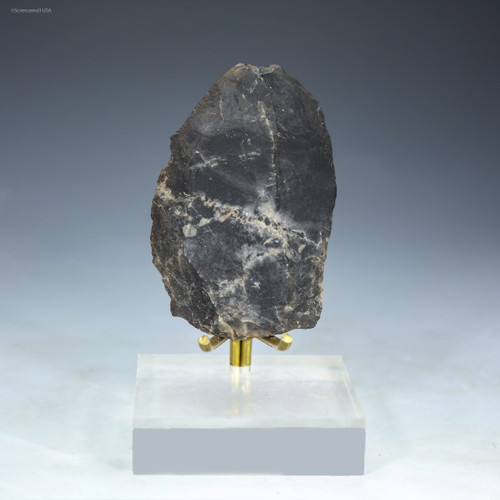
Native Gold in Quartz - Yellowknife, Great Slave Lake, CA
Brand : Jensan Scientifics LLC
- SKU:
- JPT-22218
- Availability:
- Usually ships in 24 hours.
- Weight:
- 1.00 LBS
- Minimum Purchase:
- 1 unit
- Maximum Purchase:
- 1 unit
- Shipping:
- Calculated at Checkout


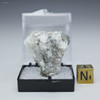
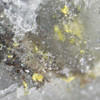

Native Gold in Quartz, Con Mine, Yellowknife Canada
This native gold in quartz specimen came from the Con Mine at Yellowknife, on the north shore of Great Slave Lake, Northwest Territories, Canada, the first gold mine in the Northwest Territories and the mine that gave rise to the city of Yellowknife. With the Con Mine closed since 2003 after 65 years of production, specimens showing visible gold from this historic locality are seldom seen on the market.
About This Native Gold Specimen
The Con Mine sits within the Yellowknife greenstone belt, part of the ancient Slave Craton, one of the oldest pieces of continental crust on Earth. Its gold was carried by hot, mineral-rich fluids moving through deep fault zones in Archean volcanic rocks of the Kam Group, then deposited in quartz veins.
Cominco poured the mine's first gold brick on September 5, 1938, and the boom that followed turned a remote bay into the city of Yellowknife. Over its lifetime, the Con Mine produced more than five million ounces of gold, yet nearly all of that ore was crushed and milled. Hand-sized pieces with visible gold, like this one, were rarely set aside, making them true survivors of Canada's northern gold rush.
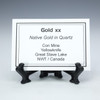
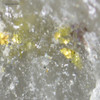
The "xx" on the specimen tag is collectors' shorthand for crystallized. Under magnification, the gold on this piece appears as bright, granular crystalline clusters, not just flat flecks. It is scattered across both faces of the milky white to translucent gray quartz and concentrated along darker mineral seams that mark the path of the gold-bearing fluids.
Product Information
| Preparation | All natural specimen, unpolished |
| Dimensions and Weight | 32 mm x 31 mm x 9 mm |
| Photographic Notes | Close-up images taken at 5x magnification to show the crystallized gold in detail |
| Science Gift Options | A standout gift for gold and mineral collectors, geology enthusiasts, and anyone drawn to the history of Canada's northern gold rush |
| What's Included | Certificate of Authenticity, specimen tag, tag stand, information sheet, perky display case as shown, brass scale cube not included (shown for scale only) |
| Provenance and Authenticity | All of our material is proprietary and sourced from scientists and/or verified scientific estate collections, backed by the included Certificate of Authenticity. |
Images professionally photographed under controlled studio lighting using Zeiss optics and a pro-grade Canon camera, for guaranteed accuracy.
The brass scale cube measures 1 cm per side.
Rarity and Significance
| Scientific Significance | ★★★★☆ |
| Locality Uniqueness | ★★★★★ |
| Rarity | ★★★★★ |
| Market Availability | ½☆☆☆☆ |
| Historical Importance | ★★★★★ |
| Display Appeal | ★★★★☆ |
Questions Commonly Asked About Con Mine Gold
Is this real, natural gold?
Yes. This is native gold, meaning natural metallic gold formed in the Earth, still in its original quartz host rock. It is an all natural, unpolished specimen with no added, plated, or enhanced gold, and it comes with a Certificate of Authenticity.
What does "xx" mean on the specimen tag?
"xx" is standard collectors' shorthand for crystallized. The gold on this specimen shows as small crystalline clusters and grains, best seen in the 5x close-up images.
Why are Con Mine gold specimens so hard to find?
The Con Mine closed in 2003, so no new material is being produced. During its 65 years of operation, almost all ore went straight to the mill, and pieces with visible gold were rarely saved as specimens.
Why is the Con Mine historically important?
The Con Mine was the first gold mine in the Northwest Territories, pouring its first gold brick on September 5, 1938. Its success launched the settlement of Yellowknife, which later became the territorial capital.
Over 65 years, it became the most productive gold mine in the Northwest Territories, yielding more than five million ounces of gold.
How should I care for this specimen?
Gold never tarnishes, so it needs no cleaning or polishing. Keep the specimen in its perky display case to protect it from dust and handling, and if you remove it, hold it by its edges, since quartz can chip if dropped.
Crystallized native gold sparkles on both sides of this specimen, set against bright milky quartz and tracing the dark seams where gold-bearing fluids once flowed. Under magnification, every grain comes alive with glittering crystalline texture. It arrives ready to display in its perky case, a genuine piece of the mine that built Yellowknife. Once Con Mine gold like this is gone, it is gone for good.