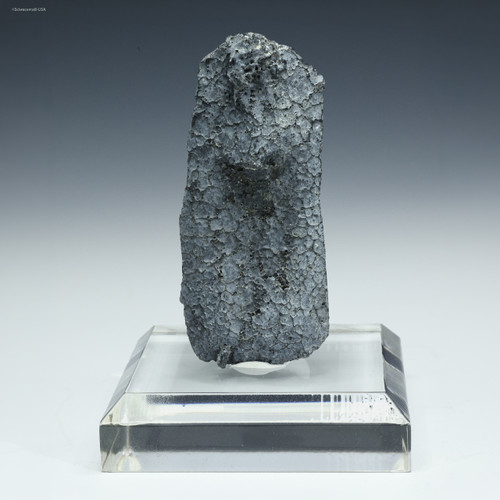
Mohorovičić Discontinuity Rock Ophiolite Complex - Newfoundland
Brand : Jensan Scientifics LLC
- SKU:
- JPT-85277
- Availability:
- Usually ships in 24 hours.
- Weight:
- 1.00 LBS
- Minimum Purchase:
- 1 unit
- Maximum Purchase:
- 1 unit
- Shipping:
- Calculated at Checkout



Mohorovičić Discontinuity - Moho Boundary Specimen
Explore the depths of our planet with this exceptional scientific specimen representing the Mohorovičić Discontinuity—the planetary crust-mantle boundary famously known as the "Moho". While humanity's deepest effort to reach this boundary via drilling (the legendary Kola Superdeep Borehole) stalled at 12 kilometers due to scorching temperatures, this rare piece offers a direct connection to the otherwise unreachable interior of our world. This specimen originates from a rare slice of ancient ocean floor and upper mantle that was lifted, tilted, and exposed at the surface.
Geology of the Bay of Islands Ophiolite Complex
This specimen was directly sourced from the Bay of Islands Ophiolite Complex. Approximately 470 million years ago, as the ancient Iapetus Ocean closed, immense tectonic forces pushed oceanic crust and mantle rock up onto the edge of ancient North America through a violent process known as obduction. This unusual geological mechanism trapped and preserved a cross-section of the deep mantle, locking away primordial rocks that typically remain crushed under impossible pressures miles beneath the seabed. The piece features a striking dark green crystalline interior and distinctive texturing characteristic of ultramafic mantle rocks.
Why This Moho Crust-Mantle Boundary Matters
Surface exposures directly linked to the Moho boundary are exceptionally rare, with the world's premier sites limited to a few major ophiolite localities, such as Oman, Cyprus, Macquarie Island, and the Tablelands of Newfoundland. These famous localities act like a giant surface laboratory, considered by scientists to be the absolute premier window into the Earth's deep interior. This historical specimen was scientist-sourced and legally collected in the 1960s, making it an exceptional piece of geological history that is increasingly difficult to acquire for private or institutional collections.
Product Information
| Object Type | Serpentinized Peridotite Mantle-border (Ophiolite Complex) |
| Locality | Tablelands, Gros Morne National Park, Western Newfoundland, Canada |
| Age / Formation | ~470 Million Years Old / Bay of Islands Ophiolite Complex |
| Dimensions / Weight | 67mm W x 35mm H x 8mm D / 24 grams |
| Specimen Description | Classic deep mantle specimen showcasing a beautiful, dark green crystalline face on one side contrasted with an impressive, beautifully weathered crust on the reverse that highlights its ancient surface exposure; Sides front and back lightly sprayed for photographic purposes |
| Scientific Significance | Provides a direct physical hand specimen linked directly to the super-rare Moho crust-mantle boundary zone. |
| Provenance | Scientist-sourced and legally collected circa 1960s. |
| What Is Included | Certificate of Authenticity, tag, tag stand, information about the specimen, "The Kola Superdeep Borehole: A Window into the Deep Continental Crust," and "Comparative Analysis of the Kola Superdeep Borehole, the Moho and Gutenberg Discontinuities." Also included is the paper "Mars Nakhla Meteorites, ALH84001, Theo's Flow, and the Moho Tablelands Connection." |
| Use and Display | Ideal for museum-style displays, advanced classroom instruction, or a serious private geological collection. |
| Authentication | Ships with an official ScienceMall-USA Certificate of Authenticity. |
| U.S. Shipping | Free Priority Shipping within the USA. |
Images professionally photographed under controlled studio lighting using Zeiss optics and a pro-grade Canon camera.
Rarity and Significance
| Scientific Significance | ★★★★★ (Exceptional – Represents one of the world's absolute premier windows into the Earth's mantle) |
| Market Availability | ★★ (Rarely available from this legal, historic 1960s collection) |
| Locality Specificity | ★★★★★ (Highly precise – Tablelands, Gros Morne National Park) |
| Display Appeal | ★★★★☆ (Striking contrast between the rich dark green interior and its naturally weathered mantle rind) |
Note: A remarkable specimen, ideal for the collector who delights in pieces that are at once highly distinctive and richly varied!
Questions Commonly Asked
What is this specimen?
This is an authentic geological hand specimen representing the Mohorovičić Discontinuity ("Moho") crust-mantle boundary zone, composed of ultramafic rock derived from the Earth's upper mantle.
Why is this locality important?
The Tablelands of Gros Morne National Park, Newfoundland, are globally celebrated as one of the finest surface exposures of an ophiolite complex— a slice of ancient ocean floor and deep earth thrust upward onto land. Here, researchers and collectors can stand directly on rock that originated in the planet's mantle.
How did this material form?
Normally, the Moho stays hidden kilometers beneath us. This is where the Tablelands of Gros Morne, Newfoundland, become extraordinary. There, about 470 million years ago, the closing of the Iapetus Ocean shoved a slab of ocean floor and the mantle beneath it up onto the edge of North America — a rare event called obduction, the opposite of a slab sinking. It is stranded, deep rock at the surface where it can be easily traversed.
How are the Tablelands a Mars Analogue for Life Beyond Earth?
The Tablelands don't just resemble Mars — they may hold the closest thing on Earth to the life we hope to find there. The landscape looks lifeless for a reason. As mantle rock weathers, it releases toxic metals such as nickel and chromium while providing almost no nutrients plants need. This isn't a climate effect. A lush boreal forest thrives on the adjacent rock under the very same sky; what separates green from bare is the composition of the bedrock itself, and the toxic soil it weathers into.
A few specialists persist. Carnivorous pitcher plants — Newfoundland's provincial flower — skip the poisoned soil entirely, trapping insects in pools of liquid inside their leaves, while tiny Arctic-like flowers hug the ground against the wind. But the truly alien life is hidden below. Where water seeps into the mantle rock, a reaction called serpentinization produces hydrogen, methane, and springs so alkaline they rival bleach, with a pH of 11 to 12.
Something lives there anyway. Sparse communities of microbes — with names like Serpentinomonas and Hydrogenophaga — run entirely on the chemistry of the rock, breathing hydrogen and building life from the reaction itself. It's a biosphere powered by geology instead of the sun.
That is what makes the Tablelands a genuine Mars analog. Serpentinization may also occur on Mars, and if life exists there, it would most likely hide in the subsurface, shielded from radiation and feeding on rock chemistry — precisely the kind of life the Tablelands already hold. This barren wasteland is one of Earth's best rehearsal grounds for recognizing life beyond our world.
This serpentinized peridotite — from the ophiolite complex of the Tablelands, at the Moho discontinuity between crust and mantle — is a rare and exceptional example of mantle rock: the very material whose geochemistry sustains life without sunlight and makes this landscape one of Earth's closest analogs for Mars.
Add this exceptional piece of the Mohorovičić Discontinuity to a serious Earth science collection, classroom display, or museum-style geological exhibit. ONLY 1 AVAILABLE.
An incredibly rare, pristine piece of Earth's deep interior—violently obducted during the closing of the Iapetus Ocean and preserved from a 1960s scientific collection.