
Fossil Crayfish & Fish Plate - Jehol Biota, China
Brand : Jensan Scientifics LLC
- SKU:
- JPT-94187
- Availability:
- Usually ships in 24 hours.
- Weight:
- 4.00 LBS
- Minimum Purchase:
- 1 unit
- Maximum Purchase:
- 1 unit
- Shipping:
- Calculated at Checkout

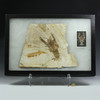


Cretaceous Crayfish and Fish, Jehol Biota
A single bedding surface from the Early Cretaceous lakebeds of western Liaoning, carrying a large, substantially complete freshwater crayfish alongside an articulated fish. Both animals settled into the same lamina of lime mud and were buried together. What you are looking at is not a composed arrangement of two separate finds — it is one moment of a Mesozoic lake floor, preserved intact.
The crayfish is Palaeocambarus licenti (Van Straelen, 1928). Following a 2023 revision of every described Jehol crayfish taxon, this is now the only valid crayfish species known from the entire Jehol Biota — a biota otherwise famous for feathered dinosaurs, early birds, and the earliest flowering plants. The accompanying fish is Lycoptera davidi, the index fossil by which these rocks have been correlated across northeast Asia for more than a century.
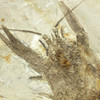
Both chelae are present with their fingers intact. The antennae sweep clear of the body across 83 mm of matrix. The tail fan is spread open. Preserved together on 200 mm of lithified lake bottom, and mounted in a Riker display case.
Product Information
| Primary Specimen | Fossil crayfish, Palaeocambarus licenti (Van Straelen, 1928) |
| Associated Specimen | Fossil fish, cf. Lycoptera davidi (Sauvage, 1880) |
| Classification | Arthropoda; Crustacea; Malacostraca; Decapoda; Astacidea; Cambaroididae Villalobos, 1955 |
| Geologic Age | Early Cretaceous, Barremian |
| Stratigraphy | Jehol Group; Yixian Formation lake shales of the Lingyuan district |
| Fossil Deposit | Jehol Biota — small freshwater lake community |
| Locality | Lingyuan, western Liaoning Province, China |
| Matrix Dimensions | 200 mm L x 150 mm H x 7 mm D (7.87 x 5.91 x 0.28 in.) |
| Crayfish Dimensions | Approximately 105 mm x 50 mm (4.13 x 1.97 in.) as preserved; antennal spread 83 mm (3.27 in.) across |
| Fish Dimensions | 68 mm L x 15 mm W (2.68 x 0.59 in.) |
| Lithology | Finely laminated pale calcareous lacustrine mudstone |
| Preparation | Natural bedding-plane surface; both animals lie on one continuous lamina |
| Display Case | Riker mount, 12 in. W x 8 1/4 in. H x 7/8 in. D, glass-topped with cotton bed |
| What's Included | The specimen in its Riker display case; a color crayfish reference illustration card mounted within the case; a specimen information sheet; and the Jensan Scientifics / Sciencemall-USA Certificate of Authenticity |
| Availability | ONLY 1 AVAILABLE |
Images professionally photographed under controlled studio lighting using Zeiss optics and a pro-grade Canon camera, for guaranteed accuracy.
The brass scale cube measures 1 cm per side.
Rarity and Significance
| Rarity | ★★★★☆ |
| Scientific Significance | ★★★★☆ |
| Preservation Quality | ★★★★½ |
| Completeness | ★★★★☆ |
| Display Impact | ★★★★★ |
| Educational Value | ★★★★★ |
Specimen Detail
What You Are Looking At
The crayfish lies with its dorsal surface exposed, the head end toward the upper left of the plate and the tail fan toward the lower right. Working from the front:
Antennae. Two long, finely segmented flagella sweep forward and outward, one crossing well clear of the body. Their combined spread measures 83 mm. Antennae are among the first structures to decay and be scavenged, so their survival at full length is a direct measure of how quickly this animal was buried.
Chelipeds. Both first pereiopods are preserved with the propodus and the movable dactylus — the two halves of the claw — still articulated and slightly agape. The elongate, narrow proportion of the claws is characteristic of the genus.
Cephalothorax. The carapace shows a granular, pitted surface texture across the branchial region, with the cervical groove faintly traceable. This is original cuticle mineral, not an impression.
Pleon and tail fan. The abdominal segments are preserved in sequence with their overlapping pleura, terminating in an opened tail fan — the telson flanked by paired uropods. The uropodal exopods show the transverse hinge known as the diaeresis, one of the diagnostic features of the Astacidea.
The fish. Below and to the left, a fully articulated fish measuring 68 mm preserves its vertebral column, ribs, and the fin rays of the dorsal, anal, and caudal fins in warm orange-brown. Additional partial fish material lies on the same surface above it, along with scattered plant and shell debris typical of these lakebeds.
The Only Crayfish in the Jehol Biota
The naming history of this animal is unusually tangled, and it ends in an interesting way.
Victor Van Straelen described the species in 1928 as Astacus licenti, based on material from what was then called Eastern Mongolia. Riuji Imaizumi added a second species, Astacus spinirostrius, from Jehol in 1938. In 1999, Rod Taylor, Frederick Schram, and Shen Yan-bin reassessed all of it, moved Van Straelen's species into a new genus as Palaeocambarus licenti, and simultaneously erected a third taxon, Cricoidoscelosus aethus, in a brand-new family of its own.
Three species, two families. That stood for over twenty years.
In 2023, Denis Audo, Tadashi Kawai, Cedric Letenneur, and Diying Huang re-examined the Jehol crayfish material in bulk and measured morphological variation across the population. Their conclusion, published in Geodiversitas, was that the supposed distinctions collapse under scrutiny: much of the apparent variation reflects whether a given specimen is a body fossil or a shed exoskeleton, and how it happened to be flattened. They synonymized A. spinirostrius and C. aethus into Palaeocambarus licenti, dissolved the family Cricoidoscelosidae, and placed the genus in Cambaroididae — the East Asian crayfish family whose only living genus is Cambaroides.
The practical result is that Palaeocambarus licenti is now the sole recognized crayfish species from the entire Jehol Biota, and the extinct sister to the crayfish still living in the rivers of northeast Asia today.
Van Straelen, V. (1928), Bulletin of the Geological Society of China 7: 133–139. Taylor, R.S., Schram, F.R. & Shen, Y.-B. (1999), Paleontological Research 3(2): 121–136. Shen, Y.-B., Schram, F.R. & Taylor, R.S. (2001), Chinese Science Bulletin 46(1): 26–33. Audo, D., Kawai, T., Letenneur, C. & Huang, D. (2023), Geodiversitas 45(24): 689–719.
Lycoptera: The Fish That Dates the Rock
Lycoptera is a small freshwater fish of the extinct family Lycopteridae, placed within the Osteoglossomorpha — the ancient teleost lineage that survives today as the arowanas, arapaima, mooneyes, and elephantfishes. Lycoptera davidi was named by Henri Sauvage in 1880.
Its importance is disproportionate to its size. Lycoptera is one of the three organisms whose joint occurrence traditionally defined the Jehol Biota, alongside the clam shrimp Eosestheria and the mayfly nymph Ephemeropsis. Sixteen species have been described, and their abundance and restricted range make the genus a working index fossil for correlating Early Cretaceous strata across China, Mongolia, Korea, and Transbaikalian Russia.
These fish are often found in dense, near-monospecific mortality layers, interpreted as seasonal kill events driven by the upwelling of oxygen-poor bottom water in late autumn and winter. That interpretation implies they lived in shoals.
The tag on this specimen reads cf. Lycoptera davidi. The abbreviation is from the Latin confer, meaning "compare with." It signals that the specimen agrees well with that species but that the characters needed for a formal, unqualified determination — typically fine skull and scale detail — are not all resolvable here. It is a mark of care, not of doubt about the genus.
Sauvage, H.E. (1880). See also Jin, F. et al. (2008), Chinese Science Bulletin 53(18): 2820–2827; Zhou, Z.-H. et al., on Jehol biostratigraphy.
The Lake, the Ash, and the Clock
Western Liaoning in the Early Cretaceous was a landscape of rift-basin lakes flanked by active volcanoes. Fine lime and clay muds accumulated season by season on the lake floors, and repeated ash falls from nearby eruptions periodically blanketed everything — killing the water column, sealing carcasses from scavengers, and generating the exceptional preservation the Jehol deposits are known for.
That volcanic ash also left datable minerals, which is why the Jehol chronology is now among the tightest in the Mesozoic record. High-precision uranium-lead dating of zircon from tuff layers brackets the Yixian Formation between 125.755 ± 0.061 million years and 124.122 ± 0.048 million years — a total depositional span of roughly 1.6 million years. The overlying Jiufotang Formation carries the biota forward to approximately 120 million years ago.
This was not always understood. The Jehol beds were long assigned to the Late Jurassic, and the original 1999 description of Palaeocambarus appeared under that heading. The argon and zircon dates from the following two decades firmly placed the whole assemblage in the Early Cretaceous, where it remains.
The delicacy of this plate is a direct record of that setting. Crayfish antennae, fish fin rays, and articulated claw joints do not survive slow burial. They survive burial measured in hours.
Swisher, C.C. III et al. (1999), Nature. Zhong, Y. et al. (2021), National Science Review 8(6): nwab063. He, H.-Y. et al. (2004). Zhou, Z.-H. (2014).
One hundred and twenty-five million years ago, a crayfish walked across the floor of a shallow lake in what is now Liaoning. A small fish drifted down nearby. Ash fell, the water went still, and the mud closed over both of them before a single antenna could drift out of place. Everything that came afterward — the birds learning to fly overhead, the first flowers opening at the lakeshore, the whole remaining span of the Cretaceous — happened above this sealed page.
Acquire This Specimen
An articulated crayfish and an associated fish together on one Jehol bedding surface, housed in a Riker display case and documented with a Certificate of Authenticity. This is a natural association, not a made-up pairing, and the species it carries is the only crayfish recognized from one of Earth's most important fossil deposits.
ONLY 1 AVAILABLE — this is a unique specimen and cannot be replaced once sold.
Offered by Jensan Scientifics / Sciencemall-USA. Serving private collectors, educators, museums, planetariums, and research institutions since 1998. Questions about this specimen are welcome before purchase.


