
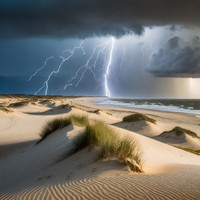
Fulgurite Lightning Sand prices and How it Forms?
Posted by The Science Mall Team on 10th Sep 2026
Fulgurite Lightning Sand Prices and How It Forms
Fulgurites are natural formations created when lightning strikes sand, soil, or rock and rapidly melts or fuses part of the material along the electrical discharge path. Sand fulgurites commonly form hollow, branching tubes with a smooth or glassy interior and an exterior coated with partly fused sand grains.
Often called lightning glass, petrified lightning, or lightning sand, fulgurites preserve physical evidence of one of Earth's most energetic natural processes. Their unusual structures make them scientifically interesting and highly collectible.
Yes. Fulgurites can have collectible value, especially when they are large, intact, strongly branched, unusually shaped, well documented, or from an important locality. Small, common fragments may be inexpensive, while exceptional display specimens can sell for hundreds of dollars or more— condition, size, morphology, provenance, rarity, and appearance all influence value.
View authentic fulgurites available at ScienceMall-USA.
What Is a Fulgurite?
A fulgurite is a natural structure produced when a lightning discharge enters the ground and transfers enough energy to rapidly heat, melt, fuse, or otherwise alter the material it passes through.
Sand fulgurites are the best-known form. They often resemble roots, branches, tubes, or irregular sculptures. A typical sand fulgurite has a rough exterior made from attached sand grains surrounding a smoother, partly glassy interior.
The name comes from the Latin word fulgur, meaning lightning.
Fulgurites are sometimes casually described as pieces of lechatelierite, but the terms are not exactly interchangeable. A fulgurite is the entire lightning-formed geological object. Lechatelierite is a silica-rich natural glass that can form within silica-rich fulgurites when quartz or other silica-bearing material is melted by extreme heat.
How Does Lightning Make Fulgurite?
When lightning strikes sandy or rocky ground, it concentrates tremendous electrical energy along a narrow path. Silica-rich material can be heated above its melting temperature almost instantaneously.
Quartz-rich sand requires temperatures of roughly 1,700-1,800°C to melt efficiently. A lightning discharge can produce temperatures well above those required for melting along portions of its path.
The event is extraordinarily brief. Material melts and then cools so rapidly that some of it solidifies as glass before an orderly crystal structure can reform.
The result can preserve the branching geometry of the electrical discharge underground.
This explains one of the most fascinating features of a fulgurite: it is not simply sand that became hot. Its form can record part of the route electrical energy took as it plunged through the ground.
Why Are Many Fulgurites Hollow?
Many sand fulgurites contain a hollow central channel. As the lightning discharge moves through the sediment, intense heating melts material surrounding the electrical pathway while gases, vaporized moisture, and expanding hot material help create an open or partially open interior.
The inside may be smooth, glass-lined, bubbly, or vesicular. The outside is generally much rougher because unmelted and partly melted grains adhere to the rapidly cooling surface.
This contrast between the rough exterior and glassy interior is one of the easiest ways to recognize a well-preserved sand fulgurite.
What Are Fulgurites Made Of?
No single chemical composition applies to all fulgurites. Their chemistry reflects the material struck by lightning.
A fulgurite formed in nearly pure quartz sand may contain abundant silica glass. A fulgurite formed in soil can incorporate clay minerals, iron oxides, feldspar, organic material, and other components. Rock fulgurites reflect the host rock's mineral composition.
Colors can therefore vary greatly. Fulgurites may be white, tan, gray, brown, greenish, reddish, or nearly black depending on their source material and the degree of melting and chemical alteration.
Types of Fulgurites
Fulgurites occur in more forms than the familiar hollow sand tube. Modern classifications recognize several varieties based on the material struck and the resulting morphology.
Sand Fulgurites
These are the classic tubular and branching forms produced in sand. They may have thin walls, hollow interiors, delicate branches, and surfaces heavily coated with fused sand grains.
Soil Fulgurites
Lightning striking more complex soils can produce irregular, glass-rich masses rather than clean tubes. Their composition may include clay, silt, gravel, and other sediment.
Rock Fulgurites
Lightning can also melt the surfaces or fractures of solid rock. Rock fulgurites may appear as thin glassy coatings, veins, channels, or locally melted areas rather than free-standing tubes.
Other Fulgurite Forms
Some lightning events can produce irregular masses, droplets, crusts, or other unusual morphologies. Fulgurites therefore represent a family of lightning-produced geological materials rather than one single shape.
Where Are Fulgurites Found?
Fulgurites have been documented worldwide wherever lightning interacts with suitable ground material.
Sandy deserts, dunes, beaches, and other quartz-rich sediments are particularly favorable for classic sand fulgurites. Rock fulgurites can also occur on exposed mountain summits and ridges where lightning frequently strikes exposed bedrock.
Researchers have documented well-known fulgurites in Europe, North America, Africa, and other regions. Their occurrence can even provide information about past lightning activity and environmental conditions.
Finding a fulgurite does not necessarily mean the surrounding area is unusually rich in them. Many are fragile and are destroyed by erosion, excavation, weather, or the collection process before they can be preserved intact.
Are Fulgurites Rare?
Lightning itself is common globally, but well-preserved fulgurites are comparatively uncommon.
Several conditions must come together. The strike must enter material capable of recording the event, sufficient melting or fusion must occur, and the resulting structure must survive after formation.
Long, branching sand fulgurites are particularly difficult to recover intact because their walls may be thin and fragile. Many specimens break naturally underground or during excavation.
For collectors, therefore, rarity depends not simply on whether the material is a fulgurite, but on the quality and completeness of the individual specimen.
What Makes a Fulgurite Valuable?
There is no universal price for fulgurites. Like mineral specimens and fossils, their value depends on several characteristics.
- Size: Larger intact specimens are generally harder to recover.
- Completeness: Long continuous sections and preserved branches can add considerable interest.
- Forms: Sculptural, branching, unusual, or recognizable forms may be especially desirable.
- Interior structure: Open tubes and clearly visible glass-lined interiors can increase scientific and display value.
- Color and texture: Unusual natural coloration or contrasting surfaces may increase appeal.
- Locality: A documented geographic source adds scientific and collectible value.
- Provenance: Reliable collection history and authenticity are particularly important for unusual or high-value specimens.
- Condition: Delicate pieces that remain largely intact are generally more desirable than heavily fragmented material.
How Much Do Fulgurites Cost?
Small or common fulgurite fragments may sell for only a few tens of dollars. Better-preserved tubes and attractive display specimens can command considerably more. Large, dramatic, highly branched, unusual, or exceptionally well-documented specimens may sell for hundreds of dollars or more.
Price alone, however, does not determine scientific quality. A smaller specimen with an excellent exposed tube, glassy interior, strong provenance, or unusual formation may be more educational than a much larger but poorly documented piece.
Fulgurites and Scientific Research
Fulgurites are more than geological curiosities. They provide laboratories for studying what happens to minerals during extremely rapid heating and cooling.
Researchers can examine glass formation, mineral transformations, high-temperature reactions, reduction and oxidation processes, magnetic effects, and other changes produced during lightning strikes.
Because a fulgurite records a very brief, high-energy geological event, its minerals and glass can also be compared with materials affected by other extreme processes such as impacts and high-temperature experimental systems.
Fulgurites have additionally been studied as evidence of past lightning activity. In suitable geological settings, their presence may help researchers reconstruct aspects of ancient environments and paleoclimate.
Can You Find Fulgurites Yourself?
They can occur in sandy deserts, dunes, beaches, exposed soils, and lightning-prone mountain environments, but recognizing one in the field can be difficult.
A possible sand fulgurite may show branching geometry, an irregular sand-coated exterior, and a smoother or glassier inner surface where it is broken.
Handle with care, as genuine fulgurites can be extremely fragile. Always check local collecting laws and land-ownership restrictions before removing geological material.
Fulgurites vs. Artificial Lightning Glass
Not every piece of glass created by a powerful electrical discharge is a naturally occurring fulgurite. Artificial electrical arcs can melt sand and produce fulgurite-like glass.
For scientific and collectible specimens, provenance matters. A natural fulgurite should have a credible history connecting it with a natural lightning event or a recognized collecting locality.
This matters especially for unusually colorful, unusually perfect, or highly sculptural material.
Why Collect Fulgurites?
A fulgurite is a rare intersection of geology, physics, mineralogy, and atmospheric science. It is simultaneously a geological specimen and a physical record of electrical energy passing through the Earth.
For a classroom or private collection, it provides an unusually direct way to demonstrate how a process lasting only a fraction of a second can permanently alter natural material.
For serious collectors, exceptional fulgurites can also be striking natural sculptures. Lightning created their branching forms not by carving or crystal growth, but by its own path.
ScienceMall-USA offers documented natural fulgurites ranging from smaller geological specimens to unusual sculptural display pieces.
Frequently Asked Questions About Fulgurites
What exactly is a fulgurite?
A fulgurite is a naturally formed structure produced when lightning strikes sand, soil, or rock and rapidly melts, fuses, or alters material along the electrical discharge path.
Is fulgurite real glass?
Many fulgurites contain natural glass produced by rapid melting and cooling. Silica-rich fulgurites may contain lechatelierite, a natural silica glass.
Why are fulgurites hollow?
Many sand fulgurites form around the path of the electrical discharge. Rapid heating, melting, expanding gases, and vaporized moisture can leave a hollow or partly hollow central channel surrounded by fused material.
Are fulgurites valuable?
They can be. Value depends on size, completeness, branching, appearance, locality, provenance, condition, and rarity. Exceptional intact specimens can be considerably more valuable than ordinary fragments.
How much does a fulgurite cost?
Small fragments may cost only tens of dollars, while attractive intact specimens can sell for substantially more. Large, unusual, highly sculptural, or well-documented specimens can reach hundreds of dollars or more.
Is every fulgurite made from sand?
No. Lightning can produce fulgurites in sand, soil, sediment, and solid rock. Their composition and shape depend heavily on the material struck.
Is fulgurite the same thing as lechatelierite?
No. Fulgurite refers to the geological object formed by lightning. Lechatelierite is a natural silica glass that may occur within silica-rich fulgurites.
Where are fulgurites found?
They have been found worldwide. Classic sand fulgurites are commonly associated with sandy deserts, dunes, beaches, and other silica-rich sediments, while rock fulgurites can occur on exposed mountain summits and bedrock surfaces.
Scientific References
Utah Geological Survey. What Are Fulgurites and Where Can They Be Found?
Oxford University Museum of Natural History. Fulgurites.
Additional scientific literature: Studies of fulgurite morphology, petrology, mineral transformations, natural glass formation, and paleolightning provide the basis for modern fulgurite classification and interpretation.
ScienceMall-USA educational geology article. Revised and expanded in 2026.