
Earth's Magnetic Field and Isua Banded Iron
Posted by The Science Mall Team on 28th Apr 2024
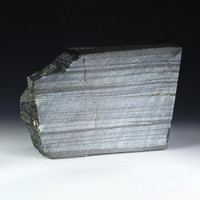
Isua banded iron comes from one of the oldest surviving geological regions on Earth.
In 2024, researchers at the University of Oxford and MIT reported evidence that selected rocks in Greenland's Isua Greenstone Belt preserve a magnetic field record about 3.7 billion years old. It is one of the earliest known records of Earth's magnetic field preserved in rocks.
Where Does Isua Banded Iron Come From?
The Isua Greenstone Belt, also called the Isua Supracrustal Belt, lies in southwestern Greenland within the Itsaq Gneiss Complex. Metamorphism has altered its ancient volcanic and sedimentary rocks. The belt includes rocks approximately 3.8 to 3.7 billion years old; the magnetic study focused on banded iron formation in its northeastern region.
For collectors, Isua banded iron specimens provide a tangible connection to this early chapter of Earth's history.
How Can a Rock Preserve an Ancient Magnetic Field?
Magnetic minerals can retain magnetization acquired in Earth's magnetic field. In the Isua rocks studied, the researchers interpreted the ancient signal as magnetization acquired when magnetite formed during metamorphism around 3.7 billion years ago. This differs from simply recording when the original sediments were deposited.
Later heating and mineral alteration can change that record. To assess its age, the team combined laboratory measurements with geological field tests, mineral studies, and radiometric dating.
What Did the 2024 Study Find?
The researchers reported a field-strength estimate of at least approximately 15 microtesla, interpreted as a lower limit. Their results suggest the ancient field could have been comparable in strength to today's, but they do not establish identical strength or an unchanged field through time.
Is This Earth's Earliest Magnetic Field Record?
Isua provides unusually ancient whole-rock evidence. Older magnetic records have been proposed from individual zircon crystals, but their interpretation remains debated. Describing Isua as preserving one of the earliest known records of Earth's magnetic field conveys its importance without treating all older claims as settled.
Why Does This Discovery Matter?
Earth's magnetic field is generated by a dynamo in the electrically conducting liquid outer core. Ancient magnetic records help scientists investigate how that dynamo operated early in Earth's history.
They also inform research into the interaction between the early atmosphere and the stronger solar wind of the young Sun. The Isua results help constrain those conditions; they do not prove that life would have been impossible without a magnetic field.
Isua Rocks for Sale for Collections and Education
Our documented Isua specimens come from the region central to this early-Earth magnetic field research. The magnetic findings apply to the samples and locations investigated in the study.
Explore Earth's oldest rocks for specimens that bring deep geological time into collections, classrooms, and displays.
Scientific Sources
- Nichols and colleagues (2024): Possible Eoarchean Records of the Geomagnetic Field Preserved in the Isua Supracrustal Belt, Southern West Greenland, Journal of Geophysical Research: Solid Earth.
- University of Oxford: Research summary, April 24, 2024.
- MIT: Research summary, April 24, 2024.
- Geological context: Isua Supracrustal Belt and the Itsaq Gneiss Complex.