

2026: Rock of the Year Award - Trinitite
Posted by The Science Mall Team on 6th Feb 2026
Why Trinitite is the 2026 Rock of the Year Award
ScienceMall-USA has selected trinitite as its 2026 Rock of the Year - a remarkable human-made geological material formed during the world's first nuclear detonation at the Trinity test site in New Mexico on July 16, 1945.
Few geological specimens can be tied to a single event, place, and moment in history as precisely as trinitite. It formed when the Trinity nuclear test exposed the desert surface to extraordinary heat and energy, melting and fusing portions of the local sand into glass.
The result was not simply an artifact of the Atomic Age. Trinitite became a physical record of the moment human technology acquired the ability to alter natural materials through nuclear processes on an unprecedented scale.
For that reason, we chose trinitite as the inaugural ScienceMall-USA Rock of the Year.
What Is Trinitite?
Trinitite is the glassy post-detonation material produced by the Trinity nuclear test at the Alamogordo Bombing Range, now part of White Sands Missile Range in New Mexico.
The Trinity device, known as the "Gadget," was a plutonium implosion device detonated shortly before sunrise on July 16, 1945. The explosion melted portions of the ground surface around ground zero, producing green, black, and, less commonly, red varieties of glassy material known as trinitite.
Scientific analyses show that trinitite is derived largely from the arkosic desert sand present at the site. The glass may also contain material derived from the test apparatus and other human-made components associated with the explosion.
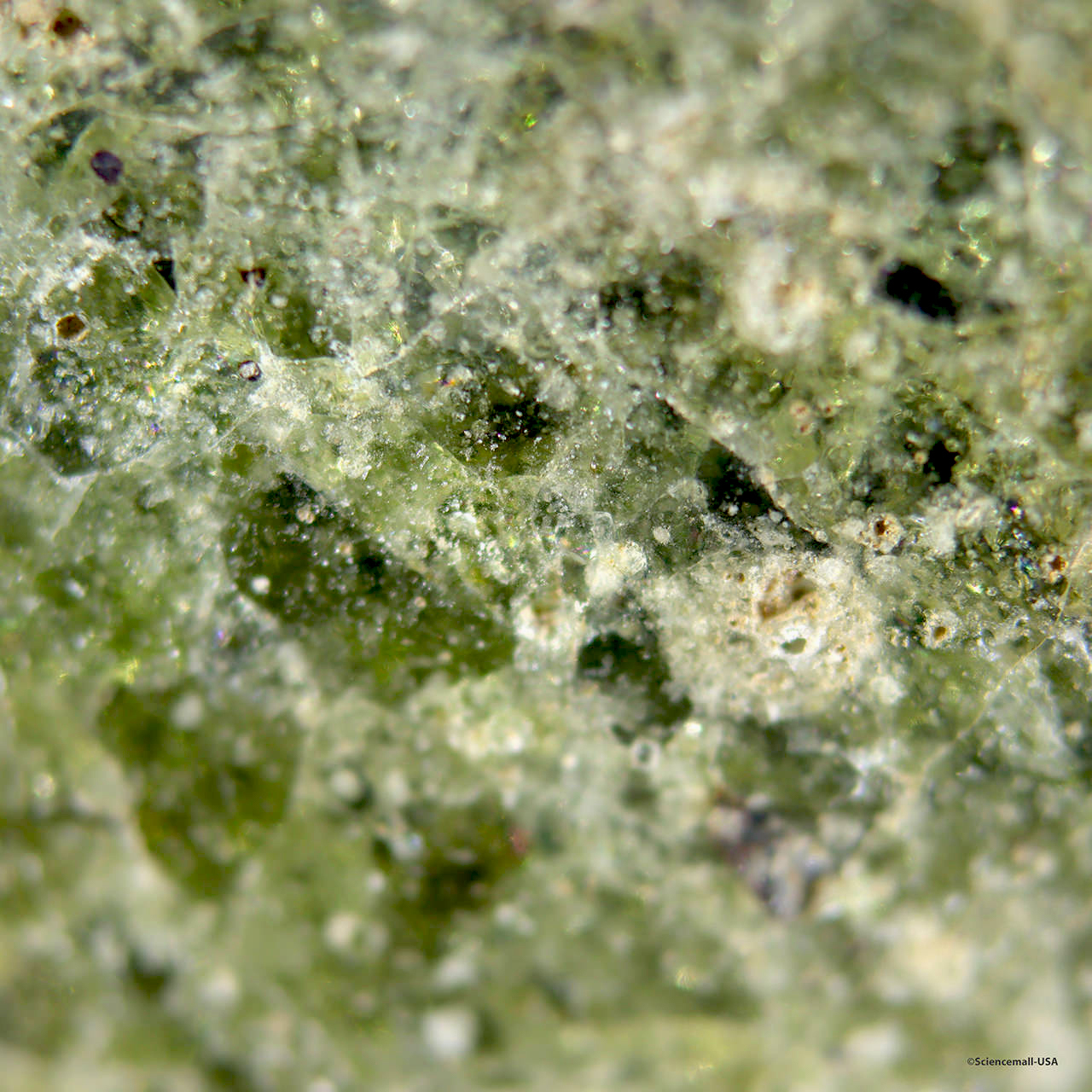
At microscopic scales, trinitite can preserve partially melted mineral grains, gas-produced vesicles, glassy matrices, metallic components, and chemical or isotopic evidence related to the nuclear event.
The Trinity Test: When Technology Became Geology
At approximately 5:29:45 a.m. Mountain War Time on July 16, 1945, the Trinity device detonated above the New Mexico desert. It was the world's first nuclear explosion and the culmination of years of research by the Manhattan Project.
The event lasted only moments, but it permanently changed the physical material beneath it.
Sand that had accumulated through ordinary geological processes was suddenly subjected to an extraordinary human-generated energy source. Quartz, feldspar, and other minerals melted or partially melted. Material associated with the test infrastructure became mixed with the molten surface material. As the melt cooled, trinitite formed.
In that sense, Trinity represents an unusual intersection between geology and technology. The starting material was natural. The process that transformed it was entirely anthropogenic.
What Trinitite Records Scientifically
Trinitite is scientifically valuable because it preserves information about both its geological precursor materials and the nuclear event that created it.
Researchers have studied trinitite using electron microscopy, mass spectrometry, isotope analysis, and other analytical techniques. Studies have identified natural mineral components inherited from the original desert sand as well as copper, lead, radionuclides, and other materials connected with the Trinity device and test infrastructure.
This makes trinitite much more than green and/or black, red glass.
It is a complex post-detonation material in which geological and human-made components mixed during this extreme event and were preserved as the resulting melt cooled.
A Geological Record of the Nuclear Age
Trinitite should not be confused with a formally defined stratigraphic boundary such as the Cretaceous-Paleogene boundary. The K-Pg boundary is a globally recognized geological boundary associated with a worldwide layer containing evidence of the Chicxulub impact.
Trinitite is different. Its distribution is local to the Trinity test site.
Nevertheless, it is an exceptionally precise material record of a major transition in human history. We know where it formed, why it formed, and almost exactly when it formed.
That degree of temporal precision is unusual in geology.
Trinitite therefore functions as a tangible geological artifact of the beginning of the Nuclear Age - a material created when human technological activity became capable of producing entirely new geological products.
Why Trinitite Is Our 2026 Rock of the Year
The ScienceMall-USA Rock of the Year designation recognizes geological materials that help explain important transitions in Earth history, science, technology, or the relationship between humanity and the physical planet.
Trinitite was selected for 2026 because it represents an unusually clear example of an irreversible technological threshold.
Before Trinity, nuclear fission had been demonstrated scientifically, but a nuclear weapon had never been detonated. After July 16, 1945, that distinction disappeared permanently.
The physical evidence of that transition remains in trinitite.
Its importance therefore comes from more than rarity, appearance, or collectibility. Its significance lies in what the material records.
Why Choose Trinitite in 2026?
There is another reason Trinitite seems particularly appropriate for 2026.
Human civilization is again experiencing a period of exceptionally rapid technological change, particularly through artificial intelligence, autonomous systems, computation, robotics, and machine-mediated decision-making.
The comparison between 1945 and 2026 is interpretive rather than geological. Artificial intelligence does not create a formal geological boundary, and trinitite itself records 1945 - not 2026.
But the historical parallel is worth considering.
Trinity represents a moment when an experimental technology moved decisively into the physical world and permanently changed what humanity could do. Artificial intelligence is now undergoing its own transition from experimental systems into technologies increasingly embedded in science, industry, communications, logistics, finance, medicine, and everyday decision-making.
Whether historians eventually regard the mid-2020s as a comparable technological threshold remains to be seen.
Trinitite gives us something tangible with which to examine what such thresholds look like after they have already occurred.
Silicon, Trinitite, and the Modern Technological World
Trinitite also has an interesting material connection to modern computing.
The desert sand from which most trinitite formed contains abundant silicate minerals, particularly quartz and feldspar. Silicon is also the fundamental semiconductor element underlying most modern integrated circuits.
These are very different forms of silicon-containing material, and trinitite should not be described as computer material. The connection is instead symbolic: one of the most historically important technological rocks of the twentieth century is dominated by geological materials built from silicon and oxygen, while elemental silicon became fundamental to the computing revolution that followed.
Is Trinitite a Rock or a Glass?
Trinitite is best described as an anthropogenic glassy melt material, or post-detonation melt glass.
It does not fit neatly into the traditional three-part classification of igneous, sedimentary, and metamorphic rocks because its energy source was human-generated.
However, collectors, geologists, museums, and researchers commonly treat trinitite alongside other event-produced geological materials such as impact melt rocks, tektites, and fulgurites.
The terminology is therefore partly contextual. Calling trinitite a "rock" in a collection is reasonable, provided its more precise origin as nuclear-test melt glass is understood.
What Makes Authentic Trinitite Important?
Authentic Trinity-site trinitite is historically finite. The original material formed during one event on one morning in 1945.
You can't recreate it simply by melting sand. Its scientific identity comes from its provenance, mineralogical characteristics, anthropogenic components, and association with the Trinity nuclear test.
This makes documented provenance especially important when trinitite is used for scientific study, education, museum displays, or serious collections.
Original surfaces can also preserve useful textures such as vesicles, partially melted grains, flow structures, and other evidence of rapid melting and cooling. For scientifically important specimens, unnecessary polishing or alteration can remove some of that information.
Frequently Asked Questions About Trinitite
When did trinitite form?
Trinitite formed during and immediately following the Trinity nuclear test on July 16, 1945, in New Mexico. The detonation occurred at approximately 5:29:45 a.m. local wartime.
What is trinitite made of?
Trinitite consists primarily of glass produced from melted local desert sand, including material derived from quartz and feldspar. Individual specimens may also contain partially melted mineral grains and components associated with the nuclear device or test infrastructure.
Why is trinitite usually green?
The familiar pale green color results from the composition of the melted desert material and trace constituents incorporated into the glass. Trinitite is heterogeneous, however, and colors can range from pale green to darker green, gray, black, and uncommon reddish material.
Is trinitite still radioactive?
Authentic trinitite can retain measurable radionuclides from the Trinity event. The amount and composition can vary considerably among specimens. Radiation characteristics should therefore be evaluated scientifically rather than assumed from appearance alone.
Is trinitite a formal geological boundary marker?
No. Trinitite is not a formally recognized global stratigraphic boundary. It is better described as a highly time-specific anthropogenic geological material that records the beginning of the Nuclear Age at the Trinity site.
Why is provenance important with trinitite?
Because ordinary glass or melted sand can resemble some trinitite, reliable provenance is important. Documentation connecting a specimen to historically collected Trinity-site material greatly strengthens its scientific and collectible significance.
Rock of the Year - Established 2026
2026 Science Mall Rock of the Year: Trinitite
Formation: Trinity nuclear test, New Mexico, July 16, 1945
Material: Anthropogenic post-detonation melt glass formed primarily from fused desert sand
Significance: Physical geological evidence of the world's first nuclear detonation and the beginning of the Nuclear Age
Why it matters: Trinitite preserves one of the clearest examples of technology becoming permanently recorded in geological material.
The ScienceMall-USA Rock of the Year is an educational and curatorial designation established by ScienceMall-USA in 2026. It is not a formal geological classification or an award issued by a professional geological organization.
Scientific References
For additional information on the Trinity test and the scientific study of trinitite:
U.S. Department of Energy - Trinity Site: World's First Nuclear Explosion
Analytical Chemistry - Oxygen Isotope Composition of Trinitite Postdetonation Materials