
Agate - Baranowski Glacier, Antarctica - 85 g
Brand : Sciencemall-USA
- SKU:
- JPT-73749
- Condition:
- New
- Availability:
- Usually ships in 24 hours.
- Weight:
- 1.00 LBS
- Minimum Purchase:
- 1 unit
- Maximum Purchase:
- 1 unit
- Shipping:
- Calculated at Checkout

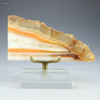
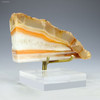


Antarctic agate from the Baranowski Glacier area - King George Island, Antarctica
Buy a remarkably beautiful and rare Antarctic agate from the Baranowski Glacier area of King George Island, Antarctica. This specimen is a highly displayable wedge-cut agate with creamy white, vivid orange-amber, pale tan-to-caramel chalcedony, and a frosty white quartz-rich center. It is an excellent specimen for collectors, educators, and anyone interested in the volcanic geology of Antarctica.
Agate from Antarctica Details:
This specimen has been cut into a wedge shape and features two flat faces that display the internal architecture of the agate. The top sloping edge preserves part of the rugged natural crust or matrix, where silica originally lined or filled a cavity in volcanic rock. On one side, the banding terminates sharply into a scalloped, botryoidal surface with deep carnelian-red borders, showing the way mineral-rich fluids pooled, cooled, and crystallized against the chamber wall.
Antarctic Agate and Volcanic Geology
This specimen represents a dramatic and less familiar side of Antarctica: its volcanic past. Antarctica is often imagined as ice alone, but the continent and nearby island groups include ancient metamorphic rocks, igneous rocks, volcanic terrains, and glacially exposed geological deposits.
Agates commonly form in volcanic environments when gas bubbles, fractures, or cavities in cooling lava are later filled by silica-rich fluids. Over time, those fluids deposit microscopic layers of chalcedony and quartz. Changes in chemistry, trace mineral content, oxidation, and fluid movement can produce distinct bands, color shifts, translucent zones, and crystal-lined interiors.
While agates are best known from major collecting regions such as Brazil, Mexico, and the western United States, Antarctic agates are much less commonly available. A specimen from the Baranowski Glacier area of King George Island combines agate formation, volcanic history, glacial exposure, and a rare polar locality in one compact display piece.
Product Information
| Object Type | Antarctic agate, chalcedony, and quartz specimen |
| Locality | Baranowski Glacier area, King George Island, Antarctica |
| Dimensions | 85 mm L x 41 mm W x 15 mm D, Weight: 85 grams |
| Specimen Description | Wedge-cut agate with creamy white, vivid orange-amber, translucent pale tan-to-caramel chalcedony, frosty white quartz or druzy chalcedony, natural crust, and botryoidal side termination |
| Scientific Significance | Connects the agate formation with volcanic cavities, silica-rich fluids, glacial exposure, and the geological history of Antarctica |
| Provenance | From an old scientific collection. Legally collected in the 1960s. |
| Condition | No repairs. Photographed with a light spray of water. |
| What Is Included | Certificate of Authenticity, specimen tag, tag stand, and information about agates and Antarctic volcanology |
| Not Included | Sizing cube and display stand are not included. |
| Use and Display | Suitable for mineral, agate, Antarctic geology, volcanic geology, classroom, museum-style, or private scientific display collections |
| Authentication and Compliance | Ships with a Sciencemall-USA Certificate of Authenticity and specimen documentation. |
| Shipping | Shipping calculated at checkout |
| U.S. Shipping | Free Priority Shipping within the USA |
Images professionally photographed under controlled studio lighting using Zeiss optics and a pro-grade Canon camera.
Rarity and Significance
| Scientific Significance | ★★★★ |
| Market Availability | ★ |
| Locality Specificity | ★★★★★ |
| Display Appeal | ★★★★★ |
This Antarctic agate is a rare, highly visual specimen with strong locality appeal. Its combination of vivid orange-amber chalcedony, frosty white quartz, natural crust, botryoidal side texture, and King George Island provenance makes it especially appealing to collectors seeking an agate with a story beyond that of an ordinary decorative material.
Questions Commonly Asked
What is this specimen?
This is an Antarctic agate specimen from the Baranowski Glacier area of King George Island. It contains chalcedony and quartz deposited in bands and layers within an original volcanic cavity or related void space.
Why is an Antarctic agate unusual?
Agates are widely collected from many parts of the world, but attractive agate specimens from Antarctica are much less commonly available. The polar locality gives this specimen unusual collecting and educational appeal.
How do agates form in volcanic rocks?
Agates commonly form when silica-rich fluids move into cavities, gas bubbles, or fractures in volcanic rock. As the fluids cool and change chemically, they deposit chalcedony and quartz in layers, creating bands, translucent zones, and crystal-lined interiors.
What is the frosty white center?
The frosty white center is a quartz-rich or druzy chalcedony zone. It gives the specimen a textured, crystalline appearance and contrasts strongly with the orange-amber chalcedony bands.
What does the natural crust show?
The preserved natural crust or matrix along the sloping edge helps show the original outer surface of the agate-bearing rock. It gives context to the polished interior and shows that this was once part of a larger volcanic cavity system.
Is this a good educational specimen?
Yes. This specimen is useful for discussing agate formation, chalcedony, quartz, volcanic cavities, glacial exposure, and the broader, fascinating geological story of Antarctica and King George Island.
Add this rare Antarctic agate to a mineral collection, a classroom geology display, an Antarctic science exhibit, or a museum-style Earth science collection. ONLY 1 AVAILABLE.
This Antarctic agate is significant because it combines the familiar beauty of banded chalcedony with a rare polar locality and a volcanic origin story. It is a compact specimen that helps connect mineral formation, volcanic cavities, silica-rich fluids, glacial exposure, and the geological complexity of Antarctica.

