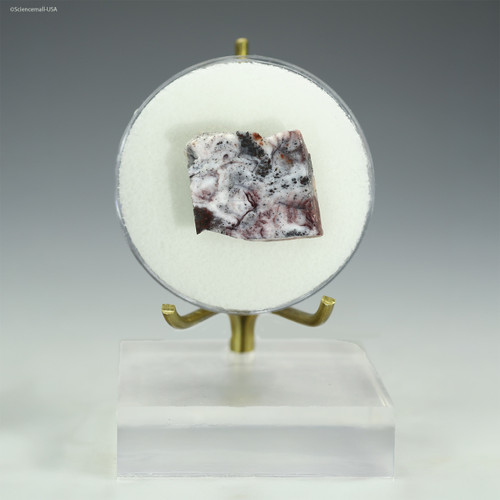
Kola Superdeep Borehole Specimen - Kola, Russia
Brand : Sciencemall-USA
- SKU:
- JPT-85998
- Availability:
- Usually ships in 24 hours.
- Weight:
- 1.00 LBS
- Minimum Purchase:
- 1 unit
- Maximum Purchase:
- 1 unit
- Shipping:
- Calculated at Checkout



Kola Superdeep Borehole crystalline metamorphic rock - Russia
This is a crystalline metamorphic rock specimen from the Kola Superdeep Borehole drill core, recovered from approximately 3,780 meters below the surface on the Kola Peninsula, Russia. The specimen displays a coarse, multicolored crystalline texture with feldspar-rich light minerals and darker mafic mineral areas.
The Kola Superdeep Borehole remains one of the most famous scientific drilling projects in Earth history, created to study the composition, structure, temperature, and behavior of deep continental crust. At this reported depth, this material is consistent with crystalline metamorphic rocks associated with the Proterozoic Pechenga section.
Kola Borehole Geological Significance
The Kola Superdeep Borehole, also known as SG-3, was drilled in the northwestern Soviet Union on the Kola Peninsula and reached more than 12 kilometers into Earth's crust. It became a landmark scientific project because it provided direct access to deep continental rocks rather than relying only on surface exposures, seismic interpretation, or theoretical models.
Material attributed to approximately 3,780 meters represents rock from far below ordinary collecting depth. This is not a decorative rock in the usual sense; it is a physical reference to scientific drilling, crustal research, and the long-standing effort to understand the hidden architecture of the continental crust.
The specimen's coarse crystalline texture, mixed light and dark mineral components, and oxidized surface coloration are consistent with metamorphic crystalline material.
This specimen was acquired from an old scientific estate collection and is accompanied by a COA, Sciencemall-USA.
Product Information
| Object Type | Crystalline metamorphic rock from the Kola Superdeep Borehole |
| Locality | Kola Superdeep Borehole, Kola Peninsula, Russia |
| Reported Depth | Approximately 3,780 meters below the surface |
| Dimensions | 45 mm L x 38 mm W x 17 mm D |
| Specimen Description | Coarse multicolored crystalline rock with light feldspar- and quartz-rich areas, darker mafic mineral patches |
| Scientific Significance | Represents material attributed to one of the deepest and most historically important continental scientific drilling projects |
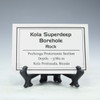
| What Is Included | Certificate of Authenticity, specimen tag, tag stand, and information about the specimen |
| Use and Display | Suitable for deep crust, geology, Earth science, drilling history, classroom, museum-style, or private scientific display collections |
| Authentication and Compliance | Ships with a Sciencemall-USA Certificate of Authenticity and specimen documentation. |
| Shipping | Shipping calculated at checkout |
| U.S. Shipping | Free Priority Shipping within the USA |
Images professionally photographed under controlled studio lighting using Zeiss optics and a pro-grade Canon camera.
Rarity and Significance
| Scientific Significance | ★★★★★+ |
| Market Availability | ⅛ ★ |
| Locality Specificity | ★★★★★ |
| Display Appeal | ★★★★ |
This Kola Superdeep Borehole specimen is a compact, highly displayable example of deep crustal material with unusual historical and scientific context. It is especially well-suited for collectors interested in scientific drilling, Earth's crust, Russian geology, and landmark geoscience projects.
Questions Commonly Asked
What is the Kola Superdeep Borehole?
The Kola Superdeep Borehole was a major scientific drilling project on the Kola Peninsula in Russia. It was drilled to study the deep continental crust and became famous for reaching ~7.5 miles below the surface.
What kind of rock is it?
The specimen is best described as a crystalline metamorphic rock. It shows a coarse crystalline texture with light feldspar- and quartz-rich areas, and darker mafic minerals.
Why is the Kola Borehole material collectible?
Kola Borehole material makes a top-tier collectible because it comes from one of the most historically significant deep-drilling projects ever undertaken. It connects directly to scientific research into the deep continental crust, making it more than a typical geological hand specimen.
What did the Kola Borehole reveal about the Conrad Discontinuity?
Before drilling began at the Kola Superdeep Borehole in 1970, geologists used seismic wave data to model Earth's crust. A change in seismic wave velocity at depth had often been interpreted as evidence for the Conrad Discontinuity: a proposed transition from an upper granitic crustal layer to a denser, more basaltic lower crust.
The Kola Borehole challenged that simple model. When drilling passed approximately 7 kilometers in depth, the expected basaltic layer was not encountered. Instead, the borehole continued through granitic and gneissic crystalline rocks. The seismic velocity change was better explained by physical and metamorphic changes in the crust, including fracturing, heat, pressure, mineral alteration, and changes in rock density, rather than by a sharp change from granite to basalt.
This made Kola important because it showed that seismic boundaries do not always correspond to simple rock-type boundaries. The borehole helped demonstrate that Earth's continental crust is more complex than earlier layered models suggested.
How did the mechanics change as scientists drilled deeper?
As scientists drilled deeper into the Kola Superdeep Borehole, the geothermal gradient rose faster than expected. Near the deepest part of the borehole, temperatures reached approximately 180°C (356°F), rather than the roughly 100°C predicted.
Under that combination of high temperature and immense pressure, the rock no longer behaved like a simple cold, rigid solid. It became mechanically difficult to drill because the deep crustal rock could deform, creep, and slowly warp back toward the open borehole after the drill bit was withdrawn.
This was one reason the project became increasingly difficult at great depth. The deeper section of the borehole revealed not only unexpected heat but also the physical challenge of drilling rock that was beginning to behave more plastically under deep-crustal conditions.
Did deep Kola Borehole rocks experience a geological version of "the bends"?
In a loose analogy, yes. Rocks brought up from the deepest sections of the Kola Superdeep Borehole were not experiencing "the bends" in the biological sense, but they did undergo a dramatic release of confining pressure as they were brought from deep-crust conditions to the surface.
At depths of 9 kilometers or more, crystalline rock is held under immense pressure. When that pressure is suddenly removed, pre-existing grain boundaries, mineral weaknesses, and microscopic fractures can open or expand. This decompression damage can increase microfracturing, change acoustic behavior, and make some deep core samples more brittle than similar rocks collected at the surface.
The result is that deep-borehole cores may behave differently from regular land rocks. Some can show pressure-release cracking, altered porosity, and dampened or unusual acoustic response when handled or gently tapped. This is one reason Kola material is scientifically interesting: it records not only the deep crustal composition but also the physical stress history of rock recovered from far below ordinary collecting depths.
Add this Kola Superdeep Borehole specimen to a serious Earth science collection, deep crust display, or educational geology exhibit. ONLY 2 AVAILABLE.
Material from the Kola Superdeep Borehole has unusual scientific significance because it represents rock recovered from depths far below ordinary collection depths. Its value lies not only in its appearance but also in its connection to one of the most ambitious attempts to directly study Earth's deep continental crust.
![Freshwater stromatolite Eocene Kuban Basin Russia [97849] shown front on a plexiglass riser.](https://cdn11.bigcommerce.com/s-ijipkdz2cc/images/stencil/500x659/products/449/3593/stromatolite-kuban-basin-russia-front-97849__91837.1738630230.jpg?c=1 "Freshwater stromatolite Eocene Kuban Basin Russia [97849] shown front on a plexiglass riser.")