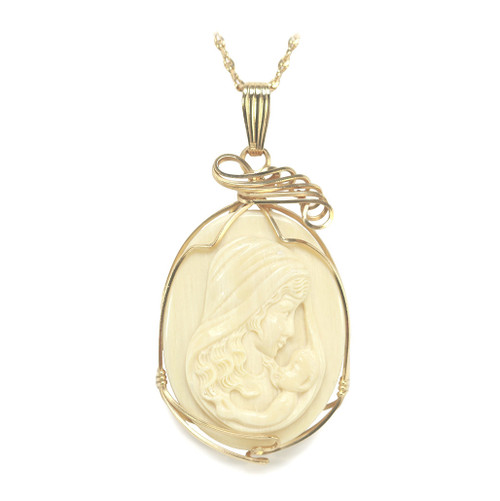
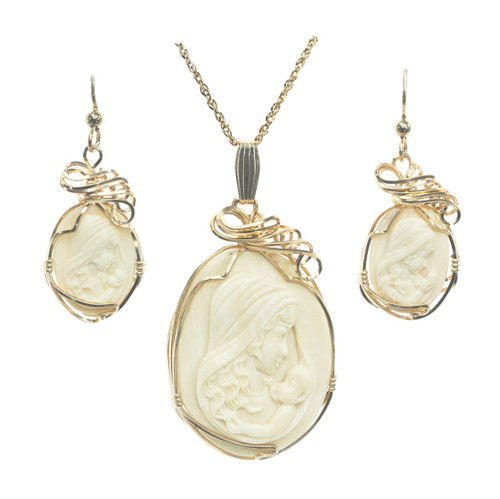
Mammoth Ivory Hooded Woman Cameo Jewelry - Large
Brand : Astra Terra Jewelry
- SKU:
- JPT-67911
- Condition:
- New
- Availability:
- Usually ships in 24 hours.
- Weight:
- 1.00 LBS
- Minimum Purchase:
- 1 unit
- Maximum Purchase:
- 2 units
- Shipping:
- Calculated at Checkout


Woolly Mammoth Ivory Cameo — Hooded Woman
A large cameo hand-carved from a fossil woolly mammoth tusk (Mammuthus primigenius) recovered from Alaskan permafrost and professionally hand-wire-wrapped in 14k gold. This is one-of-a-kind mammoth ivory jewelry, professionally trimmed and carved by hand from a single piece of tusk.
About This Mammoth Ivory Jewelry
The carving exquisitely depicts a hooded Victorian woman in bas-relief. The Alaska Native artisan creatively hand-carved her image from a single field of pale cream mammoth ivory, so her form is easily seen through depth and shadow rather than color. The fine growth lines of the tusk run softly behind her. The cream and ivory-white tones are original to the material — nothing has been bleached, dyed, or stabilized.
Is It Legal to Sell Mammoth Ivory?
Yes. Mammoth ivory is the tusk dentine of an extinct Ice Age proboscidean, not the product of any living animal. Because the woolly mammoth is an extinct species, it is not listed in the CITES Appendices and cannot be listed under the U.S. Endangered Species Act, which protects living species. Mammoth ivory, therefore, falls outside the federal restrictions governing elephant ivory, and it has been the preferred legal medium for cameo carving and scrimshaw for decades.
The Last Mammoths
Most woolly mammoths disappeared near the end of the last Ice Age, and mainland populations were essentially gone by about 10,000 years ago. A few isolated groups held on far longer. Mammoths survived on St. Paul Island, Alaska, until roughly 5,600 years ago, and the last known population of all, on Wrangel Island in Arctic Siberia, endured until about 4,000 years ago — roughly 2000 BCE, when the pyramids of Egypt were already centuries old.
Where Mammoth Ivory Sales Are Prohibited
Eight states ban the sale of mammoth ivory: California, New York, New Jersey, Illinois, New Hampshire, Nevada, Oregon, and Hawaii. Their statutes define the term "ivory" so loosely that fossil mammoth ivory is swept in alongside elephant ivory, even though the mammoth has been extinct since ~4 ka (about 2000 BCE). We cannot ship to or accept orders from those states. International buyers should confirm their own import rules before ordering. This is a statement of regulatory status, not legal advice.
Product Information
| Object | Hand-carved cameo pendant, Hooded Woman design |
| Material | Fossil mammoth ivory, Mammuthus primigenius |
| Geologic Age of Ivory | Late Pleistocene, roughly 12,000 to more than 40,000 years ago |
| Source Region | Alaska, USA — permafrost and placer deposits |
| Mounting | Professionally hand-wire-wrapped in 14k gold |
| Cameo Dimensions | 28 mm W × 40 mm L × 8 mm D |
| Pendant with Bail | 2 1/4 in L × 1 1/8 in W × 1/4 in D |
| Chain | Gold-filled chain included at no charge. The cameo is shown on a box chain. |
| Occasion | Elegant evening-wear; heirloom quality |
| Science Gift Options | Legal mammoth ivory, an exquisite natural history jewelry cameo gift, artisan hand-wire-wrapped in 14k gold and professionally carved by an Alaska Native artisan. It arrives complete with COA, jewelry box, and a free gold-filled chain, ready to give for an anniversary, birthday, special occasion, or Christmas gift. |
| What’s Included | Certificate of Authenticity (COA), information about mammoth ivory jewelry, attractive jewelry box, free gold-filled chain |
| Authenticity | Guaranteed authentic fossil mammoth ivory, Certificate of Authenticity (COA) included |
| Legality | Fossil ivory from an extinct species, not regulated under CITES or the U.S. Endangered Species Act. Some states define ivory broadly enough to include mammoth ivory, though the last woolly mammoths died out around 2000 BCE. |
| Shipping Restrictions | Sales are banned in California, New York, New Jersey, Illinois, New Hampshire, Nevada, Oregon, and Hawaii. We cannot ship to or accept orders from those states. International buyers are responsible for confirming their own national import rules before ordering. |
| Brand | Astra Terra Jewelry |
| SKU | JPT-67911 |
| Availability | ONLY 1 AVAILABLE |
Images professionally photographed under controlled studio lighting using Zeiss optics and a pro-grade Canon camera, for guaranteed accuracy.
Rarity and Significance
| Carved Jewelry Rarity | ★★★★★ |
| Carving Quality | ★★★★★ |
| Size for the Form | ★★★★★ |
| Heirloom Value | ★★★★★ |
Questions Commonly Asked
Are mammoth tusks ivory?
Yes. Mammoth ivory is dentine from the tusk of the woolly mammoth, Mammuthus primigenius, and it is true ivory in every structural sense. A mammoth tusk is a continuously growing upper incisor, laid down in nested conical increments over the animal's lifetime. That growth architecture is what makes the material carvable: the dentine is dense, fine-grained, and free of the porosity found in bone, so it takes an undercut edge and holds a polish. The woolly mammoth disappeared from mainland Alaska by about 10,000 years ago, so every carved woolly mammoth tusk on the market is fossil material recovered from the earth.
What is the difference between mammoth and mastodon?
They are different animals from different families, and they are not closely related despite the resemblance. The woolly mammoth, Mammuthus primigenius, belongs to the family Elephantidae, which also includes living elephants. The American mastodon, Mammut americanum, belongs to the family Mammutidae, a lineage that separated from the elephant lineage more than 20 million years ago. Woolly mammoths and Asian elephants are genetically very similar close relatives, but they represent separate evolutionary lineages that diverged approximately 6–7 million years ago.
Their teeth tell them apart at a glance. Mammoths were grazers, with high-crowned molars built as tightly stacked enamel plates for grinding grasses. Mastodons were browsers, with low, blunt, cone-shaped cusps for crushing twigs and leaves. Mammoths were also taller and rangier, while mastodons were shorter, heavier, and more barrel-bodied.
Their tusks differ in the same way. Mammoth tusks curve strongly and often spiral, while mastodon tusks are straighter and less twisted. Both yield true ivory and exhibit the acute outer Schreger angles characteristic of extinct proboscideans. Mastodon ivory is generally the harder material to carve, because it more often reaches the surface heavily mineralized, darkened, and prone to splitting along its growth cones.
Are mastodons found in Alaska?
They were, but only during warm intervals, and they were gone from the region long before the mammoths were. Mastodons were forest and wetland browsers, so Alaska suited them only when the north carried trees. Zazula and colleagues obtained fifty-three new radiocarbon dates on thirty-six mastodon fossils from Alaska and Yukon and found that the specimens consistently date to beyond or near the fifty-thousand-year limit of radiocarbon, with earlier full-glacial ages traced to contamination, some of it from old museum conservation treatments (Zazula et al., 2014, PNAS 111:18460–18465).
The picture that emerges is of mastodons living in the far north during the last interglacial, around 125,000 years ago, then retreating southward as glacial conditions returned near 75,000 years ago. They were absent from Alaska well before the last glacial maximum, and they held on south of the ice sheets until roughly 10,000 years ago. This is why Alaskan ivory carving is mammoth. Mastodon material from the region is scarce, far older, and too degraded for fine bas-relief work.
How is mammoth ivory different from elephant ivory?
A transverse section of any proboscidean tusk shows a distinctive cross-hatched pattern of intersecting lines known as the Schreger pattern. Where those lines cross near the outside of the tusk, they form measurable angles, and those angles differ between extinct and living proboscideans. The outer Schreger angles of mammoth ivory are acute, below about 90 degrees, while those of modern elephant ivory are obtuse, above about 115 degrees (Espinoza and Mann, 1993, Journal of the American Institute for Conservation 32:241–248).
This is the criterion used in forensic ivory identification and reproduced in the CITES Identification Guide for Ivory and Ivory Substitutes. Because a band of overlap exists between 90 and 115 degrees, the published method calls for multiple angle measurements averaged across a section rather than a single reading. Mastodon ivory, from the related extinct genus Mammut, also falls in the acute range, and discriminant analysis of the full Schreger pattern separates mastodon from mammoth and both from living elephants (Trapani and Fisher, 2003).
Where does this mammoth ivory fossil come from, and how old is it?
Alaskan mammoth ivory weathers out of frozen silt, loess, and reworked placer gravels across interior and northern Alaska, much of it exposed during gold-mining operations. Burial in permafrost is the reason the material survives at all: the tusks are kept frozen and chemically stable rather than decomposing or fully permineralizing.
Alaskan mammoth ivory used for carving is Late Pleistocene, and most tusks range in age from roughly 12,000 to more than 40,000 years old. Radiocarbon dating surveys place the last mainland woolly mammoths in northwestern North America at about 15,000 to 13,000 calendar years before present, which sets the young end, while a great deal of recovered tusk lies at or beyond the practical limit of radiocarbon, about 50,000 years, which sets the old end.
What causes the color and patina in mammoth ivory?
The cream, tan, and honey tones seen in fossil mammoth ivory come from long contact with groundwater and sediment during burial. Iron and other ions migrate into the outer dentine, staining it and producing the brown and amber gradients that some carvers exploit for tonal contrast. Other pieces, this cameo among them, are cut from mammoth ivory that stayed uniformly pale, and the carving is easily recognized in bas-relief. Blue and blue-green patches occasionally seen on mammoth ivory are vivianite, a hydrated iron phosphate that forms in the burial environment. Fine surface checking and shallow craquelure are normal in fossil ivory and reflect the burial history of mammoth tusks.
How to care for mammoth ivory
Ivory is hygroscopic, meaning it takes up and releases moisture with the surrounding air, and it expands and contracts as it does so. Sudden swings are what cause checking, so store the pendant away from direct sunlight, heat registers, car interiors, and prolonged dry conditions. Ordinary indoor humidity is fine. Wipe the ivory with a soft, dry cloth after wear, and apply perfume, lotion, and hairspray before putting the pendant on rather than after.
Never put mammoth ivory in an ultrasonic or steam cleaner. Both drive moisture and vibration into a porous, ancient material, potentially opening a crack. Alcohol, acetone, ammonia, bleach, and commercial jewelry dips will dull or etch the surface. If the ivory needs more than a dry wipe, use a barely damp cloth and dry it at once.
How to care for 14k gold jewelry
Gold does not tarnish, though the copper and silver alloyed into 14k can dull as skin oils and soap film build up on the wire. A soft, dry cloth restores the shine, and a polishing cloth made for gold will bring back the brightest finish on the wrap and bail. Gold is soft enough to scratch against harder stones, so keep the pendant in its own box or pouch rather than loose with other jewelry.
One caution applies here that would not apply to a plain gold pendant. Because this piece sets gold against ancient ivory, clean the metal with the cloth alone. Do not dip, soak, or ultrasonically clean the pendant to brighten the gold, since the treatments that are harmless to the wrap will damage the cameo. When in doubt, treat the whole piece as ivory.
Are mammoth tusks valuable, and what sets the price?
Mammoth tusk value is driven by carving grade rather than by weight alone. A tusk that has stayed frozen and unfractured yields solid, workable ivory; one that has thawed and refrozen, or weathered at the surface, splits along its growth cones and yields little. Because only a fraction of recovered tusk is sound enough to carve, mammoth tusk price is set largely by how much usable material a piece contains, along with color, the depth and evenness of the mineral staining, and the absence of cracking.
For a finished piece such as this one, the carving itself carries most of the value. Hand-carved mammoth ivory of cameo quality requires sound stock of adequate thickness for bas-relief work, and the carver's skill in reading the tusk's natural color layers determines whether the figure will display naturally and beautifully. No two carved pieces are alike, because no two tusk sections are alike.
This artisan mammoth ivory cameo jewelry has a remarkable story and makes a lasting impression for generations. Hand-carved by an Alaska Native artisan, its Victorian-style design and hand-wire-wrapped 14k gold accents make it superb as a gift or for special occasions. ONLY 1 AVAILABLE — when this cameo sells, the piece is gone.