
Hell's Gate African Rift Valley Kenya - Obsidian
Brand : Jensan Scientifics LLC
- SKU:
- JPT-29878
- Condition:
- New
- Availability:
- Usually ships in 24 hours.
- Weight:
- 1.00 LBS
- Minimum Purchase:
- 1 unit
- Maximum Purchase:
- 1 unit
- Shipping:
- Calculated at Checkout

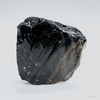


Hell's Gate Obsidian - Volcanic Glass from the East African Rift Valley, Kenya
This natural obsidian hand specimen comes from Hell's Gate National Park in Kenya's Great Rift Valley, a landscape of active continental rifting and one of the richest obsidian regions on Earth. Obsidian is volcanic glass, formed when silica-rich lava cools too quickly to crystallize, giving it a deep black color, glassy luster, and the razor-sharp conchoidal fracture prized by ancient toolmakers. The park is also familiar to film audiences as a filming location for Lara Croft: Tomb Raider - The Cradle of Life.
How Hell's Creek Obsidian Formed
Obsidian forms from viscous, silica-rich magma of roughly rhyolitic composition. When such lava reaches the surface and quenches rapidly, its atoms are frozen in place before they can arrange into mineral crystals, producing a natural glass rather than a crystalline rock. Around Hell's Gate, this eruption style is associated with the rift-related volcanic centers of the region, including the Olkaria area, which today hosts one of Kenya's major geothermal fields. The same crustal stretching that is pulling Africa apart supplies the heat and magma that generate this glass, so a piece of obsidian here is a small, tangible product of continental rifting in action.
Why This Locality Matters
The Naivasha-Nakuru Basin surrounding Hell's Gate is one of the most obsidian-rich regions on the planet. Along the Kenyan Rift, researchers have documented dozens of geochemically distinct obsidian sources, and a large share of them cluster in and around this basin. Because each lava flow carries its own trace-element signature, archaeologists can match obsidian stone tools to specific source outcrops. That work has helped reconstruct ancient movement and exchange across the Rift Valley, making the geology of this region inseparable from the story of early human toolmaking.
Product Information
| Object Type | Obsidian (natural volcanic glass) |
| Locality | Hell's Gate National Park, Naivasha-Nakuru Basin, Great Rift Valley (East African Rift), Kenya |
| Geologic Setting | Rift-related volcanism of the East African Rift, associated with the Olkaria volcanic and geothermal region |
| Dimensions | 32mm H x 32mm W x 18mm D |
| Specimen Description | Deep black natural obsidian with vitreous (glassy) luster and characteristic conchoidal fracture surfaces |
| Scientific Significance | A hands-on example of rift-valley volcanic glass from a region central to both active plate tectonics and the study of Stone Age tools |
| Provenance | Scientist-sourced; Legally obtained |
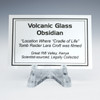
| What Is Included | Certificate of Authenticity, specimen tag, tag stand, protective case, and information about the specimen |
| Use and Display | Classroom teaching, museum-style display, or private scientific collection |
| Authentication and Compliance | Ships with a Sciencemall-USA Certificate of Authenticity and information about the specimen |
| Shipping | Calculated for international shipping |
| U.S. Shipping | Free Priority Shipping within the USA |
Images professionally photographed under controlled studio lighting using Zeiss optics and a pro-grade Canon camera.
Rarity and Significance
| Category | Rating |
| Scientific Significance | ★★★★☆ (4 / 5) |
| Market Availability | ★☆☆☆☆ (1 / 5) - uncommon from this named locality |
| Locality Specificity | ★★★★★ (5 / 5) |
| Display Appeal | ★★★★☆ (4 / 5) |
The significance of this specimen lies in its combination of a precise, meaningful locality and a clear scientific story. It is not simply a piece of glassy rock; it is material from a documented rift-valley volcanic landscape that is directly tied to active plate tectonics and the deep archaeological record of East Africa. That context is what makes it a strong teaching and display piece rather than a generic sample.
Why is the Back a Different Color?
The glassy black obsidian forms a shell around the edges, especially visible along the top and right side, where it has that classic wet-looking, vitreous sheen with smooth conchoidal (shell-like) fracture surfaces. You can see subtle reddish-brown mahogany tones bleeding through the black in places, which is typical of iron oxidation within the volcanic glass.
The central back is quite different, this is the more matte, rough interior. It has a streaky, banded appearance in tan, cream, gray, and dark charcoal tones. Those roughly parallel flow lines record how the lava moved and cooled. This lighter, fibrous-looking material is likely devitrified glass or included mineral/lithic material where the obsidian didn't stay fully glassy.
Questions Commonly Asked
Why is natural obsidian almost always geologically young, even when the surrounding rocks are ancient?
Obsidian is a glass, which means it is a metastable solid rather than a stable crystalline rock. Over long spans of geologic time, the glass slowly reorganizes itself into tiny crystals through a process called devitrification, gradually turning cloudy and eventually breaking down into fine-grained rock. Because of this, natural obsidian rarely survives in fresh, glassy form for more than a few tens of millions of years, so nearly every obsidian specimen is a record of relatively recent volcanism. This piece from the rift is a snapshot of geologically young, rift-driven eruptions rather than deep-time crust.
What is the landscape of Hell's Gate like, and why did it make such a dramatic backdrop for Tomb Raider?
Hell's Gate is one of the most visually dramatic corners of the Rift Valley. Its centerpiece is the Ol Njorowa Gorge, a deep canyon whose walls of red and ochre rock rise tens of meters and, in places, narrow to the point that they nearly close off the sky. Standing above the valley floor are Fischer's Tower and the Central Tower, steep volcanic plugs left behind after softer surrounding rock eroded away. Steam vents hiss from the ground, hot springs bubble at the surface, and two extinct volcanoes, Olkaria and Hobley's, frame the horizon. This mix of towering rock spires, sculpted cliffs, and venting geothermal steam gives the park a raw, primeval, almost otherworldly character. That is exactly why it was chosen as a filming location for Lara Croft Tomb Raider: The Cradle of Life, its gorges and cliffs standing in for a remote, ancient landscape. The same rift volcanism that built this dramatic scenery is also what produced the obsidian in this specimen.
How does this obsidian connect to the continental rifting that is splitting Africa apart?
The East African Rift is a place where the continent is being stretched and thinned, and that stretching allows magma to rise toward the surface. Some of that magma evolves into thick, silica-rich lava, and when it erupts and cools rapidly, it can solidify into obsidian rather than crystallize. The volcanic centers around Hell's Gate, including the geothermally active Olkaria region, are direct expressions of this rift magmatism. In other words, the same tectonic process that is slowly separating the Nubian and Somali plates is what produced the glass you are holding, making this specimen a physical fingerprint of a continent in the act of breaking apart.
This specimen pairs naturally with other rift-valley, volcanic-glass, and East African specimens. ONLY 1 AVAILABLE.
Volcanic glass from Hell's Gate captures a single moment in one of Earth's great geological dramas: a continent tearing itself apart along the East African Rift. Formed from rapidly cooled, silica-rich lava and drawn from a basin that ranks among the most obsidian-rich landscapes on the planet, this specimen links active plate tectonics to the deep archaeological record of early human toolmaking - a compact, authentic piece of the Rift Valley story.


