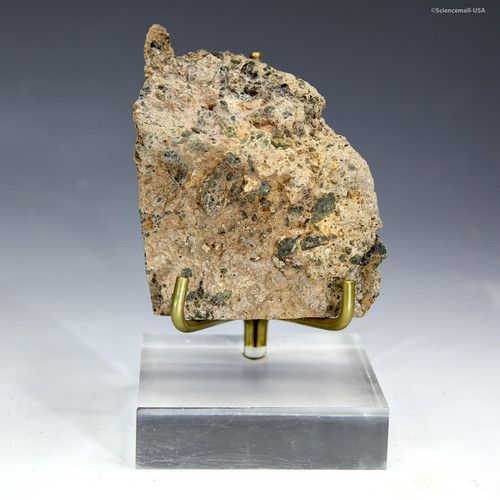
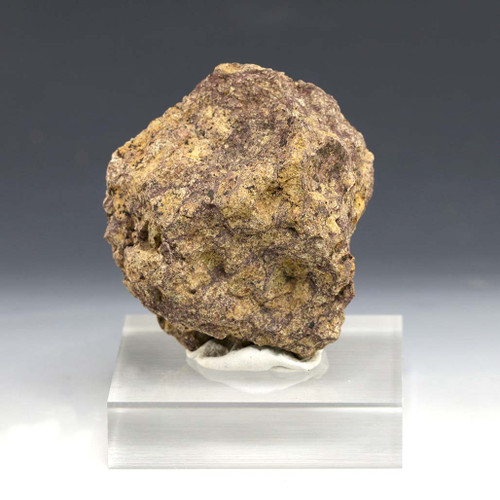
Flynn Creek Impact Structure -Central Uplift Area Breccia
- SKU:
- JPT-8478
- Availability:
- Usually ships in 24 hours.
- Weight:
- 1.00 LBS
- Minimum Purchase:
- 1 unit
- Maximum Purchase:
- 1 unit
- Shipping:
- Calculated at Checkout


Flynn Creek impact breccia from the Late Devonian Flynn Creek impact structure
Flynn Creek is a rare marine-target impact structure that was used by NASA and the USGS during Apollo-era astronaut geology training. It is an impact site with exposed deformation, carbonate brecciation, and crater-related structures. Its central uplift zone breccias record the violent disruption, collapse, transport, and redeposition of carbonate material during and shortly after crater formation, with marine resurge, rim slumping, and debris avalanches into standing seawater all contributing to the crater-filling sequence.
Flynn Creek Breccia Geological Context and Significance
Flynn Creek is scientifically important because it preserves evidence of a marine-target impact structure rather than a simple dry-land crater. The impact occurred in carbonate bedrock in what was then a shallow marine environment, creating a small but highly instructive impact structure about 3.8 km across.
This specimen is Flynn Creek impact-related carbonate breccia — not a shatter cone, but a specimen from one of North America's classic and best-studied impact structures. Formed in a shallow marine setting, Flynn Creek is among the rare examples of a wet-target crater, and was used by NASA and the USGS to train Apollo astronauts, with Eugene Shoemaker himself bringing crews here for fieldwork in the 1960s.
Flynn Creek Impact Breccia Product Details
| Object Type | Rare, Flynn Creek impact-related carbonate breccia |
| Impact Structure | Flynn Creek impact structure |
| Geological Age | Late Devonian, about 360 million years ago (360 Ma) |
| Locality | Flynn Creek impact structure, Jackson County, north-central Tennessee, USA |
| Specimen Details | 116 mm L x 84 mm W x 15 mm D; 168 g |
| Specimen Description | Flat, displayable breccia specimen showing angular carbonate fragments and impact-related disruption. No repairs. |
| Scientific Significance | Represents brecciated carbonate material from a classic shallow-marine impact structure studied for impact cratering processes. |
| What Is Included | Flynn Creek breccia specimen, specimen tag, tag stand, and Certificate of Authenticity |
| Use and Display | Suitable for impact geology displays, teaching collections, science collectors, and museum-style educational presentations. |
| Authentication and Compliance | Identified and sold as Flynn Creek impact-related breccia. This specimen is not represented as a shatter cone. |
| Shipping | Shipping calculated at checkout |
| U.S. Shipping | Free Priority Shipping within the USA |
Images professionally photographed under controlled studio lighting using Zeiss optics and a pro-grade Canon camera. Note: Lightly sprayed with water for photographic purposes.
Rarity and Significance
Scientific Significance: 5/5
Market Availability: 2/5
Impact Structure Relevance: 5/5
Display Appeal: 4/5
Buy this Flynn Creek impact breccia to add a documented piece of American impact geology to your collection. It is a tangible remnant from a Late Devonian marine-target impact structure and Apollo Era astronaut training studies.
Questions Commonly Asked About Flynn Creek Breccia
Is this Flynn Creek specimen a shatter cone?
No. This specimen is being described as Flynn Creek impact-related carbonate breccia, not as a shatter cone. Shatter cones are a specific shock-deformation feature, while breccia records broken and disrupted rock produced during impact and crater modification.
Why is Flynn Creek important in impact geology?
Flynn Creek is important because it is a well-studied impact structure formed in a shallow marine carbonate setting. Its breccias and crater-fill deposits help scientists interpret how impact structures form, collapse, and become buried in marine environments.
What makes marine-target impact structures interesting?
Marine-target impact structures are scientifically valuable because water, carbonate bedrock, resurge deposits, and post-impact sedimentation can all influence crater preservation. Flynn Creek is especially useful because it preserves evidence of impact processes in an ancient shallow-marine setting.
What sets this piece apart is its direct connection to Flynn Creek, a classic American impact structure where carbonate bedrock was fractured, disrupted, and redeposited during a Late Devonian marine setting impact event.