
Nuvvuagittuq Faux Amphibolite Garnets [110 g ~ 4.3 Ga]
Brand : Jensan Scientifics LLC
- SKU:
- JPT-28817
- Condition:
- New
- Availability:
- Usually ships in 24 hours.
- Weight:
- 1.00 LBS
- Minimum Purchase:
- 1 unit
- Maximum Purchase:
- 1 unit
- Shipping:
- Calculated at Checkout

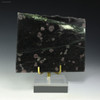




Nuvvuagittuq Garnet Paragneiss with Pyrite Cubes — 110 g
This rare scientific specimen comes from the remote Nuvvuagittuq Supracrustal Belt in northern Quebec, Canada, near Hudson Bay. This belt hosts some of the oldest rock formations on Earth, with Sm–Nd model ages indicating protoliths that may be older than 4.3 billion years.
Rocks from this region offer a rare glimpse into Earth's earliest geological evolution, bridging the Hadean and early Archean eons. Their significance lies not only in their extreme age but in the invaluable constraints they provide on our planet's early crust, mantle dynamics, and the environments that preceded the emergence of life.
Unique Geological Story
This garnet-bearing paragneiss preserves evidence of a complex volcanic–sedimentary–metamorphic origin. The rock began as early supracrustal material and was later driven to high temperature and pressure, recrystallizing into the finely banded, garnetiferous paragneiss seen today.
The abundant garnets are direct witnesses to this intense metamorphism over more than 4 billion years. Their presence, alongside other high-grade metamorphic minerals, gives the specimen a distinctive, visually striking texture that reflects its deep geological history.
Sm–Nd anomalous values from the Nuvvuagittuq Supracrustal Belt indicate that some protoliths may be older than 4.3 Ga, placing this terrain among the very earliest surviving fragments of Earth's crust.
"Faux Amphibolites" of Porpoise Cove
The Porpoise Cove locality is known for rocks referred to as "faux amphibolites." These rocks outwardly resemble classic amphibolites, yet their mineral assemblage is unusual. They are composed mainly of cummingtonite, biotite, quartz, plagioclase, garnet, anthophyllite, and cordierite.
Through extensive metamorphism, original volcanic and sedimentary layers have been transformed into banded metamorphic rocks. Researchers coined the term "faux amphibolite" because the rocks mimic amphibolite in texture and appearance, but are dominated by cummingtonite, an uncommon amphibole, rather than the typical hornblende-rich assemblage.
Scientists have proposed that some of these supracrustal rocks may preserve traces of early biological activity, potentially including fossilized microorganisms. As a result, the Nuvvuagittuq belt is a key target in the search for the earliest evidence of life on Earth, and ongoing investigations of these rocks are underway.
Specimen Details
- Locality: Nuvvuagittuq Supracrustal Belt, Porpoise Cove, northern Quebec, Canada
- Rock Type: Garnet-bearing paragneiss ("faux amphibolite") with pyrite cubes
- Size: 93 mm (L) × 81 mm (W) × 7 mm (D)
- Weight: 110 grams
- Included with Purchase: Certificate of Authenticity, detailed information sheet on the Nuvvuagittuq "faux amphibolite" garnetiferous gneiss, specimen tag, tag stand, and XRF data. Plexiglass base and sizing cube are not included.
- Legality: Professionally and legally collected in the early 2000s.
- Finish: Professionally polished flat face showcasing ancient garnets and sharp pyrite cubes. This specimen was lightly sprayed for photographic purposes. Photographed under controlled lighting to reveal natural mineral contrast. As with all natural stone, visual depth varies depending on lighting conditions.
Nuvvuagittuq Paragneiss with Euhedral Pyrite Cubes
Pyrite Textures and Metamorphic Fabric
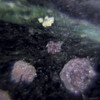
A close-up of this specimen reveals a striking cluster of euhedral pyrite cubes embedded within the Nuvvuagittuq paragneiss, part of Earth's most ancient surviving crust. The pyrite crystals display crisp, square faces and sharp geometry—remarkably intact for minerals locked inside a rock body dating back roughly 3.75 billion years.
Their metallic, pale-brassy luster contrasts strongly with the fine-grained, gray–green paragneiss matrix, creating a dynamic interplay of form and texture across the polished surface.
Under magnification, the pyrite cubes show:
- High reflectivity with subtle internal striations typical of pyrite crystal growth.
- Textbook cubic habit with clean 90° face-to-face relationships.
- Sutured and micro-fractured edges, consistent with intense tectono-thermal overprinting in the belt.
- Dark halos of alteration and fine sulfide or graphite-rich folia in the paragneiss wrap around the cubes.
The surrounding paragneiss exhibits the fine, granular sparkle characteristic of felsic metamorphic minerals equilibrated at high-grade amphibolite to granulite facies conditions. This tight mineral association—pyrite locked within an Archean metasedimentary fabric—is precisely the kind of context researchers study when probing early Earth sulfur cycles and potential prebiotic geochemical environments.
Claim to Fame: A Singular Piece of Earth's Early Crust
This specimen may represent a once-in-a-lifetime opportunity to own one of Earth's oldest and most scientifically significant rock types: Nuvvuagittuq amphibolite–garnet paragneiss from Porpoise Cove.
This rock has remained relatively unchanged for roughly 97% of Earth's history. Very few terrestrial rocks can make such a claim. For collectors, educators, and researchers, it is both a display-worthy showpiece and a tangible fragment of our planet's earliest crustal record. Very low stock. Once it is gone - it is gone.


