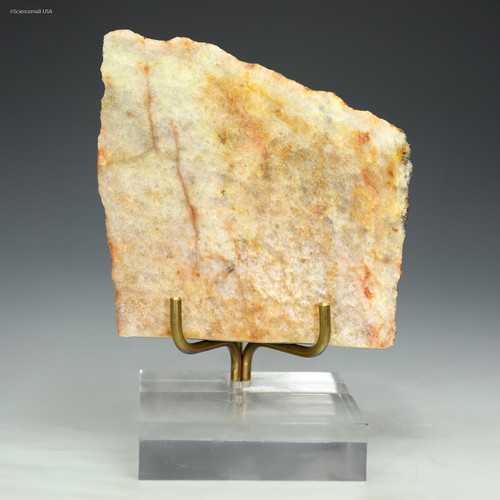
Greenlandite - Godthåbsfjord Region, SW Greenland
Brand : Sciencemall-USA
- SKU:
- JPT-71288
- Availability:
- Usually ships in 24 hours.
- Weight:
- 1.00 LBS
- Minimum Purchase:
- 1 unit
- Maximum Purchase:
- 1 unit
- Shipping:
- Calculated at Checkout



Archean Greenlandite – North Atlantic Craton, SW Greenland
Greenlandite is a metamorphic rock that contains the minerals muscovite (fuchsite variety) and quartz. Its green coloration derives from chromium-enriched muscovite formed during metamorphic processes within the early continental crust.
Greenlandite Geological Significance
This mineral-rich metamorphic specimen came from the Godthåbsfjord (Nuuk region) of Southwest Greenland, within the North Atlantic Craton — one of Earth's oldest preserved continental rafts. The surrounding crust formed during the Archean (~3.8 billion years ago; 3.8 Ga), representing early continental stabilization during the formative stages of planetary tectonic evolution.
Rocks from this region document deep-crustal metamorphism, structural reworking, and long-term lithospheric stability. While individual Greenlandite specimens are not directly radiometrically dated, they occur within Archean terranes that have persisted for billions of years across multiple tectonic cycles.
Greenlandite is valued for its geological context. It represents material formed within stabilized early continental crust, offering a direct connection to Earth's Archean Eon.
Product Table
| Object Type | Greenlandite Fuchsite-dominant metamorphic rock, Greenland |
| Locality | Godthåbsfjord (Nuuk Region), SW Greenland |
| Geological Age | Host crust formed during the Archean (~3.8 billion years ago; 3.8 Ga) |
| Tectonic Unit | North Atlantic Craton |
| Dimensions | 48 mm × 46 mm × 19 mm; 70 grams |
| Specimen Description | Dense green fuchsite-bearing matrix with layers of quartz and feldspathic components |
| What Is Included | Certificate of Authenticity, tag with tag stand, product information about Greenlandite; Free Geology poster "Earth's Oldest Rocks and Oldest Life" |
| Authentication & Compliance | Legally collected in the early 2000s |
| Shipping | Shipping calculated at checkout; International Shipping Available |
| U.S. Shipping | Free Priority Shipping within the USA |
Common Questions About Greenlandite
When was Greenlandite first documented?
Greenlandite was first documented during geological fieldwork and mapping in Southwest Greenland, in the Nuuk (Godthåbsfjord) region, by geologists characterizing some of Earth's oldest preserved continental crust within the North Atlantic Craton.
How did Greenlandite get its name?
The name "Greenlandite" derives from its geographic origin in Greenland. It is a collector and trade designation for fuchsite-bearing metamorphic rock sourced from the Archean crust of Southwest Greenland, rather than a formally defined mineral species.
Does Greenlandite contain minerals, and is it a rock or mineral?
Greenlandite contains the minerals muscovite (a chromium-bearing variety, fuchsite) and quartz. It is a rock term used in collector and lapidary contexts rather than a formally defined mineral species. The characteristic green coloration is produced by chromium-rich muscovite, which forms during metamorphic processes within early continental crust.
Is Greenlandite the oldest gemstone?
Greenlandite is widely recognized in the gem trade as the world's oldest "true" gemstone, dating back approximately 3.8 Ga. While there are older rock formations—most notably the Nuvvuagittuq Garnetiferous Schist from Quebec, Canada (dated up to 4.3 Ga)—Greenlandite holds the specific title of "oldest gemstone" because it is a translucent, homogeneous material that can be consistently cut, polished, and used in jewelry.
Scientifically, individual minerals like the Jack Hills Zircons are older (4.4 Ga), but these are microscopic grains rather than gem-quality rough. For collectors seeking an ancient material that can be worn or displayed as a finished gem, Greenlandite remains the "Gold Standard" for "The World's oldest gemstone."