
K-Pg Boundary Beloc Haiti Chicxulub Tektites - Microslide
Brand : Sciencemall-USA
- SKU:
- JPT-95581
- Condition:
- New
- Availability:
- Usually ships in 24 hours.
- Weight:
- 1.00 LBS
- Minimum Purchase:
- 1 unit
- Maximum Purchase:
- 3 units
- Shipping:
- Calculated at Checkout

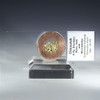
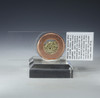


K-Pg Boundary Microtektites from Beloc, Haiti
This microslide contains K-Pg boundary microtektites from Beloc, Haiti. Extinction rock from this region reveals the high degree of devastation caused by a meteorite impact approximately 66 million years ago. This asteroid impact event ended the age of the non-avian dinosaurs and other life forms. An abundance of evidence supports the impact origin of the K-Pg boundary from Haiti.
Significance of the Beloc Formation
The Beloc Formation is the most important rock unit in Haiti, located on the southern peninsula. Numerous outcrops show the transition between the Cretaceous (K) and Paleogene (Pg) periods in the boundary event marker beds. The composite structures of the Beloc boundary bed have been argued to be the result of turbidity, ejecta, or oscillatory waves triggered by the fallout from the impact event in water. This K-Pg boundary bed consists of altered tektites, lenses of coarser tektites, cross-bedding, and marl with high iridium values.
Detailed Composition of This Material
The K-Pg layers consist of a basal unit containing impact ejecta (shocked quartz PDFs and spherules), overlaid by coarse laminated sandstone derived from coastal areas, and topped by ripples of fine sand and iridium-rich silts. This succession contains impact markers at its base and top and is interpreted as being rapidly deposited within a few minutes. The spherules are usually rounded, but many display elongated dumbbell or teardrop shapes similar to splash form tektites or microtektites.
Microslide Details
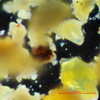
The glass particles found in the Beloc Formation range in size from 0.1 to 5 mm and can be classified based on their colors of black and yellow. Higher magnification images of this material reveal shattered quartz (PDFs), clay interspersed with various meteorite material and smectite, worn opal clasts, and remnants of soot particles intertwined and embedded in clay.
Photo Descriptions
Photo descriptions (after the front and back of slides):
- #1 - Chicxulub meteorite microscopic up-close magnification 4.5X Beloc, Haiti.
- #2 - Shredded meteoritic debris embedded in clay with sheared opal.
- #3 - Shocked quartz.
- #4 - Shocked quartz with clay, soot, associated microparticles, and microtektites.
- #5 - Overview of Beloc, Haiti, material containing material from the K-Pg boundary layer, Yucatan detailing soot, ash, clays, and microscopic particles.
Specimen Details
Microslide Size: 75mm L X 25mm W X 4mm D. Microslide well size: 12mm Diameter.
What's Included:
Ships with information and Certificate of Authenticity. Small plastic display stand included.
Note: There is enough material to fill up the microslide well. The material is loose and not encased in leucite.
Extra Details About the Chicxulub Impact
Haiti contains the second-largest reserves of iridium on Earth. This is due to its proximity to the Chicxulub impact in Yucatan. Iridium is one of the rarest metals in the world and is a strategic element involved in technology. It is interesting that an impact event from long ago has significantly influenced an essential part of the Haitian economy today!
Excellent Microslide for Studying About Impact Science
This is an excellent microslide, helpful in studying the dynamics of the K-Pg boundary.
Questions and Answers:
Does the writing on the slide say there are micro meteorite fragments? Yes, the thick impact ejecta deposit in Haiti, along with the discovery of impact melt spherules and microtektites, contributes to our understanding of the Chicxulub impact event and its global consequences. This “extinction rock” does indeed contain microscopic meteorite fragments with elevated iridium signatures.
Do the magnification pictures come with the slide? The current charge for this material does not include individual pictures of each slide, as it would be cost-prohibitive. However, each slide was carefully, accurately, and scientifically produced.
Are the magnification pictures actually from the sample for sale? Each slide was scientifically and consistently produced by a scientist for accuracy. This means that each slide shares a consistent commonality.
Best suited for: Macro and microphotography viewing.
Notice: Does not ship internationally, as it might be considered as "soil," which is prohibited.


![Jack Hills zircons [76805] shown front, on a microscope slide with description label.](https://cdn11.bigcommerce.com/s-ijipkdz2cc/images/stencil/500x659/products/139/3258/Jack-Hills-zircons-microslide-Australia-main__14639.1738627357.jpg?c=1 "Jack Hills zircons [76805] shown front, on a microscope slide with description label.")
